


Spatial model for risk prediction and sub-national prioritization to aid poliovirus eradication in Pakistan
- PMID: 29017491
- PMCID: PMC5635525
- DOI: 10.1186/s12916-017-0941-2
Spatial model for risk prediction and sub-national prioritization to aid poliovirus eradication in Pakistan
Abstract
Background: Pakistan is one of only three countries where poliovirus circulation remains endemic. For the Pakistan Polio Eradication Program, identifying high risk districts is essential to target interventions and allocate limited resources.
Methods: Using a hierarchical Bayesian framework we developed a spatial Poisson hurdle model to jointly model the probability of one or more paralytic polio cases, and the number of cases that would be detected in the event of an outbreak. Rates of underimmunization, routine immunization, and population immunity, as well as seasonality and a history of cases were used to project future risk of cases.
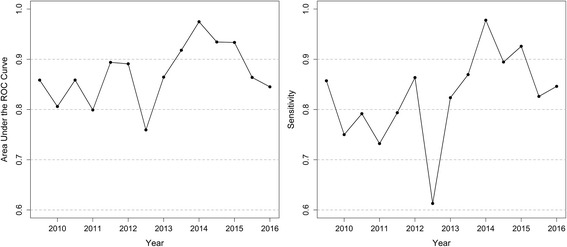
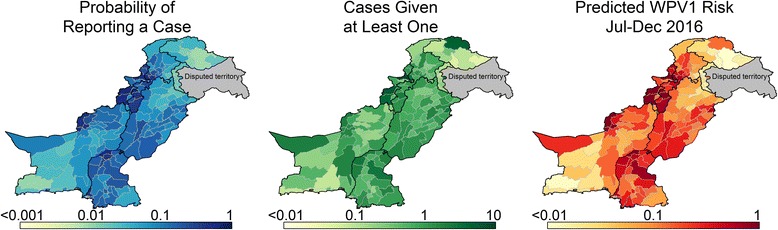
Results: The expected number of cases in each district in a 6-month period was predicted using indicators from the previous 6-months and the estimated coefficients from the model. The model achieves an average of 90% predictive accuracy as measured by area under the receiver operating characteristic (ROC) curve, for the past 3 years of cases.
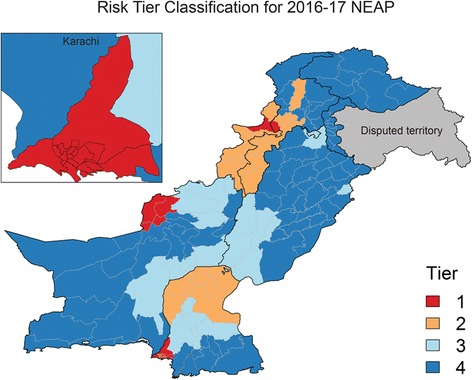
Conclusions: The risk of poliovirus has decreased dramatically in many of the key reservoir areas in Pakistan. The results of this model have been used to prioritize sub-national areas in Pakistan to receive additional immunization activities, additional monitoring, or other special interventions.
Keywords: Disease mapping; Hurdle models; Pakistan; Polio eradication; Risk mapping; Risk prioritization; Spatial epidemiology; Supplementary immunization activities; Vaccination campaigns.
Conflict of interest statement
Ethics approval and consent to participate
Permission to access the acute flaccid paralysis and vaccination campaign data was granted by the National Emergency Operation Centre in Islamabad, Pakistan.
Consent for publication
Not applicable.
Competing interests
The authors declare that they have no competing interests.
Publisher’s Note
Springer Nature remains neutral with regard to jurisdictional claims in published maps and institutional affiliations.
Figures
Comment in
-
Models and analyses to understand threats to polio eradication.BMC Med. 2017 Dec 22;15(1):221. doi: 10.1186/s12916-017-0991-5. BMC Med. 2017. PMID: 29268738 Free PMC article.
References
-
- United Nations, Department of Economic and Social Affairs PD. World Population Prospects: The 2015 Revision, Key Findings and Advance Tables. Working Paper 2015. https://esa.un.org/unpd/wpp/publications/files/key_findings_wpp_2015.pdf. Accessed 1 Apr 2017.
-
- Centers for Disease Control and Prevention Progress toward poliomyelitis eradication--eastern Mediterranean region, 1988-1994. MMWR Morb Mortal Wkly Rep. 1995;44:809–11. - PubMed
-
- Centers for Disease Control and Prevention Progress toward poliomyelitis eradication--Pakistan, 1994-1998. MMWR Morb Mortal Wkly Rep. 1999;48:121–6. - PubMed
-
- National Institute of Population Studies (NIPS) (Pakistan) and ICF International . Pakistan Demographic and Health Survey 2012-13. Islamabad, Pakistan, and Calverton, Maryland, USA: NIPS and ICF International; 2013.
Publication types
MeSH terms
Substances
LinkOut - more resources
Full Text Sources
Other Literature Sources
Medical
Miscellaneous
