


Polychlorinated biphenyls and depression: cross-sectional and longitudinal investigation of a dopamine-related Neurochemical path in the German HELPcB surveillance program
- PMID: 29017568
- PMCID: PMC5635510
- DOI: 10.1186/s12940-017-0316-3
Polychlorinated biphenyls and depression: cross-sectional and longitudinal investigation of a dopamine-related Neurochemical path in the German HELPcB surveillance program
Abstract
Background: Exposure to polychlorinated biphenyls (PCBs) is associated with depressive symptomatology. A cause of depressive symptoms is a disturbance in the neurotransmitter system of dopamine (DA). Animal as well as human studies report that PCBs can influence the DA system. This study examined whether PCB-related depressive symptoms are affected by DA metabolites in humans with high PCB body burden.
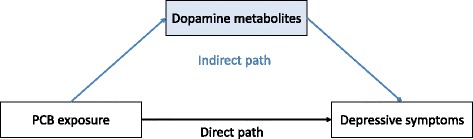
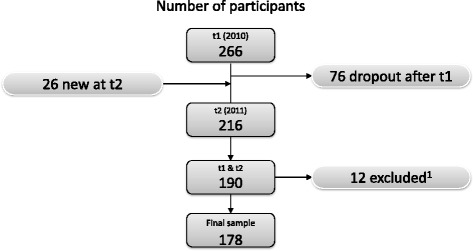
Methods: This study is part of the German HELPcB surveillance program (Health Effects in high Level exposure to PCB) for occupationally exposed workers and their relatives. Data was collected from 178 participants on two measurement time points (t1 and t2) with a one-year time lag in between the two time points. PCBs were analyzed in plasma via human biomonitoring and a validated questionnaire was used to identify existence and severity of depressive symptoms. As a surrogate for DA, we measured its metabolites homovanillic acid (HVA) and vanillylmandelic acid (VMA) in urine. Mediation analyses were performed to test whether the association between PCB exposure and severity of depressive symptoms is mediated by urinary concentration of DA metabolites HVA and VMA. The mediation was tested with the SPSS macro MEDIATE.
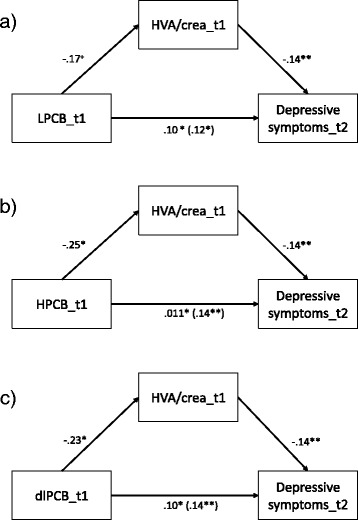
Results: We found a significant mediation over time for lower-chlorinated, higher-chlorinated and dioxin-like PCBs. The positive association between PCB exposure with severity of depressive symptoms was mediated by the main DA metabolite HVA. At t1 a higher exposure with PCBs was associated with lower concentration in urinary HVA. A reduced HVA concentration at t1 was correlated with increased depressive symptoms severity at t2. No meditations were found for VMA.
Conclusions: This work indicates that the association of PCB exposure and an increase of depressive symptoms after one year is mediated by the DA metabolite HVA as a surrogate for DA. These are first steps towards finding an explanation for an underlying neurochemical pathomechanism of PCB-related depressive symptomatology.
Keywords: Adults; Depressive symptoms; Dopamine; Homovanillic acid; Humans; Neurotoxicity; Neurotransmitter metabolites; Polychlorinated biphenyls; Vanillylmandelic acid.
Conflict of interest statement
Ethics approval and consent to participate
The HELPcB program was approved by the local ethics committee of the Medical Faculty of the RWTH Aachen University (EK 176/11). Informed consent was obtained from all participants included in the study.
Consent for publication
Not applicable.
Competing interests
The authors declare that they have no competing interests.
Publisher’s Note
Springer Nature remains neutral with regard to jurisdictional claims in published maps and institutional affiliations.
Figures
References
-
- UNEP – United Nations Environment Programme: Decision 18/32 of the UNEP Governing Council: Persistent Organic Pollutants. 1995. http://www.pops.int/documents/background/gcdecision/18_32/gc1832en.html. Accessed 13 July 2017.
-
- Longnecker MP, Rogan WJ, Lucier G. The human health effects of DDT (dichlorodiphenyltrichloroethane) and PCBs (polychlorinated biphenyls) and an overview of organochlorines in public health. Annu Rev Publ Health. 1997. https://doi.org/10.1146/annurev.publhealth.18.1.211. - DOI - PubMed
-
- Lauby-Secretan B, Loomis D, Grosse Y, El Ghissassi F, Bouvard V, Benbrahim-Tallaa L, et al. Carcinogenicity of polychlorinated biphenyls and polybrominated biphenyls. Lancet Oncol. 2013. doi:10.1016/S1470-2045(13)70104-9. - PubMed
Publication types
MeSH terms
Substances
LinkOut - more resources
Full Text Sources
Other Literature Sources
Medical
Research Materials
