Review
. 2017 Oct 10;15(1):41.
doi: 10.1186/s12964-017-0195-9.

DNA damage response and cancer therapeutics through the lens of the Fanconi Anemia DNA repair pathway

Affiliations
Review

DNA damage response and cancer therapeutics through the lens of the Fanconi Anemia DNA repair pathway

Sonali Bhattacharjee et al. Cell Commun Signal. .

Abstract

Fanconi Anemia (FA) is a rare, inherited genomic instability disorder, caused by mutations in genes involved in the repair of interstrand DNA crosslinks (ICLs). The FA signaling network contains a unique nuclear protein complex that mediates the monoubiquitylation of the FANCD2 and FANCI heterodimer, and coordinates activities of the downstream DNA repair pathway including nucleotide excision repair, translesion synthesis, and homologous recombination. FA proteins act at different steps of ICL repair in sensing, recognition and processing of DNA lesions. The multi-protein network is tightly regulated by complex mechanisms, such as ubiquitination, phosphorylation, and degradation signals that are critical for the maintenance of genome integrity and suppressing tumorigenesis. Here, we discuss recent advances in our understanding of how the FA proteins participate in ICL repair and regulation of the FA signaling network that assures the safeguard of the genome. We further discuss the potential application of designing small molecule inhibitors that inhibit the FA pathway and are synthetic lethal with DNA repair enzymes that can be used for cancer therapeutics.

Keywords: Cancer therapeutics; Combination Therapy Genomic instability; DNA damage response; DNA repair; Fanconi Anemia (FA) signaling network; Homologous recombination; Interstrand crosslink (ICL); Synthetic lethality; Translesion synthesis.


Conflict of interest statement

Ethics approval and consent to participate

Not applicable

Consent for publication

Not applicable

Competing interests

The authors declare that they have no competing interest.

Publisher’s Note

Springer Nature remains neutral with regard to jurisdictional claims in published maps and institutional affiliations.

Figures
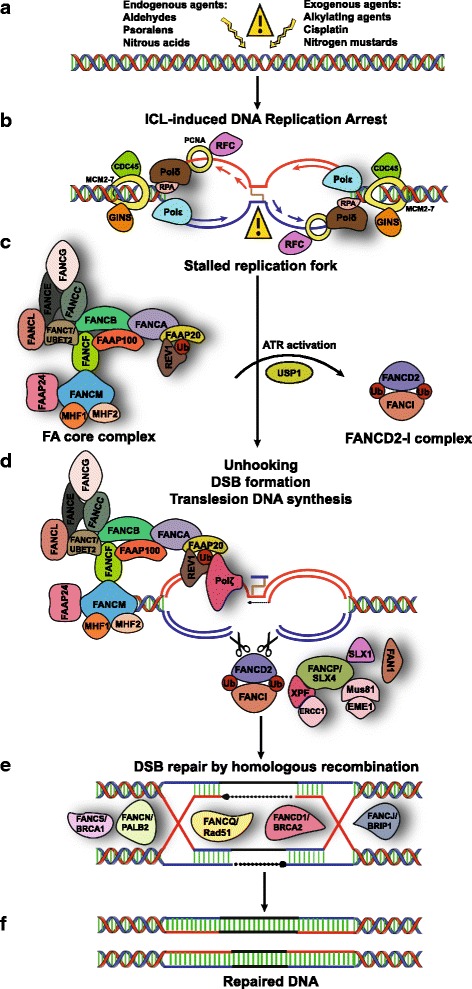
Fig. 1
Fig. 1
A model for the DNA interstrand crosslink (ICL) repair: Crosstalk between the Fanconi Anemia (FA) pathway, translesion synthesis (TLS) and homologous recombination (HR). a Certain endogenous, environmental sources and chemotherapeutic agents inflict damage to the DNA forming adducts between each DNA strands creating inter-strand crosslinks. b Two replication forks converge at the DNA ICL covalently linking the Watson and Crick strands of the DNA. The replication machinery encounters the DNA lesion at the fork leading to fork stalling. c The FA core complex detects the stalled replication fork, assembles on the DNA lesion and initiates checkpoint response by activating ATR, which in turn phosphorylates multiple FA proteins. This triggers the ubiquitin ligase activity of FANCL resulting in monoubiquitination of FANCD2 and FANCI. d The FANCD2-FANCI heterodimeric complex is recruited to the ICL site. This further recruits downstream nucleases, in particular structure specific endonucleases like SLX4 (FANCP), ERCC1-XPF, FAN1 and MUS81-EME1 to coordinate nucleolytic incisions flanking the ICL. The incisions unhook the ICL leaving crosslinked nucleotides tethered to the complementary strand. FAAP20 interacts with the FA core complex and binds to monoubiquitinated REV1. This catalyze TLS-dependent lesion bypass across the adduct, mediated by specialized TLS polymerases such as REV1 and Polζ. This restores the integrity of the template strand required for the progression of the nascent leading strand. e DSB generated after nucleolytic incisions serves as a suitable substrate for repair by the HR pathway. Downstream FA proteins promote RAD51-dependent strand invasion forming the synaptic filament. Branch migration and intermediates containing Holliday junctions are formed. f The resulting double Holliday junction is resolved by HR specific nucleases, HR repair is completed and the integrity of the DNA is restored
Fig. 2
Fig. 2
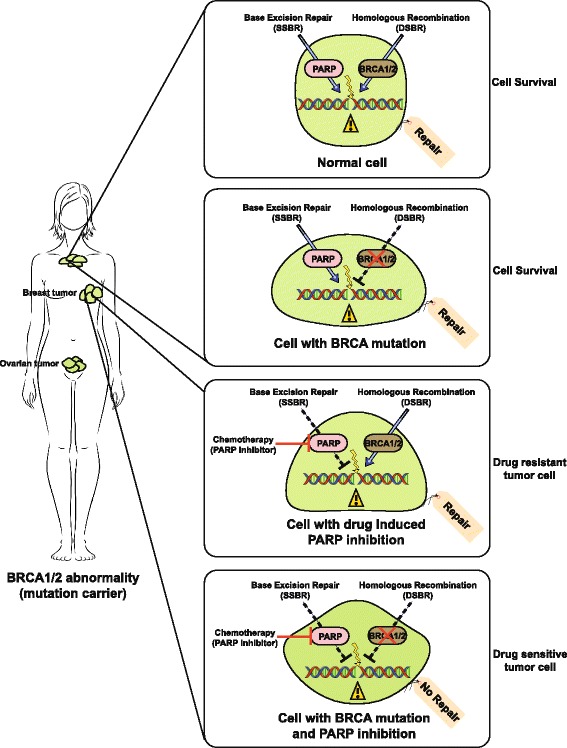
Synthetic lethal interactions to identify molecular targets for cancer therapy: Sensitizing genetically defined tumor cells by targeted inhibition of DNA damage repair pathways. A model for synthetic lethality using PARP inhibitors. In breast/ovarian tumor cells, mutation in BRCA1/2 leaves the cancer cell vulnerable to chemotherapeutic drugs against single strand break repair (SSBR). In contrast, cells with functional BRCA1/2 genes are spared as they can repair the lesions on the DNA using double strand break repair (DSBR) pathway. Compromised base excision repair (BER) pathway combined with homologous recombination (HR) deficiency leads to tumor cell death

References

    1. Mathew CG. Fanconi anaemia genes and susceptibility to cancer. Oncogene. 2006;25(43):5875–5884. doi: 10.1038/sj.onc.1209878. - DOI - PubMed
    1. Meetei AR, et al. X-linked inheritance of Fanconi anemia complementation group B. Nat Genet. 2004;36(11):1219–1224. doi: 10.1038/ng1458. - DOI - PubMed
    1. Su XY, Huang J. The Fanconi anemia pathway and DNA interstrand cross-link repair. Protein Cell. 2011;2(9):704–711. doi: 10.1007/s13238-011-1098-y. - DOI - PMC - PubMed
    1. Alter BP. Fanconi anemia and the development of leukemia. Best Pract Res Clin Haematol. 2014;27(3-4):214–221. doi: 10.1016/j.beha.2014.10.002. - DOI - PMC - PubMed
    1. Rosenberg PS, Tamary H, Alter BP. How high are carrier frequencies of rare recessive syndromes? Contemporary estimates for Fanconi Anemia in the United States and Israel. Am J Med Genet A. 2011;155A(8):1877–1883. doi: 10.1002/ajmg.a.34087. - DOI - PMC - PubMed

Substances

LinkOut - more resources