


Review of the evolution of insecticide resistance in main malaria vectors in Cameroon from 1990 to 2017
- PMID: 29017590
- PMCID: PMC5635606
- DOI: 10.1186/s13071-017-2417-9
Review of the evolution of insecticide resistance in main malaria vectors in Cameroon from 1990 to 2017
Abstract
Background: Malaria remains a major public health threat in Cameroon and disease prevention is facing strong challenges due to the rapid expansion of insecticide resistance in vector populations. The present review presents an overview of published data on insecticide resistance in the main malaria vectors in Cameroon to assist in the elaboration of future and sustainable resistance management strategies.
Methods: A systematic search on mosquito susceptibility to insecticides and insecticide resistance in malaria vectors in Cameroon was conducted using online bibliographic databases including PubMed, Google and Google Scholar. From each peer-reviewed paper, information on the year of the study, mosquito species, susceptibility levels, location, insecticides, data source and resistance mechanisms were extracted and inserted in a Microsoft Excel datasheet. The data collected were then analysed for assessing insecticide resistance evolution.
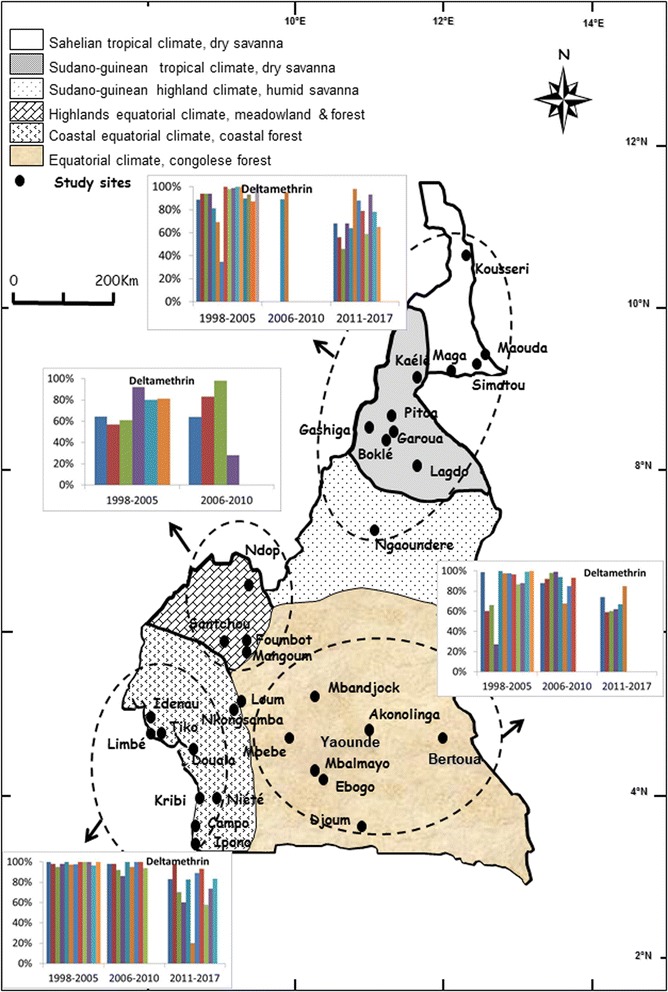
Results: Thirty-three scientific publications were selected for the analysis. The rapid evolution of insecticide resistance across the country was reported from 2000 onward. Insecticide resistance was highly prevalent in both An. gambiae (s.l.) and An. funestus. DDT, permethrin, deltamethrin and bendiocarb appeared as the most affected compounds by resistance. From 2000 to 2017 a steady increase in the prevalence of kdr allele frequency was noted in almost all sites in An. gambiae (s.l.), with the L1014F kdr allele being the most prevalent. Several detoxification genes (particularly P450 monooxygenase) were associated with DDT, pyrethroids and bendiocarb resistance. In An. funestus, resistance to DDT and pyrethroids was mainly attributed to the 119F-GSTe2 metabolic resistance marker and over-expression of P450 genes whereas the 296S-RDL mutation was detected in dieldrin-resistant An. funestus.
Conclusions: The review provides an update of insecticide resistance status in malaria vector populations in Cameroon and stresses the need for further actions to reinforce malaria control strategies in the coming years.
Keywords: An. funestus; An. gambiae (s.l.); Cameroon; Insecticide resistance; Malaria; Vector control.
Conflict of interest statement
Ethics approval and consent to participate
The study was conducted under the ethical clearance No. 2016/11/832/CE/CNERSH/SP delivered by the Cameroon National Ethics (CNE) Committee for Research on Human Health Ref No. 0977/A/MINSANTE/SESP/SG/DROS of 18 April 2012. The study did not report the use any human subject.
Consent for publication
Not applicable.
Competing interests
The authors declare that they have no competing interests.
Publisher’s Note
Springer Nature remains neutral with regard to jurisdictional claims in published maps and institutional affiliations.
Figures
References
-
- WHO . WHO global malaria programme, world malaria report. Geneva: WHO Press; 2015.
-
- Wondji CS, Dabire RK, Tukur Z, Irving H, Djouaka R, Morgan JC. Identification and distribution of a GABA receptor mutation conferring dieldrin resistance in the malaria vector Anopheles funestus in Africa. Insect Biochem Mol Biol. 2011;41:484–491. doi: 10.1016/j.ibmb.2011.03.012. - DOI - PMC - PubMed
-
- Riveron J, Irving H, Ndula M, Barnes K, Ibrahim S, Paine M, et al. Directionally selected cytochrome P450 alleles are driving the spread of pyrethroid resistance in the major malaria vector Anopheles funestus. Proc Natl Acad Sci USA. 2013;110:252–257. doi: 10.1073/pnas.1216705110. - DOI - PMC - PubMed
Publication types
MeSH terms
Substances
Grants and funding
LinkOut - more resources
Full Text Sources
Other Literature Sources
Miscellaneous
