


COllaborative Shared care to IMprove Psychosis Outcome (COSIMPO): study protocol for a randomized controlled trial
- PMID: 29017605
- PMCID: PMC5634898
- DOI: 10.1186/s13063-017-2187-x
COllaborative Shared care to IMprove Psychosis Outcome (COSIMPO): study protocol for a randomized controlled trial
Abstract
Background: Psychotic disorders are a group of severe mental disorders that cause considerable disability to sufferers and a high level of burden to families. In many low- and middle-income countries (LMIC), traditional and faith healers are the main providers of care to affected persons. Even though frequently canvassed as desirable for improved care delivery, collaboration between these complementary alternative health providers (CAPs) and conventional health providers has yet to be rigorously tested for feasibility and effectiveness on patient outcomes.
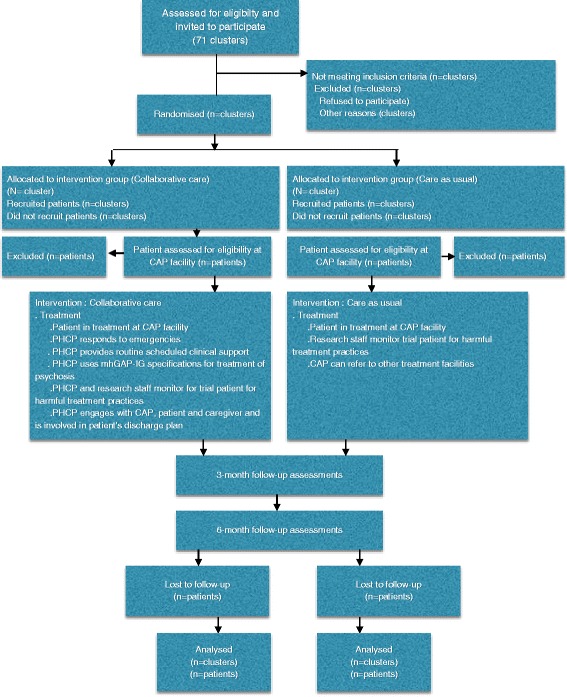
Methods/design: COSIMPO is a single-blind, cluster randomized controlled trial (RCT) being conducted in Nigeria and Ghana to compare the effectiveness of a collaborative shared care (CSC) intervention program implemented by CAPs and primary health care providers (PHCPs) with care as usual (CAU) at improving the outcome of patients with psychosis. The study is designed to test the hypotheses that patients receiving CSC will have a better clinical outcome and experience fewer harmful treatment practices from the CAPs than patients receiving CAU at 6 months after study entry. An estimated sample of 296 participants will be recruited from across 51 clusters, with a cluster consisting of a primary care clinic and its neighboring CAP facilities. CSC is a manualized intervention package consisting of regular and scheduled visits of PHCPs to CAP facilities to assist with the management of trial participants. Assistance includes the administration of antipsychotic medications, management of comorbid physical condition, assisting the CAP to avoid harmful treatment practices, and engaging with CAPs, caregivers and participants in planning discharge and rehabilitation. The primary outcome, assessed at 6 months following trial entry, is improvement on the Positive and Negative Symptom Scale (PANSS). Secondary outcomes, assessed at 3 and 6 months, consist of levels of disability, experience of harmful treatment practices and of victimization, and levels of perceived stigma and of caregivers' burden.
Discussion: Information about whether collaboration between orthodox and complementary health providers is feasible and can lead to improved outcome for patients is important to formulating policies designed to formally engage the services of traditional and faith healers within the public health system.
Trial registration: National Institutes of Health Clinical Trial registry, ID: NCT02895269 . Registered on 30 July 2016.
Keywords: Collaboration; Complementary alternative providers; Primary care; psychosis.
Conflict of interest statement
Ethics approval and consent to participate
Ethics approval was obtained from the NIMH Data Safety and Monitoring Board, the University of Ibadan/University College Hospital Ethics Committee (UI/EC/12/0219) and the Ethics Committee of the Kwame Nkrumah University of Science and Technology (CHRPE/AP/512/16).
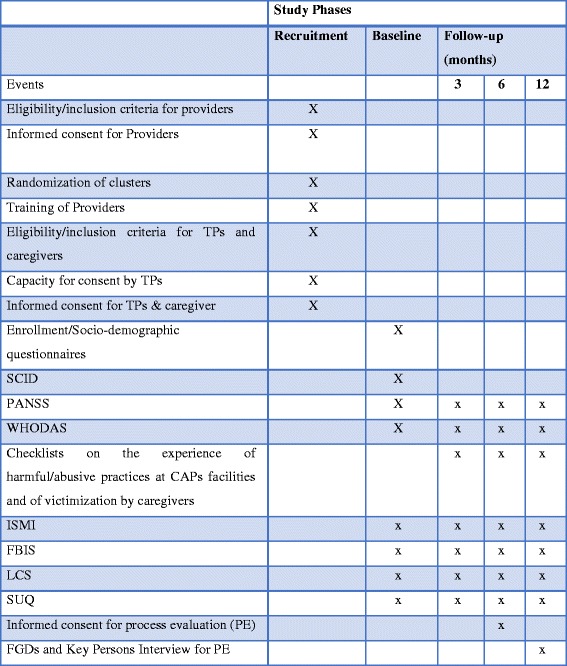
Patients presenting to the CAPs facility during the recruitment period, and who provide consent to be screened, are assessed for eligibility by the RAs. Patients who meet all of the eligibility criteria, including have a PANSS score of ≥ 60, proceed to the next stage of the enrollment procedure. Following screening and confirmation of eligibility by the RAs, a potential participant is assessed for capacity to consent by an independent social worker who has been trained to conduct such assessment. Potential participants who are deemed to have capacity are approached for consent following the provision of full trial information by the RAs. For eligible patients who are found to lack capacity to consent, a caregiver is approached to provide proxy consent. If the caregiver provides consent on behalf of the patient, the latter is still required to give assent before they are enrolled into the trial. The consenting procedure of any non-literate patient or caregiver has to be the signed confirmation of an independent adult and literate witness before enrollment is deemed to have been completed. Baseline assessments of consented participants are conducted within 3 days of enrollment while outcome assessments are conducted at 3 and 6 months following trial entry.
All Consent Forms are being administered in the local language translations. The translations are in the form of everyday use of the languages to make them understandable to all respondents, including those who have had no formal education. The translations were conducted through a process of translations and back translation by a three-member panel of bilingual members of the study team who are proficient in the source English and target study languages.
Consent for publication
Not applicable.
Competing interests
The authors declare that they have no competing interests.
Publisher’s Note
Springer Nature remains neutral with regard to jurisdictional claims in published maps and institutional affiliations.
Figures
References
-
- Murray C, Vos T, Lozano R, Naghavi M, Flaxman A, Michaud C, Ezzati M, Shibuya K, Salomon J, Abdalla S, et al. Disability-adjusted life years (DALYs) for 291 diseases and injuries in 21 regions, 1990–2010: a systematic analysis for the Global Burden of Disease Study. Lancet. 2010;2012:2197–223. - PubMed
-
- Whitefold HA, Degenhardt L, Rehm J, Baxter AJ, Ferrari AJ, Erskine HE, Charlson FJ, Norman RE, Flaxman AD, Johns N, et al. Global burden of disease attributable to mental and substance use disorders: findings from the Global Burden of Disease Study 2010. Lancet. 2013;382:1575–86. doi: 10.1016/S0140-6736(13)61611-6. - DOI - PubMed
-
- Chisholm D, Gureje O, Saldivia S, Calderon MV, Wickremasinghe R, Mendis N, Ayuso-Mateos JL, Saxena S. Schizophrenia treatment in the developing world: an interregional and multinational cost-effectiveness analysis. Bull World Health Organ. 2008;86:542–51. doi: 10.2471/BLT.07.045377. - DOI - PMC - PubMed
Publication types
MeSH terms
Substances
Associated data
Grants and funding
LinkOut - more resources
Full Text Sources
Other Literature Sources
Medical
Miscellaneous
