


Burden of Pneumonia-Associated Hospitalizations: United States, 2001-2014
- PMID: 29017956
- PMCID: PMC6556777
- DOI: 10.1016/j.chest.2017.09.041
Burden of Pneumonia-Associated Hospitalizations: United States, 2001-2014
Abstract
Background: The epidemiology of pneumonia has likely evolved in recent years, reflecting an aging population, changes in population immunity, and socioeconomic disparities.
Methods: Using the National (Nationwide) Inpatient Sample, estimated numbers and rates of pneumonia-associated hospitalizations for 2001-2014 were calculated. A pneumonia-associated hospitalization was defined as one in which the discharge record listed a principal diagnosis of pneumonia or a secondary diagnosis of pneumonia if the principal diagnosis was respiratory failure or sepsis.
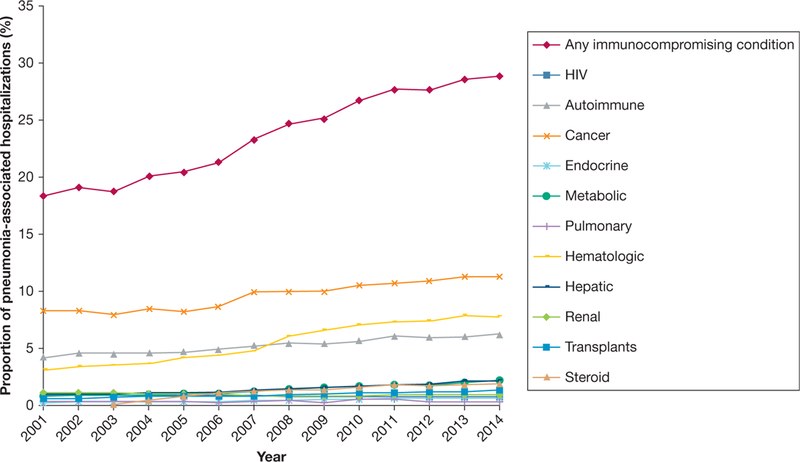
Results: There were an estimated 20,361,181 (SE, 95,601) pneumonia-associated hospitalizations in the United States during 2001-2014 (average annual age-adjusted pneumonia-associated hospitalization rate of 464.8 per 100,000 population [95% CI, 462.5-467.1]). The average annual age-adjusted pneumonia-associated hospitalization rate decreased over the study period (P < .0001). In-hospital death occurred in 7.4% (SE, 0.03) of pneumonia-associated hospitalizations. Non-Hispanic American Indian/Alaskan Natives and non-Hispanic blacks had the highest average annual age-adjusted rates of pneumonia-associated hospitalization of all race/ethnicities at 439.2 (95% CI, 415.9-462.5) and 438.6 (95% CI, 432.5-444.7) per 100,000 population, respectively. During 2001-2014, the proportion of pneumonia-associated hospitalizations colisting an immunocompromising condition increased from 18.7% (SE, 0.2) in 2001 to 29.9% (SE, 0.2) in 2014. Total charges for pneumonia-associated hospitalizations in 2014 were over $84 billion.
Conclusions: Pneumonia is a major cause of morbidity and mortality in the United States. Differences in rates and outcomes of pneumonia-associated hospitalizations between sociodemographic groups warrant further investigation. The immunocompromised population has emerged as a group experiencing a disproportionate burden of pneumonia-associated hospitalizations.
Keywords: epidemiology; pneumonia; respiratory failure; sepsis.
Copyright © 2017 American College of Chest Physicians. All rights reserved.
Figures


References
-
- National Center for Health Statistics. Leading Causes of Death. Atlanta, GA: Centers for Disease Control and Prevention; http://www.cdc.gov/nchs/fastats/leading-causes-of-death.htm. Last updated March 17, 2017. Accessed October 10, 2016.
-
- Bartlett JG. Diagnostic tests for agents of community-acquired pneumonia. Clin Infect Dis. 2011;52(suppl 4):S296–S304. - PubMed
-
- Hussey P, Anderson G, Berthelot JM, et al. Trends in socioeconomic disparities in health care quality in four countries. Int J Qual Health Care. 2008;20(1):53–61. - PubMed
-
- Singh GK, Hiatt RA. Trends and disparities in socioeconomic and behavioural characteristics, life expectancy, and cause-specific mortality of native-born and foreign-born populations in the United States, 1979–2003. Int J Epidemiol. 2006;35(4): 903–919. - PubMed
MeSH terms
Grants and funding
LinkOut - more resources
Full Text Sources
Other Literature Sources
Medical
