


Mobile Apps for Suicide Prevention: Review of Virtual Stores and Literature
- PMID: 29017992
- PMCID: PMC5654733
- DOI: 10.2196/mhealth.8036
Mobile Apps for Suicide Prevention: Review of Virtual Stores and Literature
Abstract
Background: The best manner to prevent suicide is to recognize suicidal signs and signals, and know how to respond to them.
Objective: We aim to study the existing mobile apps for suicide prevention in the literature and the most commonly used virtual stores.
Methods: Two reviews were carried out. The first was done by searching the most commonly used commercial app stores, which are iTunes and Google Play. The second was a review of mobile health (mHealth) apps in published articles within the last 10 years in the following 7 scientific databases: Science Direct, Medline, PsycINFO, Embase, The Cochrane Library, IEEE Xplore, and Google Scholar.
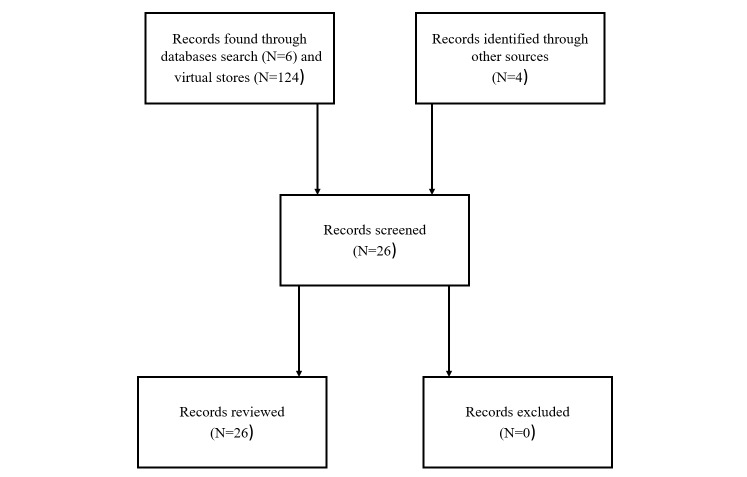
Results: A total of 124 apps related to suicide were found in the cited virtual stores but only 20 apps were specifically designed for suicide prevention. All apps were free and most were designed for Android. Furthermore, 6 relevant papers were found in the indicated scientific databases; in these studies, some real experiences with physicians, caregivers, and families were described. The importance of these people in suicide prevention was indicated.
Conclusions: The number of apps regarding suicide prevention is small, and there was little information available from literature searches, indicating that technology-based suicide prevention remains understudied. Many of the apps provided no interactive features. It is important to verify the accuracy of the results of different apps that are available on iOS and Android. The confidence generated by these apps can benefit end users, either by improving their health monitoring or simply to verify their body condition.
Keywords: app; literature; prevention; suicide; virtual stores.
©Isabel de la Torre, Gema Castillo, Jon Arambarri, Miguel López-Coronado, Manuel A Franco. Originally published in JMIR Mhealth and Uhealth (http://mhealth.jmir.org), 10.10.2017.
Conflict of interest statement
Conflicts of Interest: None declared.
Figures
References
-
- World Health Organization Suicide data. 2017. [2017-08-17]. http://www.who.int/mental_health/prevention/suicide/suicideprevent/en/
-
- Mathias C, Michael FR, Sheftall A, Hill-Kapturczak N, Crum P, Dougherty D. What's the harm in asking about suicidal ideation? Suicide Life Threat Behav. 2012 Jun;42(3):341–51. doi: 10.1111/j.1943-278X.2012.0095.x. http://europepmc.org/abstract/MED/22548324 - DOI - PMC - PubMed
-
- Siegel A. Suicide prevention by smartphone. Am J Med Internet. 2016 Aug;129:E145. doi: 10.1016/j.amjmed.2016.01.034. http://linkinghub.elsevier.com/retrieve/pii/S0002934316301012 - DOI - PubMed
-
- Lai MH, Maniam T, Chan LF, Ravindran AV. Caught in the web: a review of web-based suicide prevention. J Med Internet Res. 2014;16(1):e30. doi: 10.2196/jmir.2973. http://www.jmir.org/2014/1/e30/ - DOI - PMC - PubMed
-
- Ghoncheh R, Gould MS, Twisk JW, Kerkhof AJ, Koot HM. Efficacy of adolescent suicide prevention e-learning modules for gatekeepers: a randomized controlled trial. JMIR Ment Health. 2016 Jan 29;3(1):e8. doi: 10.2196/mental.4614. http://mental.jmir.org/2016/1/e8/ - DOI - PMC - PubMed
LinkOut - more resources
Full Text Sources
Other Literature Sources
