


Trials and Tribulations of CETP Inhibitors
- PMID: 29018035
- PMCID: PMC5756107
- DOI: 10.1161/CIRCRESAHA.117.311978
Trials and Tribulations of CETP Inhibitors
Abstract
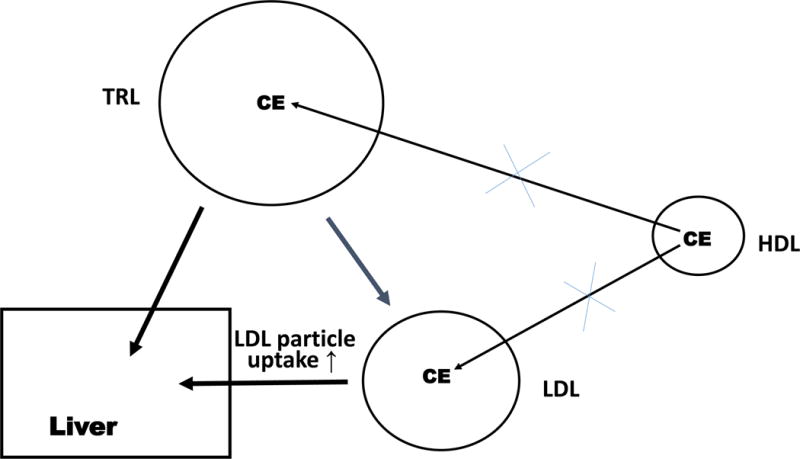
The development of CETP (cholesteryl ester transfer protein) inhibitors has had a long and difficult course with 3 compounds failing in phase III clinical trials. Finally, the REVEAL (Randomized Evaluation of the Effects of Anacetrapib through Lipid modification) trial has shown that the CETP inhibitor anacetrapib decreased coronary heart disease when added to statin therapy. Although the result is different to earlier studies, this is likely related to the size and duration of the trial. The benefit of anacetrapib seems to be largely explained by lowering of non-HDL-C (high-density lipoprotein cholesterol), rather than increases in HDL-C. Although the magnitude of benefit for coronary heart disease appeared to be moderate, in part this may have reflected aspects of the trial design. Anacetrapib treatment was associated with a small increase in blood pressure, but was devoid of major side effects and was also associated with a small reduction in diabetes mellitus. Treatment with CETP inhibitors, either alone or in combination with statins, could provide another option for patients with coronary disease who require further reduction in LDL (low-density lipoprotein) and non-HDL-C.
Keywords: anacetrapib; coronary disease; dalcetrapib; evacetrapib; torcetrapib.
© 2017 American Heart Association, Inc.
Figures
References
-
- Inazu A, Brown ML, Hesler CB, Agellon LB, Koizumi J, Takata K, Maruhama Y, Mabuchi H, Tall AR. Increased high-density lipoprotein levels caused by a common cholesteryl-ester transfer protein gene mutation. The New England journal of medicine. 1990;323:1234–8. - PubMed
-
- Barter PJ, Caulfield M, Eriksson M, Grundy SM, Kastelein JJ, Komajda M, Lopez-Sendon J, Mosca L, Tardif JC, Waters DD, Shear CL, Revkin JH, Buhr KA, Fisher MR, Tall AR, Brewer B, Investigators I Effects of torcetrapib in patients at high risk for coronary events. The New England journal of medicine. 2007;357:2109–22. - PubMed
-
- Schwartz GG, Olsson AG, Abt M, Ballantyne CM, Barter PJ, Brumm J, Chaitman BR, Holme IM, Kallend D, Leiter LA, Leitersdorf E, McMurray JJ, Mundl H, Nicholls SJ, Shah PK, Tardif JC, Wright RS, dal OI. Effects of dalcetrapib in patients with a recent acute coronary syndrome. The New England journal of medicine. 2012;367:2089–99. - PubMed
-
- Lincoff AM, Nicholls SJ, Riesmeyer JS, Barter PJ, Brewer HB, Fox KAA, Gibson CM, Granger C, Menon V, Montalescot G, Rader D, Tall AR, McErlean E, Wolski K, Ruotolo G, Vangerow B, Weerakkody G, Goodman SG, Conde D, McGuire DK, Nicolau JC, Leiva-Pons JL, Pesant Y, Li W, Kandath D, Kouz S, Tahirkheli N, Mason D, Nissen SE, Investigators A Evacetrapib and Cardiovascular Outcomes in High-Risk Vascular Disease. The New England journal of medicine. 2017;376:1933–1942. - PubMed
-
- Group HTRC. Bowman L, Hopewell JC, Chen F, Wallendszus K, Stevens W, Collins R, Wiviott SD, Cannon CP, Braunwald E, Sammons E, Landray MJ. Effects of Anacetrapib in Patients with Atherosclerotic Vascular Disease. The New England journal of medicine. 2017;377:1217–1227. - PubMed
Publication types
MeSH terms
Substances
Grants and funding
LinkOut - more resources
Full Text Sources
Other Literature Sources
