. 2017 Sep 22:8:1816.
doi: 10.3389/fmicb.2017.01816. eCollection 2017.

Molecular Mechanisms That Contribute to Horizontal Transfer of Plasmids by the Bacteriophage SPP1

Affiliations

Molecular Mechanisms That Contribute to Horizontal Transfer of Plasmids by the Bacteriophage SPP1

Ana Valero-Rello et al. Front Microbiol. .

Abstract

Natural transformation and viral-mediated transduction are the main avenues of horizontal gene transfer in Firmicutes. Bacillus subtilis SPP1 is a generalized transducing bacteriophage. Using this lytic phage as a model, we have analyzed how viral replication and recombination systems contribute to the transfer of plasmid-borne antibiotic resistances. Phage SPP1 DNA replication relies on essential phage-encoded replisome organizer (G38P), helicase loader (G39P), hexameric replicative helicase (G40P), recombinase (G35P) and in less extent on the partially dispensable 5'→3' exonuclease (G34.1P), the single-stranded DNA binding protein (G36P) and the Holliday junction resolvase (G44P). Correspondingly, the accumulation of linear concatemeric plasmid DNA, and the formation of transducing particles were blocked in the absence of G35P, G38P, G39P, and G40P, greatly reduced in the G34.1P, G36P mutants, and slightly reduced in G44P mutants. In contrast, establishment of injected linear plasmid DNA in the recipient host was independent of viral-encoded functions. DNA homology between SPP1 and the plasmid, rather than a viral packaging signal, enhanced the accumulation of packagable plasmid DNA. The transfer efficiency was also dependent on plasmid copy number, and rolling-circle plasmids were encapsidated at higher frequencies than theta-type replicating plasmids.

Keywords: SPP1; antibiotic resistance; bacteriophages; horizontal gene transfer; plasmid transduction.


Figures

FIGURE 1
FIGURE 1
Effect of the different SPP1 mutations on phage titer. B. subtilis BG214 cells were infected with the different phages at a MOI of 10, and after 2 h of infection PFU/ml was calculated. The number of phages, relative to the number of phages initially added, is indicated. The values are the mean of at least five independent assays and error bars indicate SD.
FIGURE 2
FIGURE 2
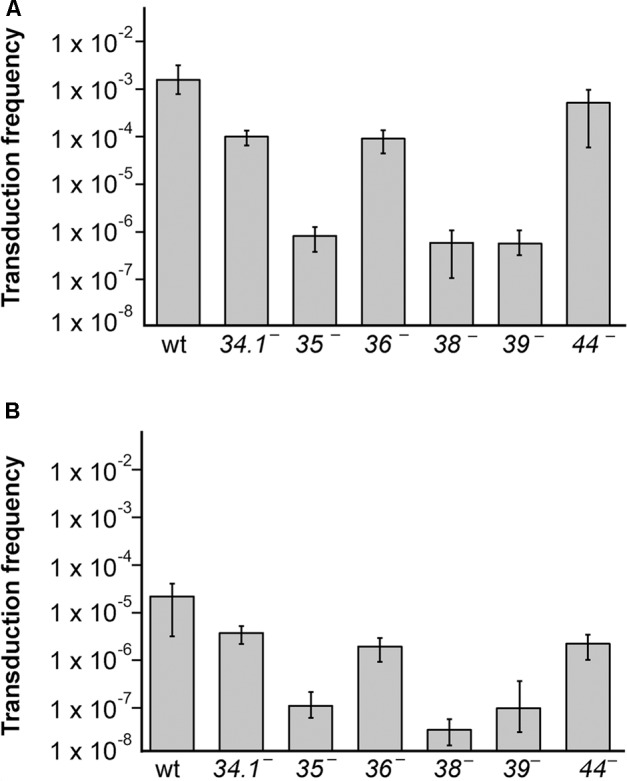
The generation of transducing lysates bearing plasmids with (pBG55) or without (pUB110) sequence homology with SPP1 is affected by mutations in viral replication and recombination genes. (A) Generation of pBG55 transducing particles after phage infections, expressed as frequency of transductants/CFU. (B) Generation of pUB110 transducing particles. BG214 cells bearing plasmids were infected with the different phage mutants and lysates were used to infect the BG295 sup3 strain to have the sus mutation only in the donor cells. The values are the mean of at least four independent assays and error bars indicate SD.
FIGURE 3
FIGURE 3
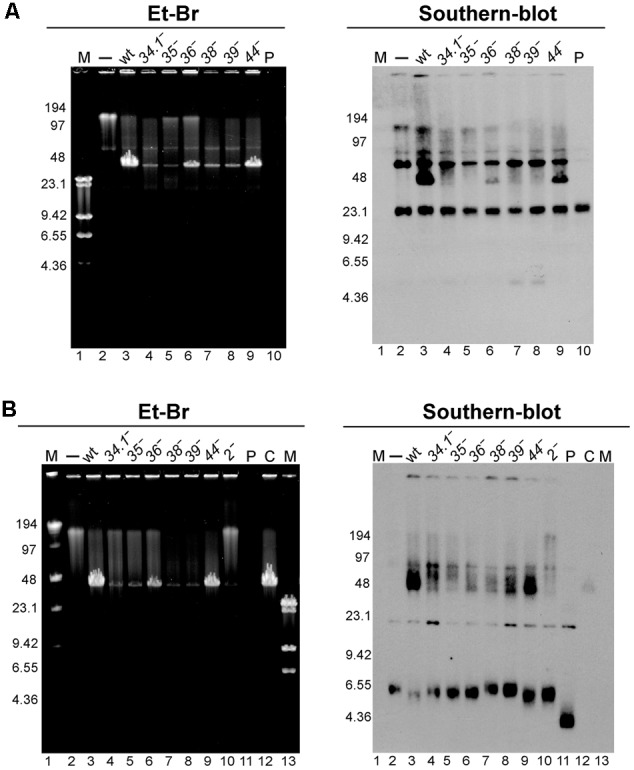
Analysis of the appearance of the transducing particles after infection with different SPP1 mutants of cells bearing RCR replicating plasmids with (pBG55 infections, A) or without regions homologous to SPP1 DNA (pUB110 infections, B). To unravel the appearance of hmw plasmid DNA 30 min after phage infections samples were analyzed by PFGE and Et-Br staining (left panel) followed by Southern-blot (right panel). M, LW and λ-HindIII markers. P, purified plasmid DNA 15 ng (pBG55 in A, and pUB110 in B); C, control, a SPP1 infection of BG214 cells without plasmid.
FIGURE 4
FIGURE 4
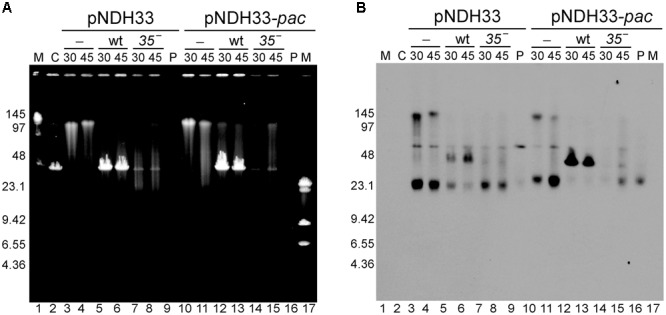
Southern-blot analysis of the appearance of the transducing particles after infection with SPP1 or with sus35 phage of cells bearing TR plasmids having (pNHD33-pac) or lacking (pNDH33) homologous regions to the phage. (A) Ethidium bromide stain and (B) Southern blot of the same gel developed with a chloramphenicol probe to visualize plasmid DNA. Lanes: 1 and 17: LW and λ-HindIII markers. Lane 2: C, control SPP1 infection of BG214 cells without plasmid. Lanes 3–4 and 10–11: control, non-infected BG214 cells bearing pNDH33 or pNDH33-pac plasmid. Lanes 5–6 and 12–13: SPP1 infection of BG214 cells bearing pNDH33 or pNDH33-pac plasmid, after 30 and 45 min infection. Lanes 7–8 and 14–15: BG214 cells bearing pNDH33 or pNDH33-pac, after 30 and 45 min infection with sus35 phage. Lane 9 and lane 16: P, 15 ng of purified pNDH33 or pNDH33-pac respectively.

References

    1. Alonso J. C., Luder G., Trautner T. A. (1986). Requirements for the formation of plasmid-transducing particles of Bacillus subtilis bacteriophage SPP1. EMBO J. 5 3723–3728. - PMC - PubMed
    1. Alonso J. C., Luder G., Trautner T. A. (1992). Intramolecular homologous recombination in Bacillus subtilis 168. Mol. Gen. Genet. 236 60–64. - PubMed
    1. Alonso J. C., Stiege C. A., Tailor R. H., Viret J. F. (1988). Functional analysis of the dna (Ts) mutants of Bacillus subtilis: plasmid pUB110 replication as a model system. Mol. Gen. Genet. 214 482–489. 10.1007/BF00330484 - DOI - PubMed
    1. Alonso J. C., Tavares P., Lurz R., Trautner T. A. (2006). “Bacteriophage SPP1,” in The Bacteriophages ed. Calendar R. (New York, NY: Oxford University Press; ) 18.
    1. Alonso J. C., Trautner T. A. (1985). A gene controlling segregation of the Bacillus subtilis plasmid pC194. Mol. Gen. Genet. 198 427–431. 10.1007/BF00332934 - DOI - PubMed