


Personality disorder services in England: findings from a national survey
- PMID: 29018548
- PMCID: PMC5623882
- DOI: 10.1192/pb.bp.116.055251
Personality disorder services in England: findings from a national survey
Abstract
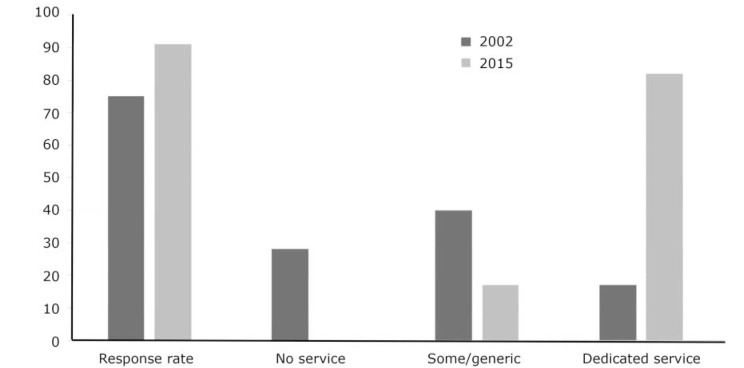
Aims and method We aimed to evaluate the availability and nature of services for people affected by personality disorder in England by conducting a survey of English National Health Service (NHS) mental health trusts and independent organisations. Results In England, 84% of organisations reported having at least one dedicated personality disorder service. This represents a fivefold increase compared with a 2002 survey. However, only 55% of organisations reported that patients had equal access across localities to these dedicated services. Dedicated services commonly had good levels of service use and carer involvement, and engagement in education, research and training. However, a wider multidisciplinary team and a greater number of biopsychosocial interventions were available through generic services. Clinical implications There has been a substantial increase in service provision for people affected by personality disorder, but continued variability in the availability of services is apparent and it remains unclear whether quality of care has improved.
Conflict of interest statement
Declaration of interest None.
Figures
References
-
- Keown P, Holloway F, Kuipers E. The prevalence of personality disorders, psychotic disorders and affective disorders amongst the patients seen by a community mental health team in London. Soc Psychiatry Psychiatr Epidemiol 2002; 37: 225–9. - PubMed
-
- Bowden-Jones O, Iqbal MZ, Tyrer P, Seivewright N, Cooper S, Judd A, et al. Prevalence of personality disorder in alcohol and drug services and associated comorbidity. Addiction 2004; 99: 1306–14. - PubMed
-
- Banerjee PJM, Gibbon S, Huband N. Assessment of personality disorder. Adv Psychiatr Treat 2009; 15: 389–97.
-
- Singleton N, Meltzer H, Gatward R. Psychiatric Morbidity among Prisoners in England and Wales. Department of Health, 1998.
-
- Stone MH. Long-term outcome in personality disorders. Br J Psychiatry 1993; 162: 299–313. - PubMed
LinkOut - more resources
Full Text Sources
Other Literature Sources
