Disentangling age-gender interactions associated with risks of fatal and non-fatal road traffic injuries in the Sultanate of Oman
- PMID: 29018585
- PMCID: PMC5623270
- DOI: 10.1136/bmjgh-2017-000394
Disentangling age-gender interactions associated with risks of fatal and non-fatal road traffic injuries in the Sultanate of Oman
Abstract
Objective: Road traffic injuries (RTIs) are the leading cause of disability-adjusted life years lost in Oman, Saudi Arabia and United Arab Emirates. Injury prevention strategies often overlook the interaction of individual and behavioural risk factors in assessing the severity of RTI outcomes. We conducted a systematic investigation of the underlying interactive effects of age and gender on the severity of fatal and non-fatal RTI outcomes in the Sultanate of Oman.
Methods: We used the Royal Oman Police national database of road traffic crashes for the period 2010-2014. Our study was based on 35 785 registered incidents: of these, 10.2% fatal injuries, 6.2% serious, 27.3% moderate, 37.3% mild injuries and 19% only vehicle damage but no human injuries. We applied a generalised ordered logit regression to estimate the effect of age and gender on RTI severity, controlling for risk behaviours, personal characteristics, vehicle, road, traffic, environment conditions and geographical location.
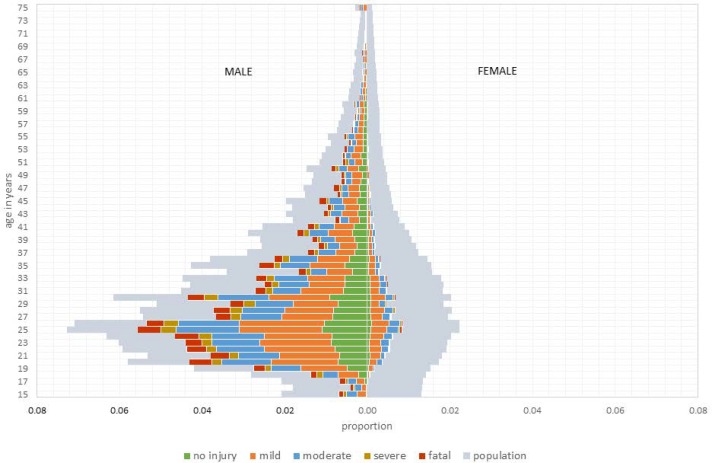
Results: The most dominant group at risk of all types of RTIs was young male drivers. The probability of severe incapacitating injuries was the highest for drivers aged 25-29 (26.6%) years, whereas the probability of fatal injuries was the highest for those aged 20-24 (26.9%) years. Analysis of three-way interactions of age, gender and causes of crash show that overspeeding was the primary cause of different types of RTIs. In particular, the probability of fatal injuries among male drivers attributed to overspeeding ranged from 3%-6% for those aged 35 years and above to 13.4% and 17.7% for those aged 25-29 years and 20-24 years, respectively.
Conclusions: The high burden of severe and fatal RTIs in Oman was primarily attributed to overspeed driving behaviour of young male drivers in the 20-29 years age range. Our findings highlight the critical need for designing early gender-sensitive road safety interventions targeting young male and female drivers.
Keywords: Oman; age-gender interaction; cause of crash; generalised ordered logit regression; middle-east; registration data; road traffic injuries; severity.
Conflict of interest statement
Competing interests: None declared.
Figures
References
-
- WHO. Global status report on road safety 2015. Geneva: world health organisation, 2015. http://www.who.int/violence_injury_prevention/road_safety_status/2015/en/ (accessed 25 Nov 2016).
-
- Murray CJ, Barber RM, Foreman KJ, et al. Global, regional, and national disability-adjusted life years (DALYs) for 306 diseases and injuries and healthy life expectancy (HALE) for 188 countries, 1990-2013: quantifying the epidemiological transition. Lancet 2015;386:2145–91. 10.1016/S0140-6736(15)61340-X - DOI - PMC - PubMed
-
- IHME. Institute for health metrics and evaluation. university of washington; 2015. http://www.healthdata.org/gbd/data-visualizations (accessed 4 Oct 2016).
LinkOut - more resources
Full Text Sources
Other Literature Sources