


Traffic-Related Air Pollution and Autism Spectrum Disorder: A Population-Based Nested Case-Control Study in Israel
- PMID: 29020136
- PMCID: PMC6963689
- DOI: 10.1093/aje/kwx294
Traffic-Related Air Pollution and Autism Spectrum Disorder: A Population-Based Nested Case-Control Study in Israel
Abstract
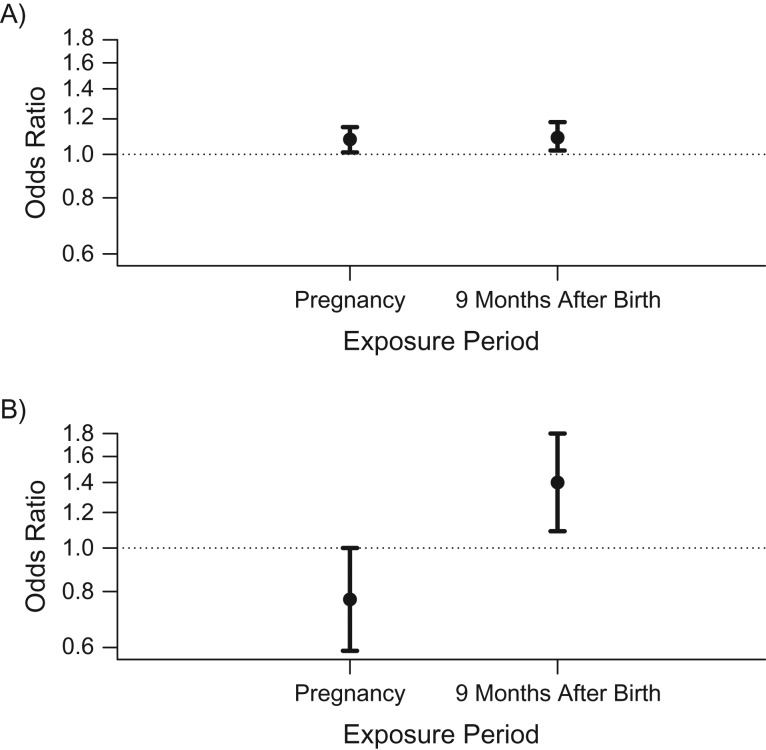
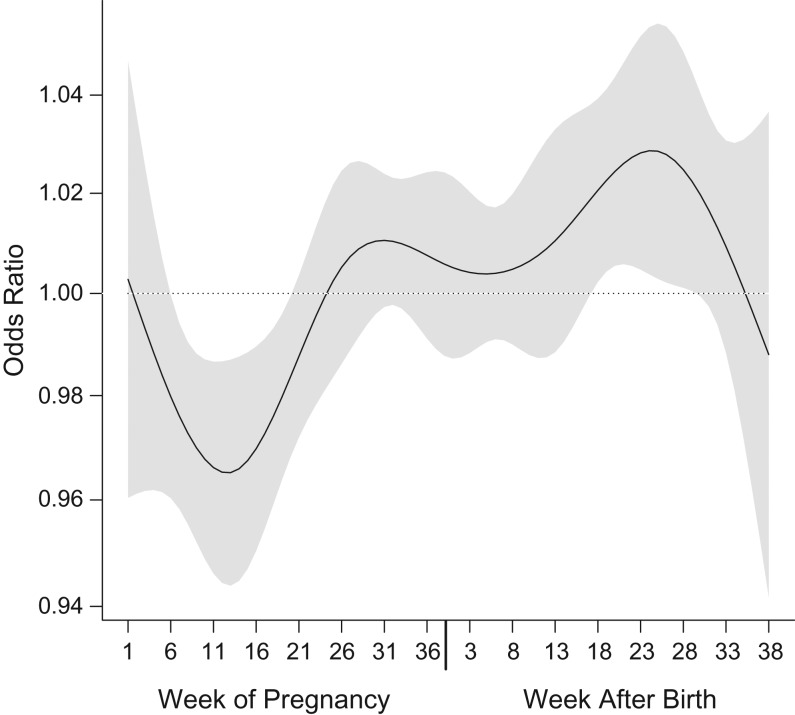
Accumulating evidence suggests that perinatal air pollutant exposures are associated with increased risk of autism spectrum disorder (ASD), but evidence for traffic pollutants outside the United States is inconclusive. We assessed the association between nitrogen dioxide, a traffic pollution tracer, and risk of ASD. We conducted a nested case-control study among the entire population of children born during 2005-2009 in the central coastal area of Israel. Cases were identified through the National Insurance Institute of Israel (n = 2,098). Controls were a 20% random sample of the remaining children (n = 54,191). Exposure was based on an optimized dispersion model. We estimated adjusted odds ratios and 95% confidence intervals using logistic regression and a distributed-lag model. In models mutually adjusted for the 2 periods, the odds ratio per 5.85-parts per billion (ppb) increment of nitrogen dioxide exposure during pregnancy (median, 16.8 ppb; range, 7.5-31.2 ppb) was 0.77 (95% confidence interval: 0.59, 1.00), and the odds ratio for exposure during the 9 months after birth was 1.40 (95% confidence interval: 1.09, 1.80). A distributed-lag model revealed reduced risk around week 13 of pregnancy and elevated risk around week 26 after birth. These findings suggest that postnatal exposure to nitrogen dioxide in Israel is associated with increased odds of ASD, and prenatal exposure with lower odds. The latter may relate to selection effects.
Figures
References
-
- American Psychiatric Association Diagnostic and Statistical Manual of Mental Disorders, Fifth Edition. Arlington, VA: American Psychiatric Publishing; 2013.
-
- Lichtenstein P, Carlström E, Råstam M, et al. The genetics of autism spectrum disorders and related neuropsychiatric disorders in childhood. Am J Psychiatry. 2010;167(11):1357–1363. - PubMed
Publication types
MeSH terms
Substances
Grants and funding
LinkOut - more resources
Full Text Sources
Other Literature Sources
Medical
