. 2017 Sep 15;31(18):1870-1879.
doi: 10.1101/gad.301093.117. Epub 2017 Oct 11.

Two distinct transcription termination modes dictated by promoters

Affiliations

Two distinct transcription termination modes dictated by promoters

Takashi S Miki et al. Genes Dev. .

Abstract

Transcription termination determines the ends of transcriptional units and thereby ensures the integrity of the transcriptome and faithful gene regulation. Studies in yeast and human cells have identified the exoribonuclease XRN2 as a key termination factor for protein-coding genes. Here we performed a genome-wide investigation of RNA polymerase II (Pol II) transcription termination in XRN2-deficient Caenorhabditis elegans and observed two distinct modes of termination. Although a subset of genes requires XRN2, termination of other genes appears both independent of, and refractory to, XRN2. XRN2 independence is not merely a consequence of failure to recruit XRN2, since XRN2 is present on-and promotes Pol II accumulation near the polyadenylation sites of-both gene classes. Unexpectedly, promoters instruct the choice of termination mode, but XRN2-independent termination additionally requires a compatible region downstream from the 3' end cleavage site. Hence, different termination mechanisms may work with different configurations of Pol II complexes dictated by promoters.

Keywords: RNA polymerase II; XRN2, Caenorhabditis elegans; transcription termination.


Figures

Figure 1.
Figure 1.
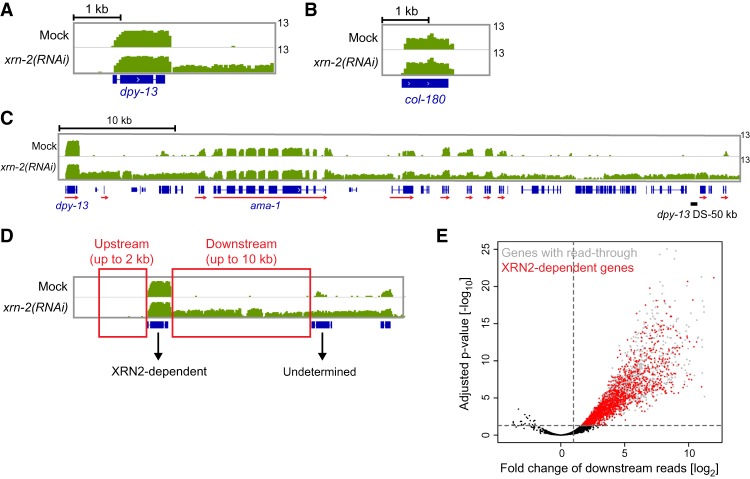
XRN2 inactivation yields readthrough transcripts on a specific subset of genes. Wild-type animals were treated with mock or xrn-2 RNAi from L1 to L4 stage and analyzed by RNA sequencing (RNA-seq). Snapshots of dpy-13 (A), col-180 (B), and a >50-kb region downstream from dpy-13 (C) genes are shown. RNA levels were normalized to total library size and are shown in green in a log2 scale (0–13). Genes are shown in blue. Only reads aligning to the same strand as the gene of interest are included, and genes on the same strand are marked with red arrows. (D) Schematic of the downstream and upstream regions used to identify XRN2-dependent termination. The upstream region consists of the 2 kb immediately upstream of the transcript start site (TSS), while the downstream region consists of the intergenic region downstream from the transcript end site (TES), extending either until the TSS of the next downstream gene on the same strand or up to 10 kb at the longest. Genes showing significantly up-regulated read number in downstream regions in xrn-2(RNAi) versus mock but no significantly up-regulated read number in upstream regions were classified as XRN2-dependent. Genes showing significant up-regulation in both upstream and downstream regions could not be classified accurately and were omitted from further analysis. (E) Volcano plot showing genome-wide analysis of read counts in regions downstream from all expressed genes. The X-axis represents the log2 fold change in reads between mock and xrn-2 RNAi conditions, while the Y-axis represents the adjusted −log10 P-value for each comparison. Cutoffs of P < 0.05 and log2 fold change ≥1 were used to define genes showing increased downstream readthrough in xrn-2 RNAi (red plus gray points). This set of genes was further filtered based on changes in upstream read counts and operon membership to result in the final set of high-confidence XRN2-dependent genes (red points; see the text).
Figure 2.
Figure 2.
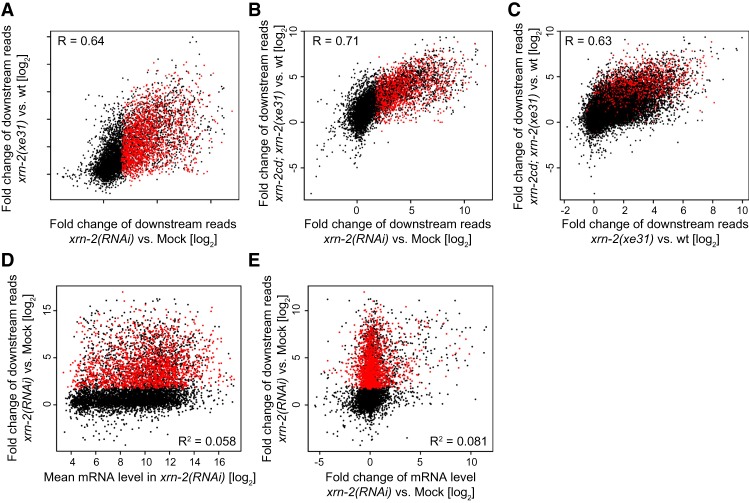
Assignment of XRN2 independence is robust to different XRN2 depletion strategies and not explained by gene expression levels or dynamics. (AC) Scatter plots comparing log2 fold change of read density in downstream regions in three experiments inactivating XRN2 as indicated. In all experiments involving the xrn-2(xe31ts) allele, xrn-2 inactivation was achieved by a 10-h shift to restrictive temperature. XDT (XRN2-dependent for termination) genes as defined in the xrn-2(RNAi) experiment are colored red. (D,E) Scatter plots showing the log2 fold change of read density in downstream regions upon xrn-2(RNAi) versus the log2 mean mRNA expression levels in xrn-2(RNAi) conditions (D) or the log2 fold change of the corresponding mRNA expression levels upon xrn-2(RNAi) (E). XDT genes are shown in red.
Figure 3.
Figure 3.
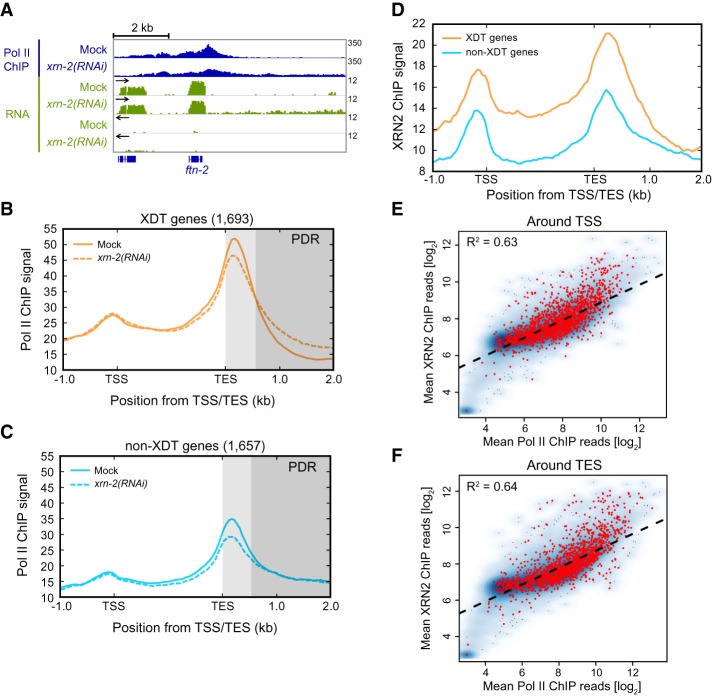
XRN2 is required for efficient transcription termination of a subset of genes (A) Wild-type animals were treated with mock or xrn-2 RNAi from L1 to L4 larval stages followed by Pol II ChIP-seq analysis. A snapshot of the ftn-2 gene is shown. ChIP signal is shown in blue in a linear scale (0–350), and RNA signal from both strands is shown in green in a log2 scale (0–12). Arrows indicate the 5′-to-3′ strand direction. (B,C) Metagene plots show Pol II ChIP signal on XDT (B) and non-XDT (C) genes with 1-kb upstream and 2-kb downstream regions. Gene bodies were scaled between the TSS and TES. ChIP signal represents the mean of two biological replicates from each condition, quantified in 50-bp bins across each gene and flanking regions. Proximal PDR is shaded in light gray, and distal PDR is shaded in dark gray. (D) XRN2 ChIP-seq was performed by immunoprecipitating transgenic XRN2-GFP from animals lacking endogenous XRN2. Metagene plots display XRN2 ChIP signals on XDT and non-XDT genes. Scaling is as in B and C. (E,F) Smoothed scatter plots showing mean XRN2 ChIP signal versus mean Pol II ChIP signal in 1-kb windows around the TSSs (E) or TESs (F) of protein-coding genes in wild-type animals. The blue density cloud represents all protein-coding genes, with darker-blue regions indicating a higher density of points, and lighter-blue regions indicating a lower density of points. The red points indicate XDT genes. The dashed line represents a linear regression of XRN2 ChIP signal against Pol II signal.
Figure 4.
Figure 4.
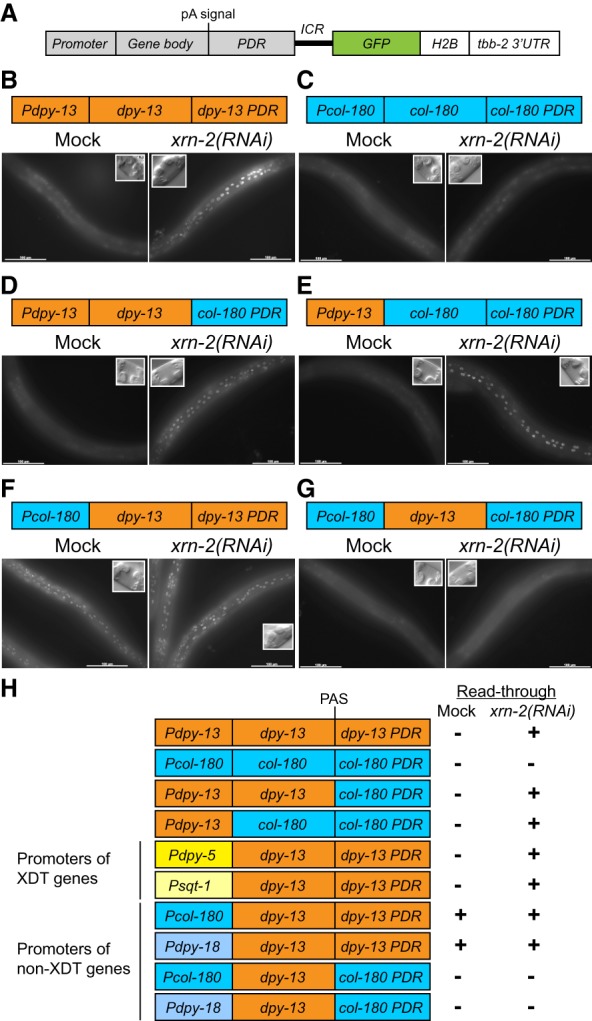
Promoters determine XRN2 dependence in transcription termination. (A) A transcription readthrough reporter. The indicated construct was integrated into an intergenic region with no active transcription. (BG) Animals carrying the indicated constructs were treated with mock or xrn-2 RNAi from L1 to L4 stage and observed for GFP signal. The insets show differential interference contrast (DIC) images that confirm mid-L4 stage vulva morphology. Bar, 100 µm. (H) Summary of the reporter assay. All phenotypes, GFP-positive (+) or GFP-negative (−), were fully penetrant and scored for ≥10 animals per condition.
Figure 5.
Figure 5.
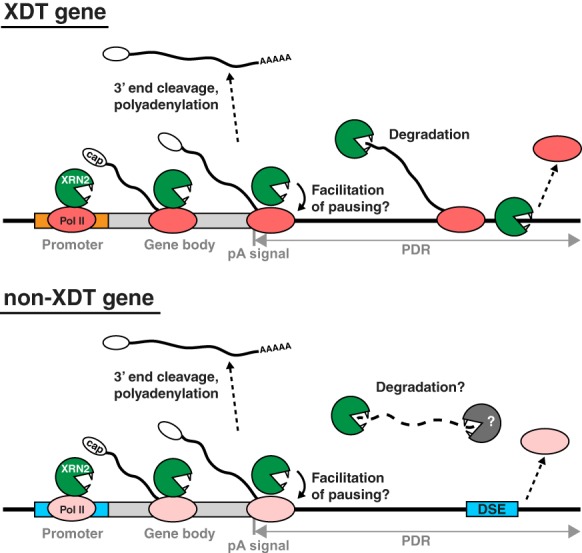
Models for XRN2-dependent and DSE-dependent transcription termination. XRN2 is recruited to Pol II on both XDT and non-XDT genes and facilitates Pol II accumulation at the gene ends, possibly by promoting pausing. On XDT genes, XRN2 degrades a nascent transcript following 3′ end cleavage and terminates Pol II. On non-XDT genes, Pol II transcribes beyond the pA site up to a DSE, which induces Pol II termination. Cleavage at the pA site separates the nascent mRNA from the downstream fragment; XRN2 might contribute, with other RNases, to the degradation of the latter. Different Pol II colors illustrate presumed differences in TEC properties and/or composition, determined by promoters, which result in differences in termination modes. See the text for details.

Comment in

References

    1. Ahn JH, Rechsteiner A, Strome S, Kelly WG. 2016. A conserved nuclear cyclophilin is required for both RNA polymerase II elongation and co-transcriptional splicing in Caenorhabditis elegans. PLoS Genet 12: e1006227. - PMC - PubMed
    1. Allen MA, Hillier LW, Waterston RH, Blumenthal T. 2011. A global analysis of C. elegans trans-splicing. Genome Res 21: 255–264. - PMC - PubMed
    1. Ambrosini G, Praz V, Jagannathan V, Bucher P. 2003. Signal search analysis server. Nucleic Acids Res 31: 3618–3620. - PMC - PubMed
    1. Baejen C, Andreani J, Torkler P, Battaglia S, Schwalb B, Lidschreiber M, Maier KC, Boltendahl A, Rus P, Esslinger S, et al. 2017. Genome-wide analysis of RNA polymerase II termination at protein-coding genes. Mol Cell 66: 38–49. - PubMed
    1. Bowman EA, Riddle DL, Kelly W. 2011. Amino acid substitutions in the Caenorhabditis elegans RNA polymerase II large subunit AMA-1/RPB-1 that result in α-amanitin resistance and/or reduced function. G3 1: 411–416. - PMC - PubMed

Publication types

MeSH terms