


Association Between Urinary Sodium and Potassium Excretion and Blood Pressure Among Adults in the United States: National Health and Nutrition Examination Survey, 2014
- PMID: 29021321
- PMCID: PMC5771856
- DOI: 10.1161/CIRCULATIONAHA.117.029193
Association Between Urinary Sodium and Potassium Excretion and Blood Pressure Among Adults in the United States: National Health and Nutrition Examination Survey, 2014
Abstract
Background: Higher levels of sodium and lower levels of potassium intake are associated with higher blood pressure. However, the shape and magnitude of these associations can vary by study participant characteristics or intake assessment method. Twenty-four-hour urinary excretion of sodium and potassium are unaffected by recall errors and represent all sources of intake, and were collected for the first time in a nationally representative US survey. Our objective was to assess the associations of blood pressure and hypertension with 24-hour urinary excretion of sodium and potassium among US adults.
Methods: Cross-sectional data were obtained from 766 participants age 20 to 69 years with complete blood pressure and 24-hour urine collections in the 2014 National Health and Nutrition Examination Survey, a nationally representative survey of the US noninstitutionalized population. Usual 24-hour urinary electrolyte excretion (sodium, potassium, and their ratio) was estimated from ≤2 collections on nonconsecutive days, adjusting for day-to-day variability in excretion. Outcomes included systolic and diastolic blood pressure from the average of 3 measures and hypertension status, based on average blood pressure ≥140/90 and antihypertensive medication use.
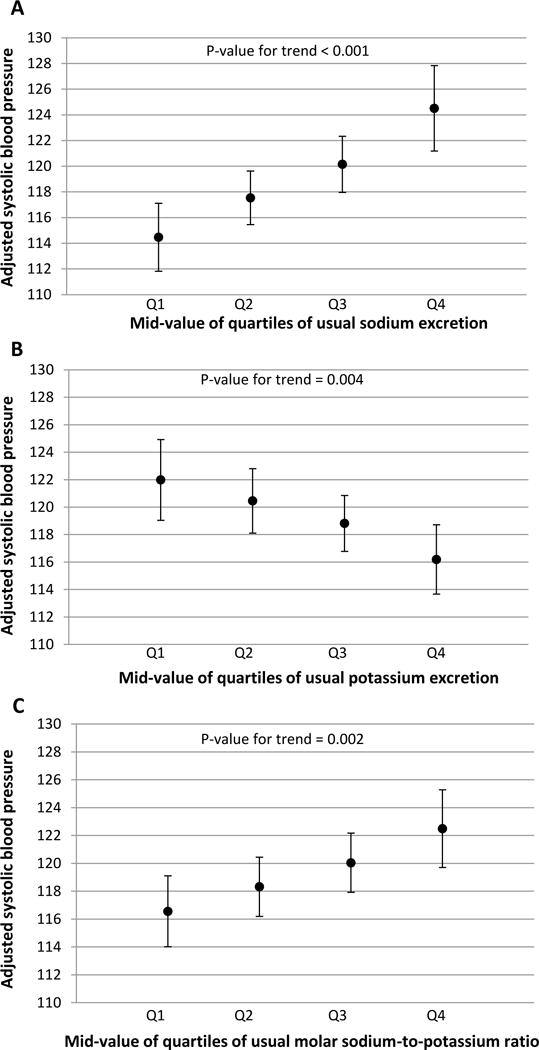
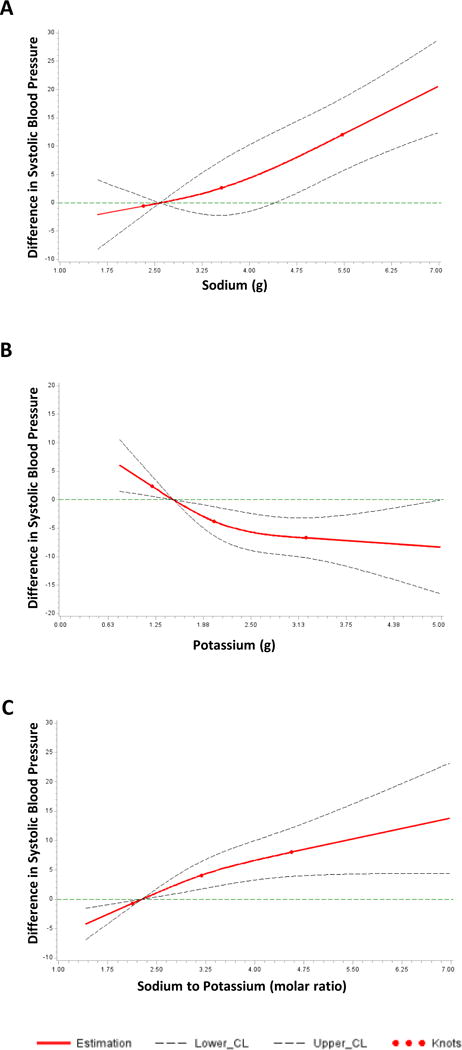
Results: After multivariable adjustment, each 1000-mg difference in usual 24-hour sodium excretion was directly associated with systolic (4.58 mm Hg; 95% confidence interval [CI], 2.64-6.51) and diastolic (2.25 mm Hg; 95% CI, 0.83-3.67) blood pressures. Each 1000-mg difference in potassium excretion was inversely associated with systolic blood pressure (-3.72 mm Hg; 95% CI, -6.01 to -1.42). Each 0.5 U difference in sodium-to-potassium ratio was directly associated with systolic blood pressure (1.72 mm Hg; 95% CI, 0.76-2.68). Hypertension was linearly associated with progressively higher sodium and lower potassium excretion; in comparison with the lowest quartile of excretion, the adjusted odds of hypertension for the highest quartile was 4.22 (95% CI, 1.36-13.15) for sodium, and 0.38 (95% CI, 0.17-0.87) for potassium (P<0.01 for trends).
Conclusions: These cross-sectional results show a strong dose-response association between urinary sodium excretion and blood pressure, and an inverse association between urinary potassium excretion and blood pressure, in a nationally representative sample of US adults.
Keywords: blood pressure; hypertension; nutrition surveys; potassium; sodium.
© 2017 American Heart Association, Inc.
Conflict of interest statement
None
Figures
Comment in
-
Sodium and Potassium Intake in US Adults.Circulation. 2018 Jan 16;137(3):247-249. doi: 10.1161/CIRCULATIONAHA.117.031371. Circulation. 2018. PMID: 29335285 Free PMC article. No abstract available.
References
-
- Benjamin EJ, Blaha MJ, Chiuve SE, Cushman M, Das SR, Deo R, de Ferranti SD, Floyd J, Fornage M, Gillespie C, Isasi CR, Jiménez MC, Jordan LC, Judd SE, Lackland D, Lichtman JH, Lisabeth L, Liu S, Longenecker CT, Mackey RH, Matsushita K, Mozaffarian D, Mussolino ME, Nasir K, Neumar RW, Palaniappan L, Pandey DK, Thiagarajan RR, Reeves MJ, Ritchey M, Rodriguez CJ, Roth GA, Rosamond WD, Sasson C, Towfighi A, Tsao CW, Turner MB, Virani SS, Voeks JH, Willey JZ, Wilkins JT, Wu JH, Alger HM, Wong SS, Muntner P. Heart Disease and Stroke Statistics—2017 Update: A Report From the American Heart Association. Circulation. 2017:e16–e458. - PMC - PubMed
-
- Institute of Medicine. Dietary Reference Intakes for Water, Potassium, Sodium, Chloride, and Sulfate. Washington, D.C.: THE NATIONAL ACADEMIES PRESS; 2005. pp. 269–397.
-
- He FJ, MacGregor GA. A comprehensive review on salt and health and current experience of worldwide salt reduction programmes. J Hum Hypertens. 2009;23:363–384. - PubMed
MeSH terms
Substances
Grants and funding
LinkOut - more resources
Full Text Sources
Other Literature Sources
Medical
