


Wrist Acceleration Cut Points for Moderate-to-Vigorous Physical Activity in Youth
- PMID: 29023358
- PMCID: PMC6195186
- DOI: 10.1249/MSS.0000000000001449
Wrist Acceleration Cut Points for Moderate-to-Vigorous Physical Activity in Youth
Erratum in
-
Wrist Acceleration Cut Points for Moderate-to-Vigorous Physical Activity in Youth-Corrigendum.Med Sci Sports Exerc. 2018 Nov;50(11):2385. doi: 10.1249/MSS.0000000000001767. Med Sci Sports Exerc. 2018. PMID: 30334921 No abstract available.
Abstract
Purpose: This study aimed to examine the validity of wrist acceleration cut points for classifying moderate (MPA), vigorous (VPA), and moderate-to-vigorous (MVPA) physical activity.
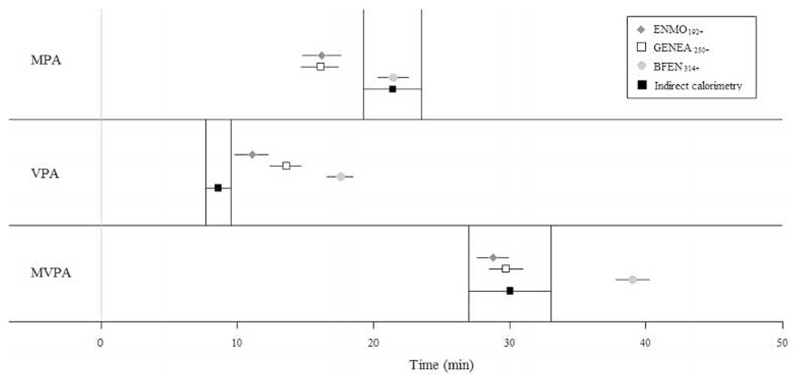
Methods: Fifty-seven children (5-12 yr) completed 15 semistructured activities. Three sets of wrist cut points (>192 mg, >250 mg, and >314 mg), previously developed using Euclidian norm minus one (ENMO192+), GENEActiv software (GENEA250+), and band-pass filter followed by Euclidian norm (BFEN314+), were evaluated against indirect calorimetry. Analyses included classification accuracy, equivalence testing, and Bland-Altman procedures.
Results: All cut points classified MPA, VPA, and MVPA with substantial accuracy (ENMO192+: κ = 0.72 [95% confidence interval = 0.72-0.73], MVPA: area under the receiver operating characteristic curve (ROC-AUC) = 0.85 [0.85-0.86]; GENEA250+: κ = 0.75 [0.74-0.76], MVPA: ROC-AUC = 0.85 [0.85-0.86]; BFEN314+: κ = 0.73 [0.72-0.74], MVPA: ROC-AUC = 0.86 [0.86-0.87]). BFEN314+ misclassified 19.7% non-MVPA epochs as MPA, whereas ENMO192+ and GENEA250+ misclassified 32.6% and 26.5% of MPA epochs as non-MVPA, respectively. Group estimates of MPA time were equivalent (P < 0.01) to indirect calorimetry for the BFEN314+ MPA cut point (mean bias = -1.5%, limits of agreement [LoA] = -57.5% to 60.6%), whereas estimates of MVPA time were equivalent (P < 0.01) to indirect calorimetry for the ENMO192+ (mean bias = -1.1%, LoA = -53.7% to 55.9%) and GENEA250+ (mean bias = 2.2%, LoA = -56.5% to 52.2%) cut points. Individual variability (LoA) was large for MPA (min: BFEN314+, -60.6% to 57.5%; max: GENEA250+, -42.0% to 104.1%), VPA (min: BFEN314+, -238.9% to 54.6%; max: ENMO192+, -244.5% to 127.4%), and MVPA (min: ENMO192+, -53.7% to 55.0%; max: BFEN314+, -83.9% to 25.3%).
Conclusion: Wrist acceleration cut points misclassified a considerable proportion of non-MVPA and MVPA. Group-level estimates of MVPA were acceptable; however, error for individual-level prediction was larger.
Conflict of interest statement
The authors have no conflict of interest to declare. The results of the present study do not constitute endorsement by the American College of Sports Medicine. The results are presented clearly, honestly, and without fabrication, falsification, or inappropriate data manipulation.
Figures
References
-
- Rennie KL, Wareham NJ. The validation of physical activity instruments for measuring energy expenditure: problems and pitfalls. Public Health Nutr. 1998;1(04):265–71. - PubMed
-
- Trost SG. State of the Art Reviews: Measurement of Physical Activity in Children and Adolescents. Am J Lifestyle Med. 2007;1(4):299–314.
-
- Freedson PS, John D. Comment on estimating activity and sedentary behavior from an accelerometer on the hip and wrist. Med Sci Sports Exerc. 2013;45(5):962–3. - PubMed
-
- UK Biobank. Category 2 enhanced phenotyping at baseline assessment visit in last 100-150,000 participants. [cited 2017 Jan 21];2009 [internet] Available from: http://www.ukbiobank.ac.uk/wp-content/uploads/2011/06/Protocol_addendum_....
Publication types
MeSH terms
Grants and funding
LinkOut - more resources
Full Text Sources
Other Literature Sources
Medical
