


Vaccination Coverage for Selected Vaccines, Exemption Rates, and Provisional Enrollment Among Children in Kindergarten - United States, 2016-17 School Year
- PMID: 29023430
- PMCID: PMC5657930
- DOI: 10.15585/mmwr.mm6640a3
Vaccination Coverage for Selected Vaccines, Exemption Rates, and Provisional Enrollment Among Children in Kindergarten - United States, 2016-17 School Year
Erratum in
-
Erratum: Vol. 66, No. 40.MMWR Morb Mortal Wkly Rep. 2017 Oct 27;66(42):1160. doi: 10.15585/mmwr.mm6642a10. MMWR Morb Mortal Wkly Rep. 2017. PMID: 29073127 Free PMC article. No abstract available.
Abstract
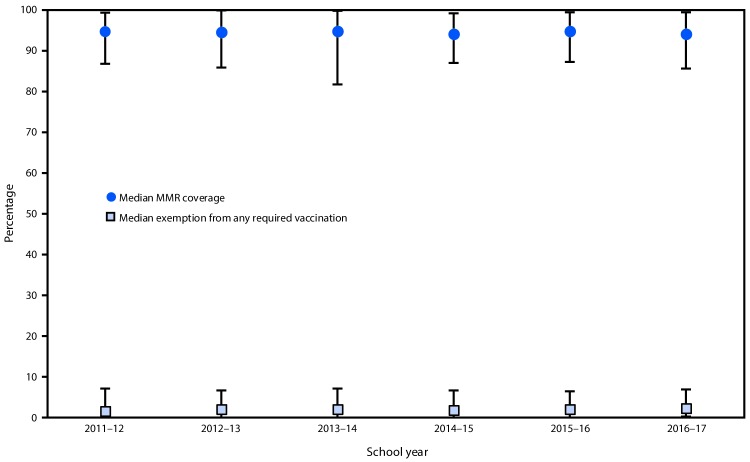
State and local school vaccination requirements help protect students and communities against vaccine-preventable diseases (1). CDC reports vaccination coverage and exemption data for children attending kindergarten (kindergartners) collected by federally funded immunization programs in the United States.* The typical age range for kindergartners is 4-6 years. Although vaccination requirements vary by state (the District of Columbia [DC] is counted as a state in this report.), the Advisory Committee on Immunization Practices recommends that children in this age range have received, among other vaccinations, 5 doses of diphtheria, tetanus, and acellular pertussis vaccine (DTaP), 2 doses of measles, mumps, and rubella vaccine (MMR), and 2 doses of varicella vaccine (2). This report summarizes 2016-17 school year MMR, DTaP, and varicella vaccination coverage reported by immunization programs in 49 states, exemptions in 50 states, and kindergartners provisionally enrolled or within a grace period in 27 states. Median vaccination coverage† was 94.5% for the state-required number of doses of DTaP; 94.0% for 2 doses of MMR; and 93.8% for 2 doses of varicella vaccine. The median percentage of kindergartners with an exemption from at least one vaccine§ was 2.0%, similar to 2015-16 (1.9%). Median grace period and provisional enrollment was 2.0%. Vaccination coverage remains consistently high and exemptions low at state and national levels. Local-level vaccination coverage data provide opportunities for immunization programs to identify schools, districts, counties, or regions susceptible to vaccine-preventable diseases and for schools to address undervaccination through implementation of existing state and local vaccination policies (1) to protect communities through increased coverage.
Conflict of interest statement
Figures
References
-
- Hinman AR, Orenstein WA, Williamson DE, Darrington D. Childhood immunization: laws that work. J Law Med Ethics 2002;30(Suppl):122–7. - PubMed
-
- Robinson CL, Romero JR, Kempe A, Pellegrini C; Advisory Committee on Immunization Practices Child/Adolescent Immunization Work Group. Advisory Committee on Immunization Practices recommended immunization schedule for children and adolescents aged 18 years or younger—United States, 2017. MMWR Morb Mortal Wkly Rep 2017;66:134–5. 10.15585/mmwr.mm6605e1 - DOI - PMC - PubMed
-
- CDC. SchoolVaxView interactive! Atlanta, GA: US Department of Health and Human Services, CDC; 2016. https://www.cdc.gov/vaccines/vaxview/index.html
-
- California Department of Public Health. Exemptions: new law (SB 277) effective in 2016. Sacramento, CA: California Department of Public Health; 2015. http://www.shotsforschool.org/laws/exemptions
MeSH terms
Substances
LinkOut - more resources
Full Text Sources
Other Literature Sources
Medical
