. 2017 Oct 12;13(10):e1005134.
doi: 10.1371/journal.pcbi.1005134. eCollection 2017 Oct.

Women are underrepresented in computational biology: An analysis of the scholarly literature in biology, computer science and computational biology

Affiliations

Women are underrepresented in computational biology: An analysis of the scholarly literature in biology, computer science and computational biology

Kevin S Bonham et al. PLoS Comput Biol. .

Abstract

While women are generally underrepresented in STEM fields, there are noticeable differences between fields. For instance, the gender ratio in biology is more balanced than in computer science. We were interested in how this difference is reflected in the interdisciplinary field of computational/quantitative biology. To this end, we examined the proportion of female authors in publications from the PubMed and arXiv databases. There are fewer female authors on research papers in computational biology, as compared to biology in general. This is true across authorship position, year, and journal impact factor. A comparison with arXiv shows that quantitative biology papers have a higher ratio of female authors than computer science papers, placing computational biology in between its two parent fields in terms of gender representation. Both in biology and in computational biology, a female last author increases the probability of other authors on the paper being female, pointing to a potential role of female PIs in influencing the gender balance.


Conflict of interest statement

The authors have declared that no competing interests exist.

Figures
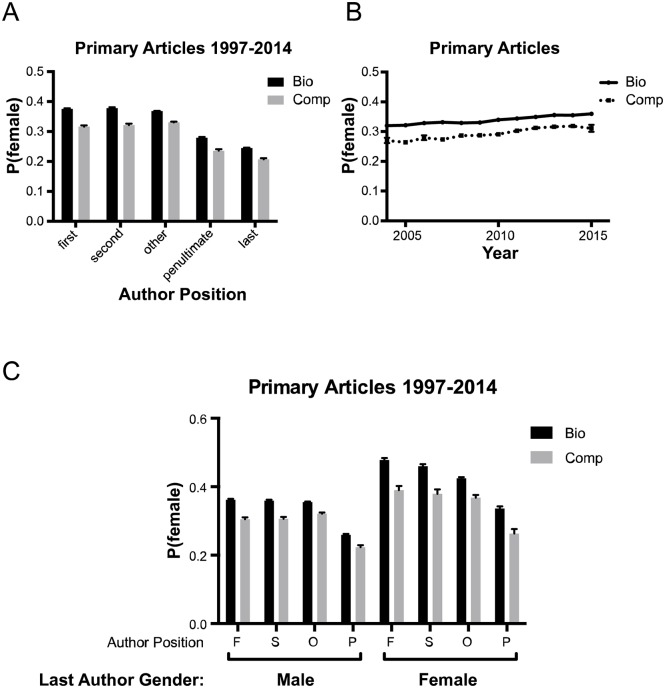
Fig 1
Fig 1
A: Mean probability that an author in a given position is female for primary articles indexed in Pubmed with the MeSH term Biology (black) or Computational Biology (grey). The bio dataset is inclusive of papers in the comp dataset. Error bars represent 95% confidence intervals. B: Mean probability that an author is female for publications in a given year. Error bars represent 95% confidence intervals. C: Mean probability that the first (F), second (S), penultimate (P) or other (O) author is female for publications where the last author is male (Pfemale < 0.2) or female (Pfemale > 0.8). Papers where the gender of the last author was uncertain or could not be determined were excluded. Error bars represent 95% confidence intervals.
Fig 2
Fig 2
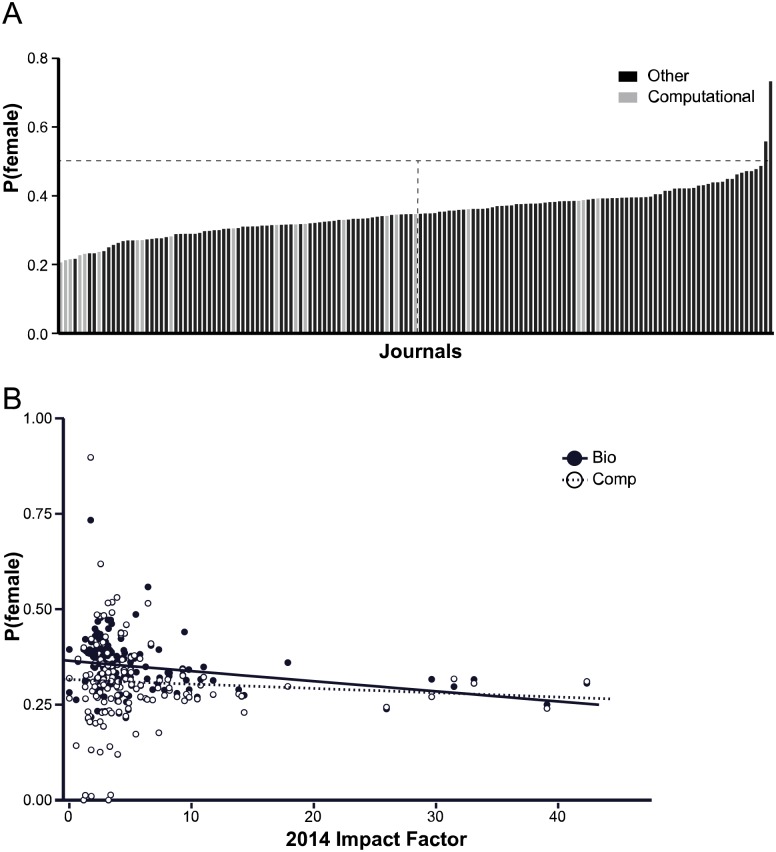
A: Mean probability that an author is female for every journal that had at least 1000 authors in our dataset. Grey bars represent journals that have the words “Bioinformatics”, “Computational”, “Computer”, “System(s)”, or “omic(s)” in their title. Vertical line represents the median for female author representation. See also S1 Table. B: Mean probability that an author is female for articles in the “Bio” dataset (black dot) or in the “Comp” dataset (open dot) for each journal that had at least 1000 authors plotted against the journals' 2014 impact factor. Journals that had computational biology articles are included in both datasets. An ordinary least squares regression was performed for each dataset. Bio: m = −0.00264, PZ > |z| = 0.0022. Comp: m = −0.00079, PZ > |z| = 0.568.
Fig 3
Fig 3
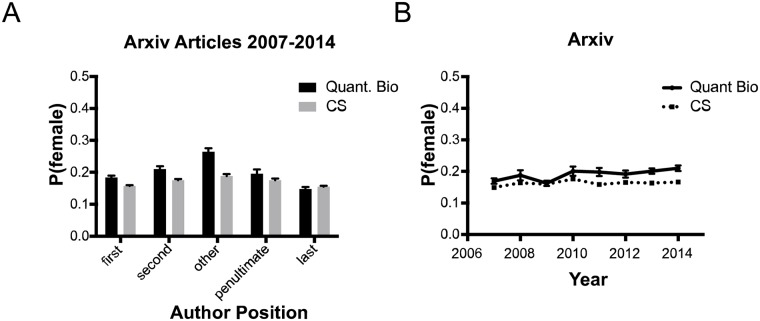
A: Mean probability that an author in a given position is female for all preprints in the arXiv quantitative biology (black) or computer science (grey) categories between 2007 and 2014. Error bars represent 95% confidence intervals. B: Mean probability of authors being female in arXiv preprints in a given year. Error bars represent 95% confidence intervals. Slopes were determined using ordinary least squares regression. The slope for qbio is slightly positive (p < 0.05), but the slope for cs is not.

References

    1. Grunspan DZ, Eddy SL, Brownell SE, Wiggins BL, Crowe AJ, Goodreau SM. Males Under-Estimate Academic Performance of Their Female Peers in Undergraduate Biology Classrooms. PLoS ONE. 2016. 11:e0148405 10.1371/journal.pone.0148405 - DOI - PMC - PubMed
    1. MacNell L, Driscoll A, Hunt AN. What’s in a Name: Exposing Gender Bias in Student Ratings of Teaching. Innovative Higher Education. 2014. 40: 291–303. 10.1007/s10755-014-9313-4 - DOI
    1. Milkman KL, Akinola M, Chugh D. What happens before? A field experiment exploring how pay and representation differentially shape bias on the pathway into organizations. J Appl Psychol. 2015. 100:1678–1712. 10.1037/apl0000022 - DOI - PubMed
    1. Moss-Racusin CA, Dovidio JF, Brescoll VL, Graham MJ, Handelsman J. Science faculty’s subtle gender biases favor male students. Proc Natl Acad Sci U S A. 2012. 109:16474–16479. 10.1073/pnas.1211286109 - DOI - PMC - PubMed
    1. Larivière V, Ni C, Gingras Y, Cronin B, Sugimoto CR. Bibliometrics: global gender disparities in science. Nature. 2013. 504: 211–213. 10.1038/504211a - DOI - PubMed

MeSH terms

LinkOut - more resources