


Geographic variations of the bird-borne structural risk of West Nile virus circulation in Europe
- PMID: 29023472
- PMCID: PMC5638290
- DOI: 10.1371/journal.pone.0185962
Geographic variations of the bird-borne structural risk of West Nile virus circulation in Europe
Abstract
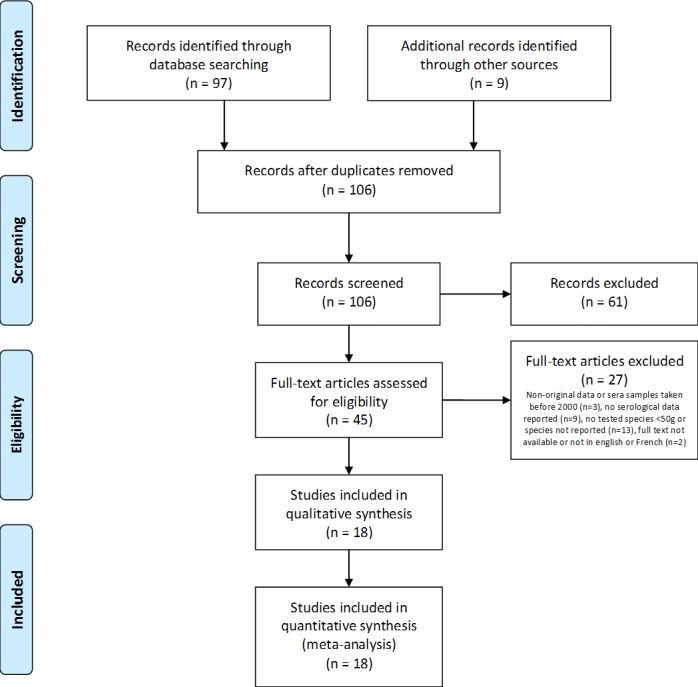
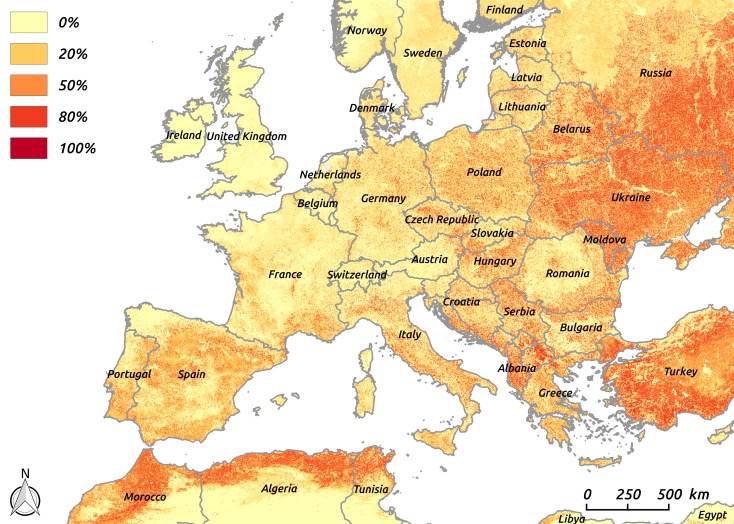
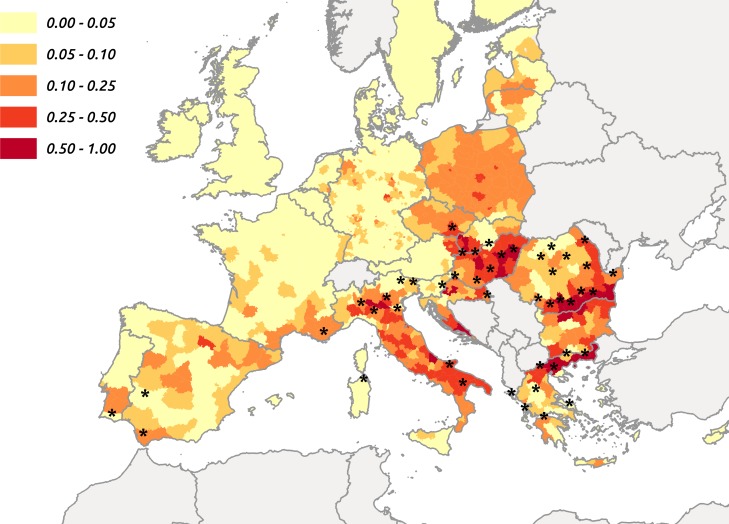
The structural risk of West Nile Disease results from the usual functioning of the socio-ecological system, which may favour the introduction of the pathogen, its circulation and the occurrence of disease cases. Its geographic variations result from the local interactions between three components: (i) reservoir hosts, (ii) vectors, both characterized by their diversity, abundance and competence, (iii) and the socio-economic context that impacts the exposure of human to infectious bites. We developed a model of bird-borne structural risk of West Nile Virus (WNV) circulation in Europe, and analysed the association between the geographic variations of this risk and the occurrence of WND human cases between 2002 and 2014. A meta-analysis of WNV serosurveys conducted in wild bird populations was performed to elaborate a model of WNV seropositivity in European bird species, considered a proxy for bird exposure to WNV. Several eco-ethological traits of bird species were linked to seropositivity and the statistical model adequately fitted species-specific seropositivity data (area under the ROC curve: 0.85). Combined with species distribution maps, this model allowed deriving geographic variations of the bird-borne structural risk of WNV circulation. The association between this risk, and the occurrence of WND human cases across the European Union was assessed. Geographic risk variations of bird-borne structural risk allowed predicting WND case occurrence in administrative districts of the EU with a sensitivity of 86% (95% CI: 0.79-0.92), and a specificity of 68% (95% CI: 0.66-0.71). Disentangling structural and conjectural health risks is important for public health managers as risk mitigation procedures differ according to risk type. The results obtained show promise for the prevention of WND in Europe. Combined with analyses of vector-borne structural risk, they should allow designing efficient and targeted prevention measures.
Conflict of interest statement
Figures
References
-
- Bunning ML, Bowen RA, Cropp B, Sullivan K, Davis B, et al. (2001) Experimental infection of horses with West Nile virus and their potential to infect mosquitoes and serve as amplifying hosts. Ann NY Acad Sci 951: 338–339. - PubMed
-
- Rossi S, Ross T, Evans J (2010) West Nile virus. Clin Lab Med 30: 47–65. doi: 10.1016/j.cll.2009.10.006 - DOI - PMC - PubMed
-
- Sambri V, Capobianchi M, Charrel R, Fyodorova M, Gaibani P, et al. (2013) West Nile virus in Europe: emergence, epidemiology, diagnosis, treatment, and prevention. Clinical Microbiology and Infection 19: 699–704. doi: 10.1111/1469-0691.12211 - DOI - PubMed
-
- Castillo-Olivares J, Wood J (2004) West Nile virus infection of horses. Vet Res: 467–483. doi: 10.1051/vetres:2004022 - DOI - PubMed
-
- Gardner I, Wong S, Ferraro G, Balasuriya U, Hullinger P, et al. (2007) Incidence and effects of West Nile virus infection in vaccinated and unvaccinated horses in California. Vet Res 38: 109–116. - PubMed
Publication types
MeSH terms
LinkOut - more resources
Full Text Sources
Other Literature Sources
Medical
