


Adenovirus vector-based multi-epitope vaccine provides partial protection against H5, H7, and H9 avian influenza viruses
- PMID: 29023601
- PMCID: PMC5638338
- DOI: 10.1371/journal.pone.0186244
Adenovirus vector-based multi-epitope vaccine provides partial protection against H5, H7, and H9 avian influenza viruses
Abstract
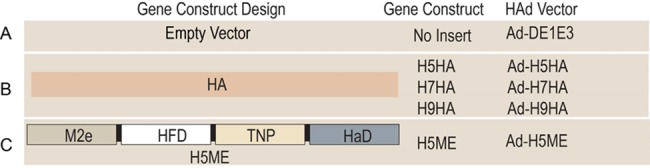
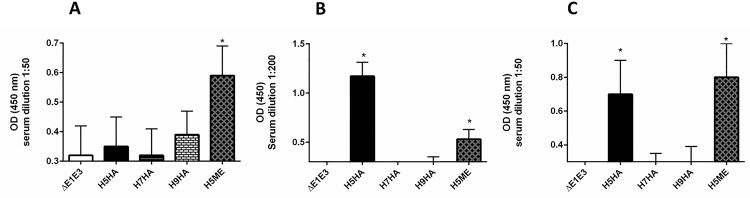
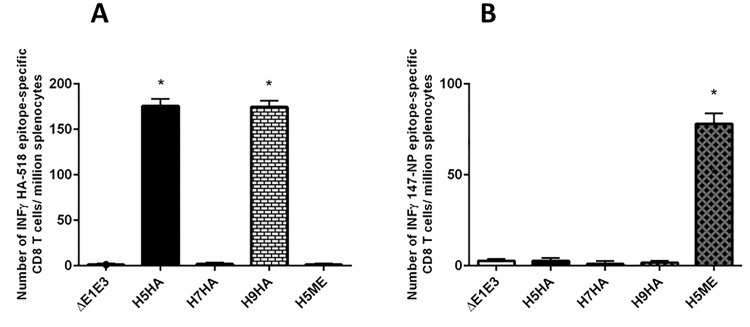
The emergence of H5, H7, and H9 avian influenza virus subtypes in humans reveals their pandemic potential. Although human-to-human transmission has been limited, the genetic reassortment of the avian and human/porcine influenza viruses or mutations in some of the genes resulting in virus replication in the upper respiratory tract of humans could generate novel pandemic influenza viruses. Current vaccines do not provide cross protection against antigenically distinct strains of the H5, H7, and H9 influenza viruses. Therefore, newer vaccine approaches are needed to overcome these potential threats. We developed an egg-independent, adenovirus vector-based, multi-epitope (ME) vaccine approach using the relatively conserved immunogenic domains of the H5N1 influenza virus [M2 ectodomain (M2e), hemagglutinin (HA) fusion domain (HFD), T-cell epitope of nucleoprotein (TNP). and HA α-helix domain (HαD)]. Our ME vaccine induced humoral and cell-mediated immune responses and caused a significant reduction in the viral loads in the lungs of vaccinated mice that were challenged with antigenically distinct H5, H7, or H9 avian influenza viruses. These results suggest that our ME vaccine approach provided broad protection against the avian influenza viruses. Further improvement of this vaccine will lead to a pre-pandemic vaccine that may lower morbidity, hinder transmission, and prevent mortality in a pandemic situation before a strain-matched vaccine becomes available.
Conflict of interest statement
Figures
References
-
- Belser JA, Bridges CB, Katz JM, Tumpey TM. Past, present, and possible future human infection with influenza virus A subtype H7. Emerg Infect Dis. 2009;15(6):859–65. Epub 2009/06/16. doi: 10.3201/eid1506.090072 . - DOI - PMC - PubMed
-
- Katz JM, Veguilla V, Belser JA, Maines TR, Van Hoeven N, Pappas C, et al. The public health impact of avian influenza viruses. Poult Sci. 2009;88(4):872–9. Epub 2009/03/12. doi: 10.3382/ps.2008-00465 . - DOI - PubMed
-
- WHO | Cumulative number of confirmed human cases of avian influenza A(H5N1) reported to WHO: World Health Organization; 2017 [updated 2017-08-09 13:07:55]. Available from: http://www.who.int/influenza/human_animal_interface/H5N1_cumulative_tabl....
-
- Gao R, Cao B, Hu Y, Feng Z, Wang D, Hu W, et al. Human infection with a novel avian-origin influenza A (H7N9) virus. N Engl J Med. 2013;368(20):1888–97. Epub 2013/04/13. doi: 10.1056/NEJMoa1304459 . - DOI - PubMed
-
- FAO H7N9 situation update—Avian Influenza A(H7N9) virus—FAO Emergency Prevention System for Animal Health (EMPRES-AH) 2017. Available from: http://www.fao.org/ag/againfo/programmes/en/empres/h7n9/situation_update....
MeSH terms
Substances
Grants and funding
LinkOut - more resources
Full Text Sources
Other Literature Sources
Medical
