


Friendship in War: Camaraderie and Prevention of Posttraumatic Stress Disorder Prevention
- PMID: 29023929
- PMCID: PMC5659877
- DOI: 10.1002/jts.22224
Friendship in War: Camaraderie and Prevention of Posttraumatic Stress Disorder Prevention
Abstract
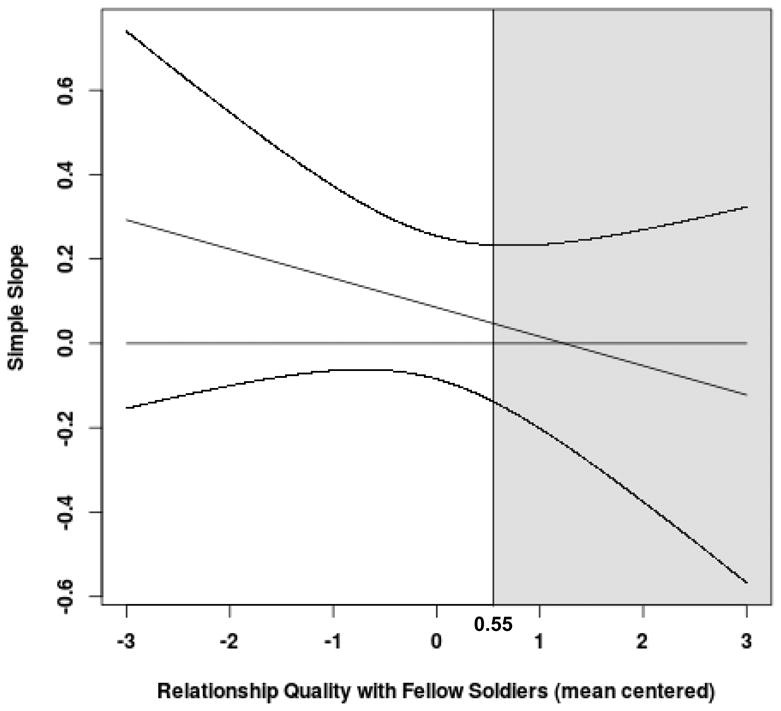
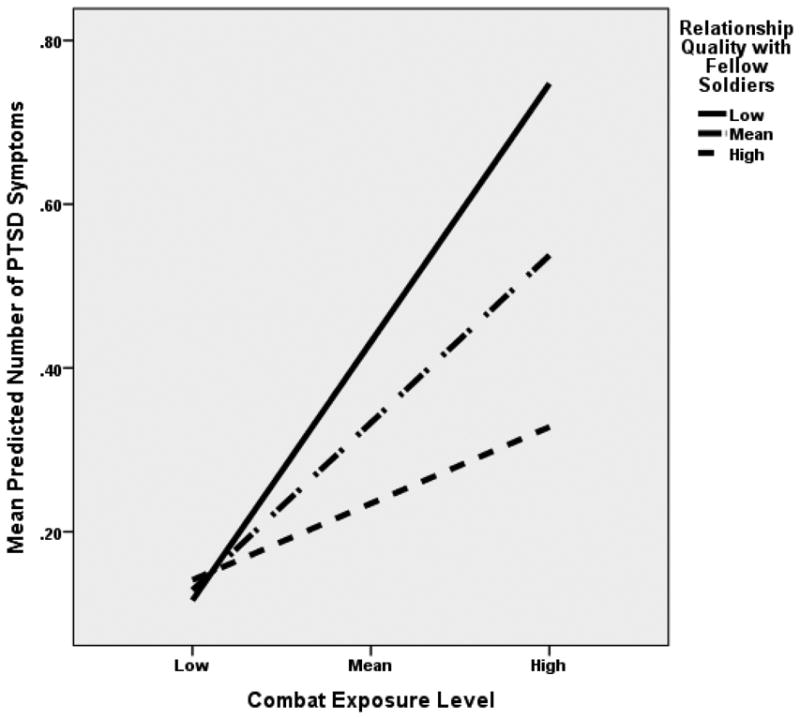
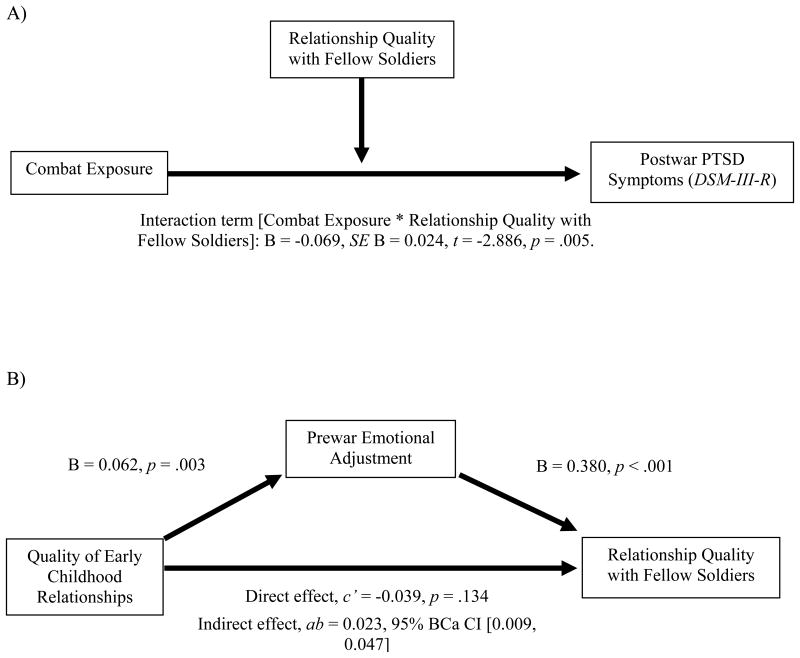
Aspects of social support during combat deployment, such as unit cohesion, have been shown to affect later posttraumatic stress disorder (PTSD) development among veterans. We utilized a longitudinal database to assess how relationship quality with fellow soldiers in World War II (WWII) might be linked with postwar PTSD symptoms. Data were available on 101 men who experienced combat exposure in WWII, documented through postwar assessment. Upon study entry (1939 to 1942), data were collected on the quality of participants' early childhood relationships and their emotional adjustment during college. Data on WWII experiences were collected in 1946. Relationship quality with fellow soldiers in WWII was examined as a moderator of the link between combat exposure and postwar PTSD symptoms. Prewar emotional adjustment was examined as a mediator between quality of childhood relationships and subsequent quality of relationships quality with fellow soldiers during war. Better quality relationships with fellow soldiers attenuated (i.e., moderated) the link between combat exposure severity and PTSD symptom count, explaining a significant percent of the variance, R2 = .19, p < .001. There was also a significant indirect mediation effect of childhood relationship quality on relationships with soldiers through prewar emotional adjustment, ab = 0.02, 95% BCa CI [0.01, 0.05]. Results suggest that better peer relationship quality during deployment may reduce the likelihood of subsequent PTSD symptom development, and that the quality of early relationships may set the stage for better relationships during stressful contexts such as war. These findings have implications for PTSD risk factor screening prior to deployment, and underscore the importance of interpersonal support among soldiers during deployment.
Copyright © 2017 International Society for Traumatic Stress Studies.
Figures
References
-
- American Psychiatric Association. Diagnostic and statistical manual of mental disorders. 3rd ed., rev. Washington, DC: Author; 1987.
-
- American Psychiatric Association. Diagnostic and statistical manual of mental disorders. 4th ed. Washington, DC: Author; 1994.
-
- American Psychiatric Association. Diagnostic and statistical manual of mental disorders. 5th ed. Washington, DC: Author; 2013.
-
- Ardelt M, Landes SD, Vaillant GE. The Long-Term Effects of World War II Combat Exposure on Later Life Well-Being Moderated by Generativity. Research in Human Development. 2010;7:202–220. https://doi.org/10.1080/15427609.2010.504505. - DOI
-
- Bauer DJ, Curran PJ. Probing Interactions in Fixed and Multilevel Regression: Inferential and Graphical Techniques. Multivariate Behavioral Research. 2005;40:373–400. https://doi.org/10.1207/s15327906mbr4003_5. - DOI - PubMed
Publication types
MeSH terms
Grants and funding
LinkOut - more resources
Full Text Sources
Other Literature Sources
Medical
