


Association of schizotypy with striatocortical functional connectivity and its asymmetry in healthy adults
- PMID: 29024192
- PMCID: PMC6866618
- DOI: 10.1002/hbm.23842
Association of schizotypy with striatocortical functional connectivity and its asymmetry in healthy adults
Abstract
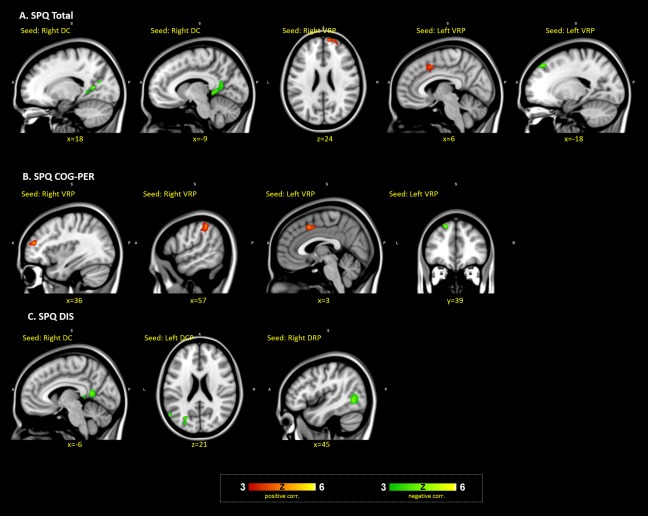
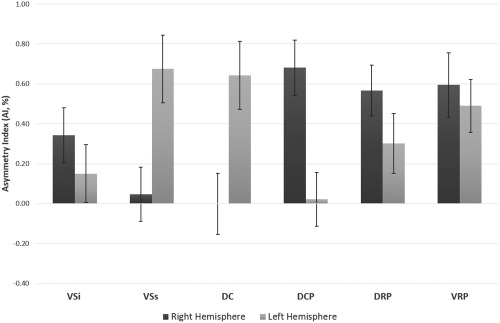
Altered striatocortical functional connectivity has been suggested to be a trait marker of schizophrenia spectrum disorders, including schizotypal personality. In the present study, we examined the association between schizotypal personality traits and striatocortical functional connectivity in a sample of healthy adults. The German version of the Schizotypal Personality Questionnaire was obtained from N = 111 participants recruited from the general public. Resting-state functional magnetic resonance imaging scans were acquired at 3T. Six striatal seed regions in each hemisphere were defined and striatocortical resting-state functional connectivity (rsFC) as well as its lateralization indices was calculated. Regression analysis showed that schizotypy scores, especially from the positive dimension, were positively correlated with rsFC between ventral striatum and frontal cortex and negatively associated with rsFC between dorsal striatum and posterior cingulate. No significant associations were found between negative dimension schizotypy and striatocortical rsFC. We also found positive correlations between schizotypy total scores and lateralization index of right dorsal caudate and right rostral putamen. In conclusion, the present study extends previous evidence of altered striatocortical rsFC in the schizophrenia spectrum. The observed associations resemble in part the alterations observed in psychotic patients and their relatives, providing support for dimensionality from schizotypal personality to the clinical disorder. Hum Brain Mapp 39:288-299, 2018. © 2017 Wiley Periodicals, Inc.
Keywords: connectivity; functional magnetic resonance imaging; lateralization; resting state; schizotypy; striatum.
© 2017 Wiley Periodicals, Inc.
Conflict of interest statement
The authors declare no conflict of interest.
Figures
References
-
- Ahsan RL, Allom R, Gousias IS, Habib H, Turkheimer FE, Free S, Lemieux L, Myers R, Duncan JS, Brooks DJ, Koepp MJ, Hammers A (2007): Volumes, spatial extents and a probabilistic atlas of the human basal ganglia and thalamus. NeuroImage 38:261–270. - PubMed
-
- Aichert DS, Williams SCR, Möller HJ, Kumari V, Ettinger U (2012): Functional neural correlates of psychometric schizotypy: An fMRI study of antisaccades. Psychophysiology 49:345–356. - PubMed
-
- Alexander GE, Crutcher MD, DeLong MR (1990): Basal ganglia‐thalamocortical circuits: Parallel substrates for motor, oculomotor, “prefrontal” and “limbic” functions. Prog Brain Res 85:119–146. - PubMed
-
- Ashburner J (2007): A fast diffeomorphic image registration algorithm. NeuroImage 38:95–113. - PubMed
Publication types
MeSH terms
LinkOut - more resources
Full Text Sources
Other Literature Sources
