


Hepatic artery aneurysm causing gastrointestinal haemorrhage - Case report and literature review
- PMID: 29024839
- PMCID: PMC5742007
- DOI: 10.1016/j.ijscr.2017.08.067
Hepatic artery aneurysm causing gastrointestinal haemorrhage - Case report and literature review
Abstract
Introduction: True hepatic artery aneurysms (HAAs) are rare, and when complicated by gastrointestinal haemorrhage, it becomes an even rarer disease entity. The mortality is high and imaging may fail to provide the diagnosis. We present a case of a true hepatic artery aneurysm complicated by a fistula to the duodenum which was first recognised during surgery.
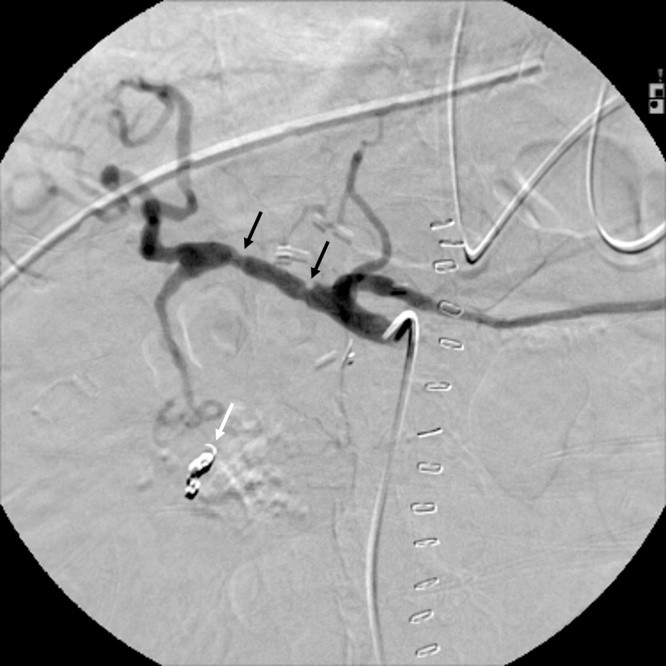
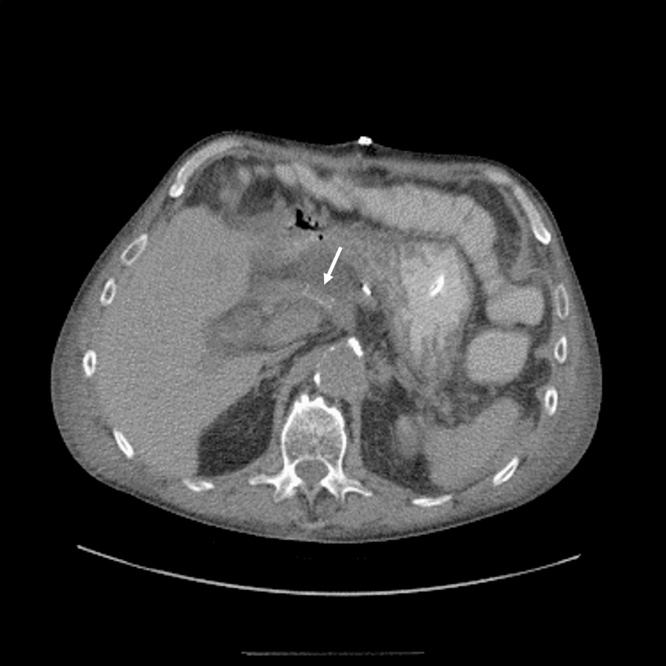
Presentation of case: A 77-year-old man presented with upper gastrointestinal haemorrhage. Upper endoscopy revealed an ulceration in the duodenal bulb, which was refractory to endoscopic treatment. Computed tomography and angiography did not reveal the source of haemorrhage and as such, the diagnosis was delayed, until laparotomy was performed. Resection of the HAA and graft placement resulted in complete haemostasis.
Discussion: True hepatic aneurysms communicating with the gastrointestinal tract have only been presented in case reports and short case series. Arteriosclerosis is a relatively common risk factor, but the underlying pathology is unknown. Meanwhile, gastrointestinal haemorrhage is a symptom of other, more common diseases in the gastrointestinal tract, and these factors, complicate the diagnostic workup.
Conclusion: In the case of treatment refractory duodenal haemorrhage, a visceral aneurysm should be considered. Even though angiography is performed, a HAA may remain undetected due to bleeding cessation. Improved computed tomography modalities could aid in the detection of gastrointestinal haemorrhage from HAAs, and ensure timely treatment by endovascular methods or surgery if the diagnosis is kept in mind in the initial evaluation.
Keywords: Case-report; Endovascular treatment; Gastrointestinal haemorrhage; Hepatic artery aneurysm; Radiological detection.
Copyright © 2017 The Authors. Published by Elsevier Ltd.. All rights reserved.
Figures

References
-
- Arneson M.A., Smith R.S. Ruptured hepatic artery aneurysm: case report and review of literature. Ann. Vasc. Surg. 2005;(July):540–545. - PubMed
-
- Abbas M.A., Fowl R.J., Stone W.M., Panneton J.M., Oldenburg W.A., Bower T.C. Hepatic artery aneurysm: factors that predict complications. J. Vasc. Surg. 2003;(July):41–45. - PubMed
-
- Shanley C.J., Shah N.L., Messina L.M. Common splanchnic artery aneurysms: splenic, hepatic, and celiac. Ann. Vasc. Surg. 1996;(May):315–322. - PubMed
-
- Werner C., Bonnevie B. Gastrointestinal bleeding from a fistula between an aneurysm of the hepatic artery and the pancreatic duct. Eur. J. Vasc. Surg. 1993;(January):95–97. - PubMed
LinkOut - more resources
Full Text Sources
Other Literature Sources
Research Materials
