


Brain energetics during the sleep-wake cycle
- PMID: 29024871
- PMCID: PMC5732842
- DOI: 10.1016/j.conb.2017.09.010
Brain energetics during the sleep-wake cycle
Abstract
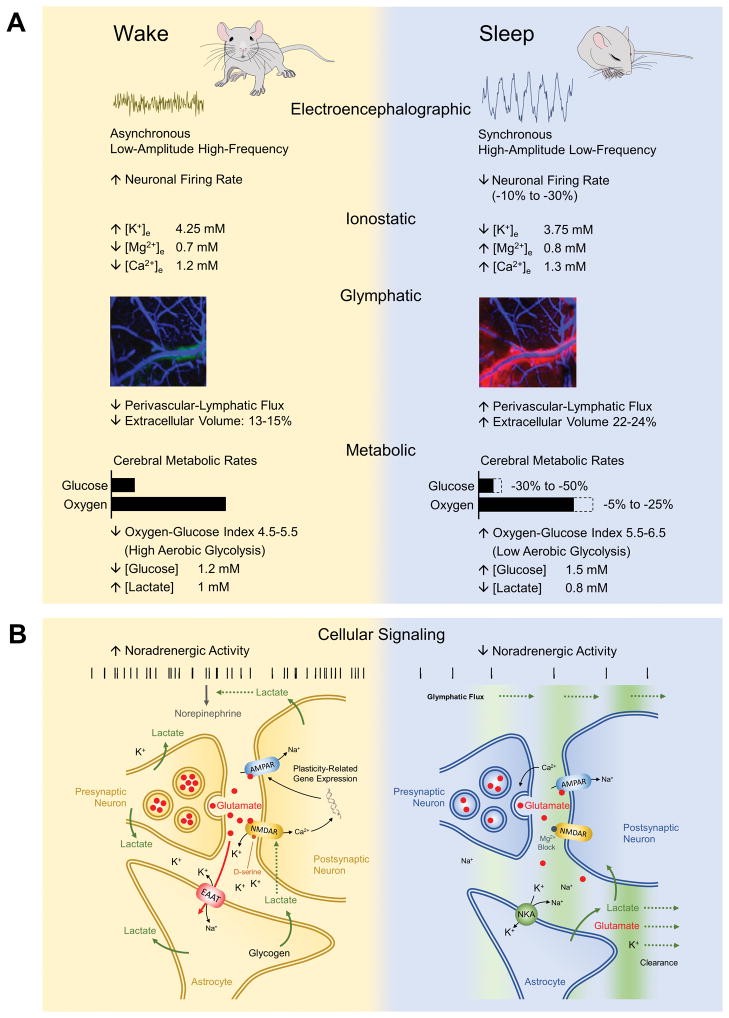
Brain activity during wakefulness is associated with high metabolic rates that are believed to support information processing and memory encoding. In spite of loss of consciousness, sleep still carries a substantial energy cost. Experimental evidence supports a cerebral metabolic shift taking place during sleep that suppresses aerobic glycolysis, a hallmark of environment-oriented waking behavior and synaptic plasticity. Recent studies reveal that glial astrocytes respond to the reduction of wake-promoting neuromodulators by regulating volume, composition and glymphatic drainage of interstitial fluid. These events are accompanied by changes in neuronal discharge patterns, astrocyte-neuron interactions, synaptic transactions and underlying metabolic features. Internally-generated neuronal activity and network homeostasis are proposed to account for the high sleep-related energy demand.
Copyright © 2017 Elsevier Ltd. All rights reserved.
Conflict of interest statement
Nothing declared.
Figures
References
-
- Harris JJ, Jolivet R, Attwell D. Synaptic energy use and supply. Neuron. 2012;75:762–777. - PubMed
-
- Stender J, Mortensen KN, Thibaut A, Darkner S, Laureys S, Gjedde A, Kupers R. The Minimal Energetic Requirement of Sustained Awareness after Brain Injury. Curr Biol. 2016;26:1494–1499. In vivo human [18F]-fluorodeoxyglucose positron-emission tomography study of patients in minimally conscious state and unresponsive wakefulness syndrome as well as healthy subjects. The specific amount of glucose utilization required to sustain conscious awareness was identified as 42% of the healthy control value. This result reveals that the energy expended by the brain during wakefulness is due to processes (e.g., information processing) that operate beyond the function of supporting consciousness. - PubMed
-
- Wehr TA. A brain-warming function for REM sleep. Neuroscience & Biobehavioral Reviews. 1992;16:379–397. - PubMed
Publication types
MeSH terms
Grants and funding
LinkOut - more resources
Full Text Sources
Other Literature Sources
