


Physical activity, mediating factors and risk of colon cancer: insights into adiposity and circulating biomarkers from the EPIC cohort
- PMID: 29025032
- PMCID: PMC6241846
- DOI: 10.1093/ije/dyx174
Physical activity, mediating factors and risk of colon cancer: insights into adiposity and circulating biomarkers from the EPIC cohort
Abstract
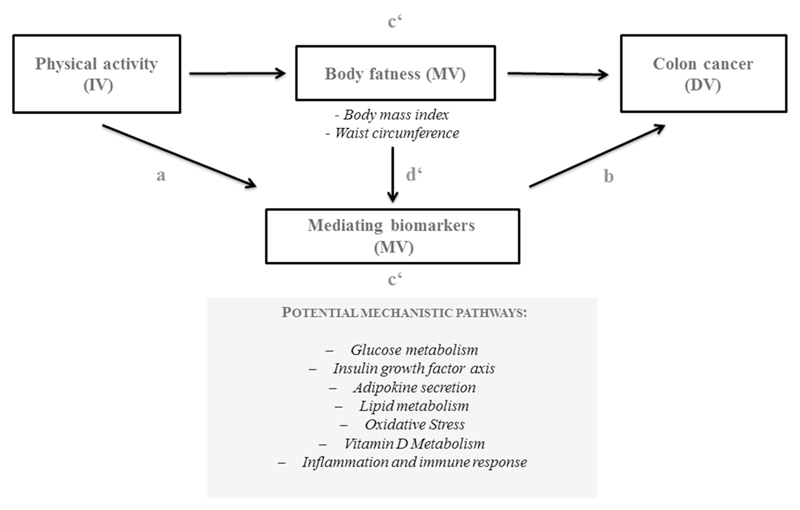
Background: There is convincing evidence that high physical activity lowers the risk of colon cancer; however, the underlying biological mechanisms remain largely unknown. We aimed to determine the extent to which body fatness and biomarkers of various biologically plausible pathways account for the association between physical activity and colon cancer.
Methods: We conducted a nested case-control study in a cohort of 519 978 men and women aged 25 to 70 years followed from 1992 to 2003. A total of 713 incident colon cancer cases were matched, using risk-set sampling, to 713 controls on age, sex, study centre, fasting status and hormonal therapy use. The amount of total physical activity during the past year was expressed in metabolic equivalent of task [MET]-h/week. Anthropometric measurements and blood samples were collected at study baseline.
Results: High physical activity was associated with a lower risk of colon cancer: relative risk ≥91 MET-h/week vs <91 MET-h/week = 0.75 [95% confidence interval (CI): 0.57 to 0.96]. In mediation analyses, this association was accounted for by waist circumference: proportion explained effect (PEE) = 17%; CI: 4% to 52%; and the biomarkers soluble leptin receptor (sOB-R): PEE = 15%; 95% CI: 1% to 50% and 5-hydroxyvitamin D (25[OH]D): PEE = 30%; 95% CI: 12% to 88%. In combination, these factors explained 45% (95% CI: 20% to 125%) of the association. Beyond waist circumference, sOB-R and 25[OH]D additionally explained 10% (95% CI: 1%; 56%) and 23% (95% CI: 6%; 111%) of the association, respectively.
Conclusions: Promoting physical activity, particularly outdoors, and maintaining metabolic health and adequate vitamin D levels could represent a promising strategy for colon cancer prevention.
Keywords: Physical activity; adiposity; biomarkers; colon cancer; mediating factors.
© The Author 2017; all rights reserved. Published by Oxford University Press on behalf of the International Epidemiological Association
Conflict of interest statement
None of the funders/sponsors had any role in the design and conduct of the study; collection, management, analysis, and interpretation of the data; and preparation, review, or approval of the manuscript; and decision to submit the manuscript for publication. The authors disclose no potential conflicts of interest related to this study.
We would like to express special thanks to Ellen Kohlsdorf (EPIC-Potsdam, Germany) and Bertrand Hemon (IARC-France) for their work on data management and technical assistance. We thank all participants in the EPIC study for their outstanding cooperation. Persons named in the acknowledgement have confirmed their agreement.
Data sharing: For information on how to submit an application for gaining access to EPIC data and/or biospecimens, please follow the instructions at
Figures
References
-
- de Vries E, Soerjomataram I, Lemmens VE, Coebergh JW, Barendregt JJ, Oenema A, et al. Lifestyle changes and reduction of colon cancer incidence in Europe: A scenario study of physical activity promotion and weight reduction. European journal of cancer. 2010;46(14):2605–16. doi: 10.1016/j.ejca.2010.07.040. - DOI - PubMed
-
- Kyu HH, Bachman VF, Alexander LT, Mumford JE, Afshin A, Estep K, et al. Physical activity and risk of breast cancer, colon cancer, diabetes, ischemic heart disease, and ischemic stroke events: systematic review and dose-response meta-analysis for the Global Burden of Disease Study 2013. Bmj. 2016;354:i3857. doi: 10.1136/bmj.i3857. - DOI - PMC - PubMed
Publication types
MeSH terms
Substances
Grants and funding
LinkOut - more resources
Full Text Sources
Other Literature Sources
Medical
Miscellaneous
