


Preparing the prescription: a review of the aim and measurement of social referral programmes
- PMID: 29025843
- PMCID: PMC5652530
- DOI: 10.1136/bmjopen-2017-017734
Preparing the prescription: a review of the aim and measurement of social referral programmes
Abstract
Objective: Our aim is to review, and qualitatively evaluate, the aims and measures of social referral programmes. Our first objective is to identify the aims of social referral initiatives. Our second objective is to identify the measures used to evaluate whether the aims of social referral were met.
Design: Literature review.
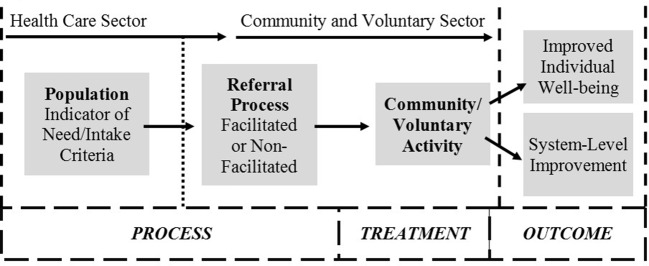
Background: Social referral programmes, also called social prescribing and emergency case referral, link primary and secondary healthcare with community services, often under the guise of decreasing health system costs.
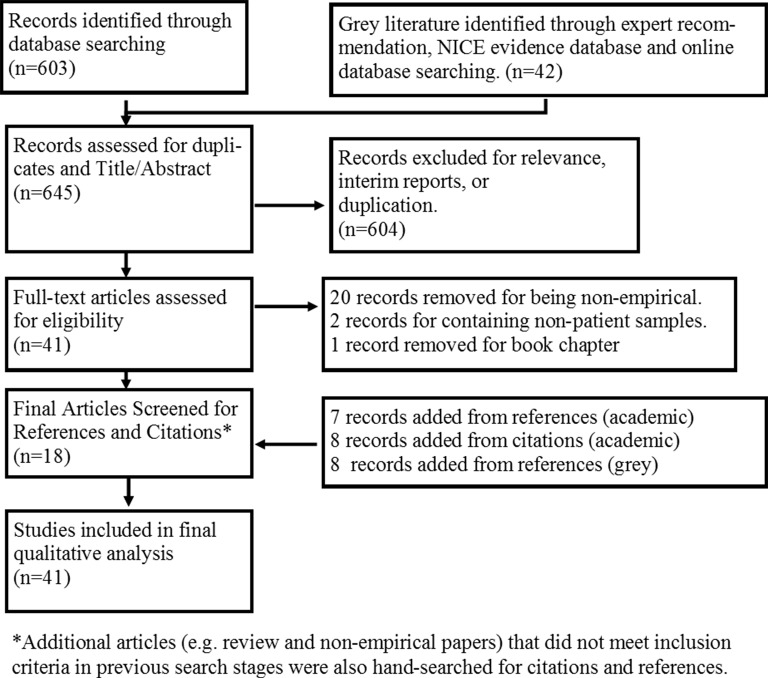
Method: Following the PRISMA guidelines, we undertook a literature review to address that aim. We searched in five academic online databases and in one online non-academic search engine, including both academic and grey literature, for articles referring to 'social prescribing' or 'community referral'.
Results: We identified 41 relevant articles and reports. After extracting the aims, measures and type of study, we found that most social referral programmes aimed to address a wide variety of system and individual health problems. This included cost savings, resource reallocation and improved mental, physical and social well-being. Across the 41 studies and reports, there were 154 different kinds of measures or methods of evaluation identified. Of these, the most commonly used individual measure was the Warwick-Edinburgh Mental Well-being Scale, used in nine studies and reports.
Conclusions: These inconsistencies in aims and measures used pose serious problems when social prescribing and other referral programmes are often advertised as a solution to health services-budgeting constraints, as well as a range of chronic mental and physical health conditions. We recommend researchers and local community organisers alike to critically evaluate for whom, where and why their social referral programmes 'work'.
Keywords: Health Services Research; Literature Review; Social Medicine; Social Prescribing; Social Referral.
© Article author(s) (or their employer(s) unless otherwise stated in the text of the article) 2017. All rights reserved. No commercial use is permitted unless otherwise expressly granted.
Conflict of interest statement
Competing interests: None declared.
Figures
References
-
- Marmot M. UCL Institute of Health Equity. Review of social determinants and the health divide in the WHO European Region: final report. Copenhagen: WHO Regional Office for Europe, 2014.
-
- Marmot MG, Stansfeld S, Patel C, et al. Health inequalities among British civil servants: the Whitehall II study. The Lancet 1991;337:1387–93. - PubMed
-
- Kimberlee R, Ward R, Jones M, et al. Proving our value: Measuring the economic impact of Wellspring Health Living Centre’s social prescribing Wellbeing Programme for low level mental health issues encountered by GP services. Bristol: University of the West of England, 2014.
Publication types
MeSH terms
LinkOut - more resources
Full Text Sources
Other Literature Sources
Miscellaneous
