. 2017 Oct 12;8(1):899.
doi: 10.1038/s41467-017-00916-7.

Binary temporal upconversion codes of Mn2+-activated nanoparticles for multilevel anti-counterfeiting

Affiliations

Binary temporal upconversion codes of Mn2+-activated nanoparticles for multilevel anti-counterfeiting

Xiaowang Liu et al. Nat Commun. .

Abstract

Optical characteristics of luminescent materials, such as emission profile and lifetime, play an important role in their applications in optical data storage, document security, diagnostics, and therapeutics. Lanthanide-doped upconversion nanoparticles are particularly suitable for such applications due to their inherent optical properties, including large anti-Stokes shift, distinguishable spectroscopic fingerprint, and long luminescence lifetime. However, conventional upconversion nanoparticles have a limited capacity for information storage or complexity to prevent counterfeiting. Here, we demonstrate that integration of long-lived Mn2+ upconversion emission and relatively short-lived lanthanide upconversion emission in a particulate platform allows the generation of binary temporal codes for efficient data encoding. Precise control of the particle's structure allows the excitation feasible both under 980 and 808 nm irradiation. We find that the as-prepared Mn2+-doped nanoparticles are especially useful for multilevel anti-counterfeiting with high-throughput rate of authentication and without the need for complex time-gated decoding instrumentation.Luminescent materials that are capable of binary temporal coding are desirable for multilevel anti-counterfeiting. Here, the authors engineer nanoparticles that produce binary color codes on different timescales by combining the long-lived luminescence of Mn2+ with the relatively short-lived emission of lanthanides.


Conflict of interest statement

The authors declare no competing financial interests.

Figures
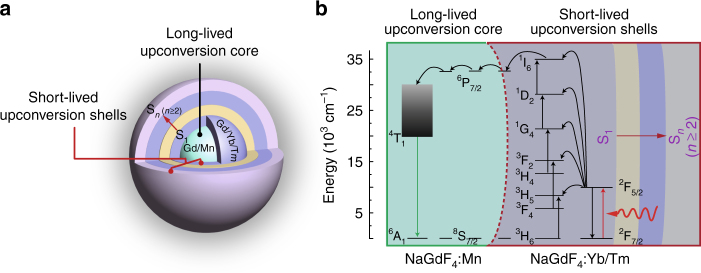
Fig. 1
Fig. 1
Rational design of binary temporal upconversion codes through Mn2+ codoping. a Structure design of a multilayer nanoparticle for simultaneously displaying short- and long-lived upconversion emissions. Noted that NaGdF4:Mn(30 mol%) and NaGdF4:Yb/Tm(49/1 mol%) are exploited as core and first shell (S1) of the multilayer nanoparticle to achieve long-lived Mn2+ luminescence through Gd-sublattice-mediated energy migration. Other characteristic lanthanide emissions from the nanoparticle can be realized by further coating additional shell layers (Sn) with different lanthanide compositions: strategy i S2 = NaYF4, ii S2 = NaYF4:A (A = Eu3+, Eu3+/Tb3+ or Tb3+), iii S2 = NaYF4, S3 = NaYF4:Yb/Er (5/0.05, 20/2 or 50/0.05 mol%), iv S2 = NaYF4:Nd (20 mol%), S3 = NaYF4:Nd/Yb/Er(1/30/0.5 or 2/10/1 mol%), and v S2 = NaYF4, S3 = NaYF4:Nd (20 mol%), S4 = NaYF4:Nd/Yb/Er(2/10/1 mol%). b Proposed energy transfer pathway between the core and shell layers accounting for the simultaneous generation of short- and long-lived upconversion luminescence under excitation at 980 nm
Fig. 2
Fig. 2
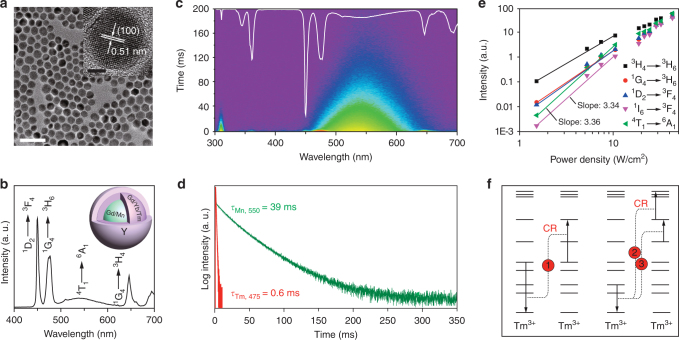
Characterization of multilayer nanoparticles of NaGdF4:Mn (30 mol%)@NaGdF4:Yb/Tm (49/1 mol%)@NaYF4. a TEM image of the as-prepared upconversion nanoparticles, scale bar, 50 nm. (Inset: high-resolution TEM imaging of a single core-shell-shell nanoparticle, scale bar, 5 nm). b Emission profile of the as-prepared nanoparticles under excitation at 980 nm (power density: 30 W cm−2). c Time-resolved spectrum of the as-prepared Mn2+-doped upconversion nanoparticles. d Lifetime comparison of Mn2+ emission (550 nm, 4T1 → 6A1) and Tm3+ (475 nm, 1D2 → 3F4) of the as-prepared Mn2+-doped nanoparticles recorded in aqueous solution at room temperature. e Power density dependence of the upconverted Tm3+ and Mn2+ emissions. Note that the slopes of power-dependent emission centered at 345 nm for Tm3+ and at 550 nm for Mn2+ are measured to be 3.34 and 3.36, respectively. f Proposed cross-relaxation (CR) processes between two neighboring Tm3+ ions, accounting for the experimentally observed lower exponential power dependence of the Tm3+ and Mn2+ emissions
Fig. 3
Fig. 3
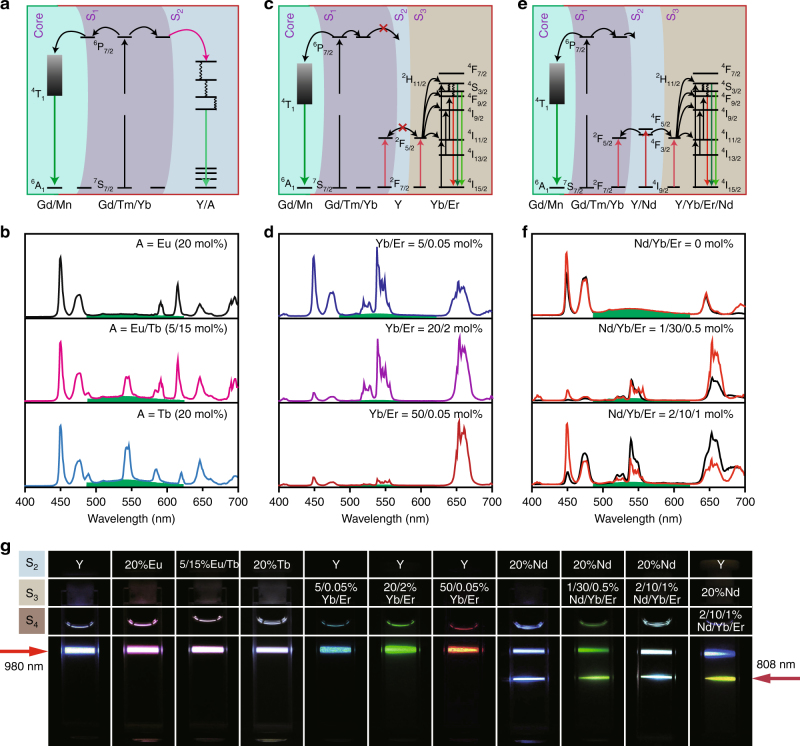
Synthetic strategies for tuning short-lived upconversion emission. a Doping of lanthanide activators (A = Eu3+, Eu3+/Tb3+ or Tb3+) into the outmost shell (S2) of NaYF4 to realize interfacial energy transfer. In contrast to energy migration strategy, interfacial energy transfer mainly occurs at the interface and has less effect on the Mn2+ luminescence. b Representative emission profiles of the as-prepared NaGdF4:Mn(30 mol%)@NaGdF4:Yb/Tm(49/1 mol%)@NaYF4:A (A = Eu3+, Eu3+/Tb3+ or Tb3+) nanoparticles. c Strategy involving the addition of NaYF4 (S2) and NaYF4:Yb/Er (S3) layers. Note that the emission dependence of the NaYF4:Yb/Er shell on the relative doping level of Yb/Er provides an additional means to modulate the emission color of the nanoparticles. d Emission profiles of the as-prepared NaGdF4:Mn(30 mol%)@NaGdF4:Yb/Tm(49/1 mol%)@NaYF4@NaYF4:Yb/Er(5/0.05, 20/2 or 50/0.05) nanoparticles. e Doping of Nd3+ into the NaYF4 shell (S2) allows the excitation to be carried out either under 980 or 808 nm. Notably, the small-sized and curved arrow between S1 and S2 layers is used to represent a much weaker interfacial energy transfer from Gd3+ to Nd3+ relative to energy migration from Gd3+ in the S1 layer to Mn2+ in the core. f Emission spectra of NaGdF4:Mn(30 mol%)@NaGdF4:Yb/Tm(49/1 mol%)@NaYF4:Nd(20 mol%) nanoparticles and the corresponding multilayer nanoparticles passivated with NaYF4:Nd/Yb/Er (x mol%) (x = 1/30/0.5 or 2/10/1) under excitation at 980 (red curve) and 808 nm (black curve). The pump powers of the 980 and 808 nm lasers were fixed at 1 and 4 W for spectral measurement, respectively. g Luminescence photographs showing multicolour tuning of the steady upconversion of the as-prepared nanoparticles under excitation at 980 or 808 nm. The energy transfer from Nd3+  → Yb3+  → Tm3+  → Gd3+  → Mn2+ under excitation at 808 nm can be largely suppressed by growth of an inert shell between NaYF4:Nd (20 mol%) and NaGdF4:Yb/Tm(49/1 mol%), and thus different color outputs can be generated upon excitation at 980 and 808 nm (Supplementary Fig. 19)
Fig. 4
Fig. 4
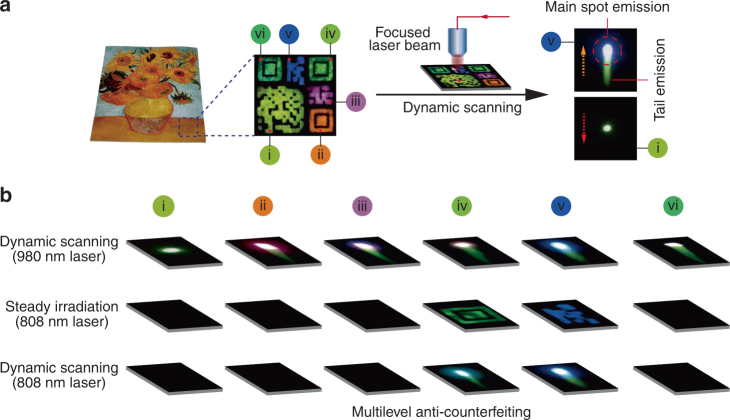
Multilevel anti-counterfeiting application with Mn2+-activated core-shell nanoparticles. a General design of the 2D patterns (i to vi) made with nanoparticles of different composition. Steady irradiation with a 980 nm laser (6 W cm−2) leads to multicolor features of the patterns, while dynamic scanning of the patterns with a focused laser beam (64 W cm−2) gives rise to a different scenario. Unlike purely lanthanide-doped nanoparticles with only a bright spot of emission emerging from pattern i under the dynamic scanning, the as-prepared Mn2+-doped nanoparticles show a bright spot of emission with a green-colored tail from pattern v. b Emission profiles of the patterns recorded under different irradiation conditions. Each pattern varies significantly in emission color under dynamic scanning at 980 nm. Steady irradiation or dynamic scanning at 808 nm of the patterns iv and v, made with Nd3+-sensitized nanoparticles, can provide a similar level of readout to that on 980 excitation. Nanoparticles used for generating the patterns: i NaYF4:Yb/Er (20/2 mol%); ii NaGdF4:Mn (30 mol%)@NaGdF4:Yb/Tm (49/1 mol%)@NaYF4@NaYF4:Yb/Er (50/0.05 mol%); iii NaGdF4:Mn (30 mol%)@NaGdF4:Yb/Tm(49/1 mol%)@NaYF4:Eu(20 mol%); iv NaGdF4:Mn(30 mol%)@NaGdF4:Yb/Tm(49/1 mol%)@NaYF4:Nd(20 mol%)@NaYF4:Nd/Yb/Er(2/10/1 mol%); v NaGdF4:Mn(30 mol%)@NaGdF4:Yb/Tm(49/1 mol%)@NaYF4:Nd(20 mol%); and vi NaGdF4:Mn(30 mol%)@NaGdF4:Yb/Tm(49/1 mol%)@NaYF4@NaYF4:Yb/Er(5/0.05 mol%)

References

    1. Höppe HA. Recent developments in the field of inorganic phosphors. Angew. Chem. Int. Ed. 2009;48:3572–3582. doi: 10.1002/anie.200804005. - DOI - PubMed
    1. Bünzli JCG, Piguet C. Taking advantage of luminescent lanthanide ions. Chem. Soc. Rev. 2005;34:1048–1077. doi: 10.1039/b406082m. - DOI - PubMed
    1. Gai S, Li C, Yang P, Lin J. Recent progress in rare earth micro/nanocrystals: soft chemical synthesis, luminescent properties, and biomedical applications. Chem. Rev. 2014;114:2343–2389. doi: 10.1021/cr4001594. - DOI - PubMed
    1. Chen G, Qiu H, Prasad PN, Chen X. Upconversion nanoparticles: design, nanochemistry, and applications in theranostics. Chem. Rev. 2014;114:5161–5214. doi: 10.1021/cr400425h. - DOI - PMC - PubMed
    1. Zhou L, et al. Single-band upconversion nanoprobes for multiplexed simultaneous in situ molecular mapping of cancer biomarkers. Nat. Commun. 2015;6:6938. doi: 10.1038/ncomms7938. - DOI - PMC - PubMed

Publication types