Review
. 2017 Aug 31:6:1620.
doi: 10.12688/f1000research.11976.1. eCollection 2017.

Protein clustering for cell polarity: Par-3 as a paradigm

Affiliations
Review

Protein clustering for cell polarity: Par-3 as a paradigm

Tony J C Harris. F1000Res. .

Abstract

The scaffold protein Par-3 ( Drosophila Bazooka) is a central organizer of cell polarity across animals. This review focuses on how the clustering of Par-3 contributes to cell polarity. It begins with the Par-3 homo-oligomerization mechanism and its regulation by Par-1 phosphorylation. The role of polarized cytoskeletal networks in distributing Par-3 clusters to one end of the cell is then discussed, as is the subsequent maintenance of polarized Par-3 clusters through hindered mobility and inhibition from the opposite pole. Finally, specific roles of Par-3 clusters are reviewed, including the bundling of microtubules, the cortical docking of centrosomes, the growth and positioning of cadherin-catenin clusters, and the inhibition of the Par-6-aPKC kinase cassette. Examples are drawn from Drosophila, Caenorhabditis elegans, mammalian cell culture, and biochemical studies.

Keywords: Par-3 clusters; Protein clustering; cell polarity.


Conflict of interest statement

Competing interests: The author declares that he has no competing interests.No competing interests were disclosed.No competing interests were disclosed.No competing interests were disclosed.

Figures
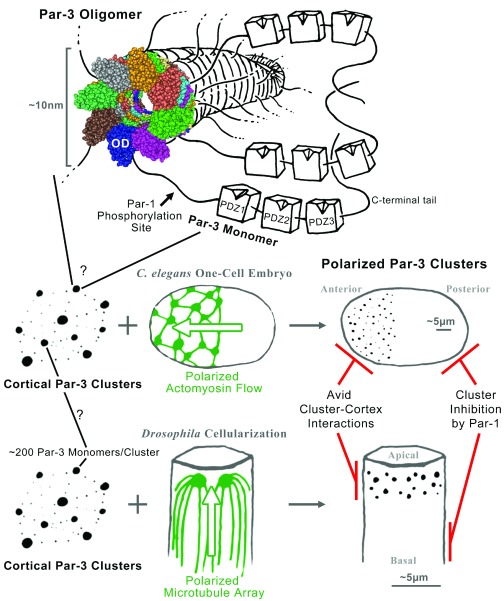
Figure 1.
Figure 1.. The organization and polarization of Par-3 clusters.
The oligomerization domain of a Par-3 monomer mediates the formation of a helical fiber from which the linker regions and PDZ domains of Par-3 would emanate like branches of a tree. The space-filling structural model is a Cn3D view of the model of Zhang et al. (PDB: 3ZEE) . Somehow these fibers are organized into local Par-3 clusters scattered across the cell cortex. In the Caenorhabditis elegans one-cell embryo, a polarized actomyosin flow sweeps the Par-3 puncta to one pole, forming the anterior end of the embryo. In the cellularizing Drosophila embryo, a polarized microtubule array positions the Par-3 puncta to one end of each cell, forming the apicolateral domain. Once the polarity of Par-3 clusters is established, it can be maintained by avid interactions between the clusters and the cell cortex combined with inhibition of Par-3 complex formation at the opposite pole by Par-1 phosphorylation. See main text for further details.

References

    1. Goldstein B, Macara IG: The PAR proteins: fundamental players in animal cell polarization. Dev Cell. 2007;13(5):609–22. 10.1016/j.devcel.2007.10.007 - DOI - PMC - PubMed
    2. F1000 Recommendation

    1. St Johnston D, Ahringer J: Cell polarity in eggs and epithelia: parallels and diversity. Cell. 2010;141(5):757–74. 10.1016/j.cell.2010.05.011 - DOI - PubMed
    1. Tepass U: The apical polarity protein network in Drosophila epithelial cells: regulation of polarity, junctions, morphogenesis, cell growth, and survival. Annu Rev Cell Dev Biol. 2012;28:655–85. 10.1146/annurev-cellbio-092910-154033 - DOI - PubMed
    1. Martin SG, Arkowitz RA: Cell polarization in budding and fission yeasts. FEMS Microbiol Rev. 2014;38(2):228–53. 10.1111/1574-6976.12055 - DOI - PubMed
    2. F1000 Recommendation

    1. Nelson WJ: Adaptation of core mechanisms to generate cell polarity. Nature. 2003;422(6933):766–74. 10.1038/nature01602 - DOI - PMC - PubMed

LinkOut - more resources