


Endoscopic ultrasound-guided fine needle aspiration of pancreatic lesions with 22 versus 25 Gauge needles: A meta-analysis
- PMID: 29026598
- PMCID: PMC5625867
- DOI: 10.1177/2050640616680972
Endoscopic ultrasound-guided fine needle aspiration of pancreatic lesions with 22 versus 25 Gauge needles: A meta-analysis
Abstract
Background: Robust data in favour of a clear superiority of 22 versus 25 Gauge needles for endoscopic ultrasound-guided fine needle aspiration are still lacking.
Objective: We aimed to compare the diagnostic sensitivity, specificity and safety of these two needles for endoscopic ultrasound-guided fine needle aspiration of solid pancreatic lesions.
Methods: A computerized bibliographic search was restricted to randomized controlled trials only. Pooled effects were calculated using a random-effects model and expressed in terms of risk ratio and 95% confidence interval.
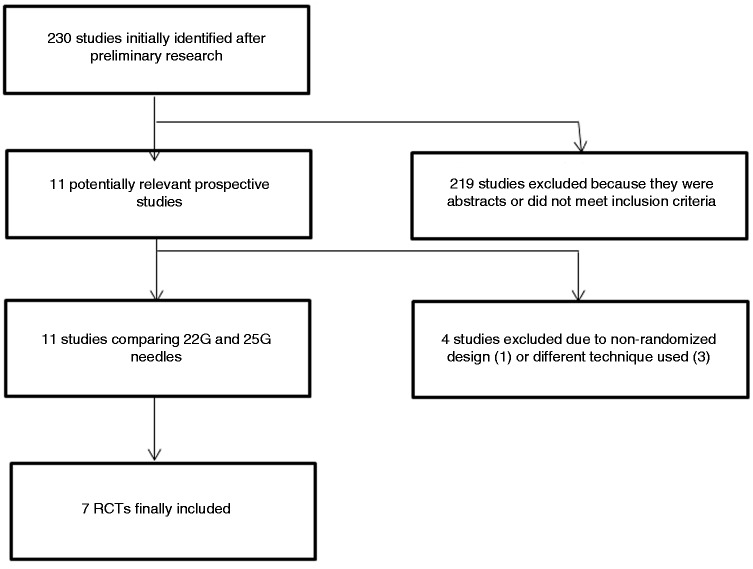
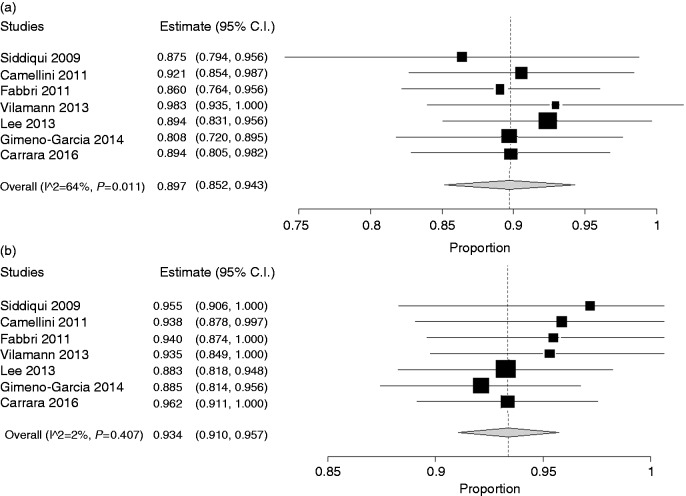
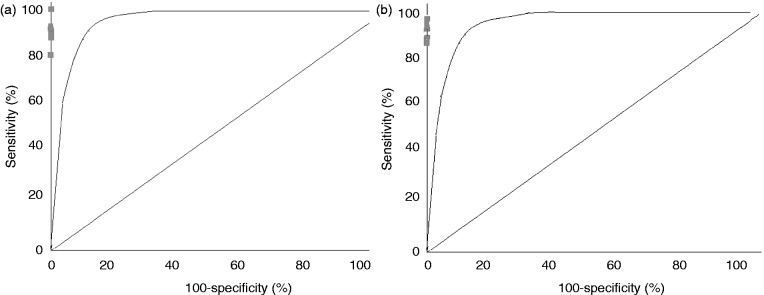
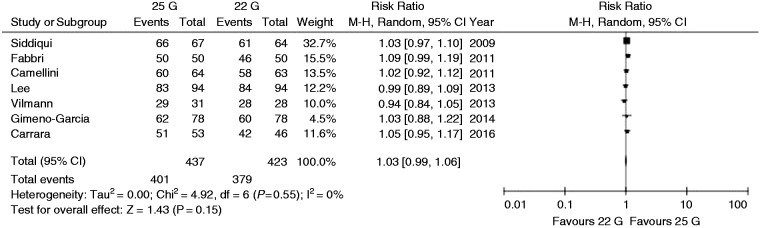
Results: We analysed seven trials with 689 patients and 732 lesions (295 sampled with 22 Gauge needle, 309 with 25 Gauge needle, and 128 with both needles). A non-significant superiority of 25 Gauge in terms of pooled sensitivity (risk ratio: 0.93, 0.91-0.95 versus 0.89, 0.85-0.94 of 22 Gauge needle; p = 0.13) and no difference in terms of specificity (1.00, 0.98-1.00 in both groups; p = 0.85) were observed. Sample adequacy was similar between the two devices (risk ratio: 1.03, 0.99-1.06; p = 0.15). Very few adverse events were observed and did not impact on patient outcomes.
Conclusion: Our meta-analysis reveals non-superiority of 25 Gauge over 22 Gauge; hence no definitive recommendations over the use of one particular device can be made.
Keywords: EUS; FNA; pancreas; sensitivity; specificity.
Figures

References
LinkOut - more resources
Full Text Sources
Other Literature Sources
Molecular Biology Databases
