Review
. 2017 Jul 4;3(8):e000124.
doi: 10.1099/mgen.0.000124. eCollection 2017 Aug.

Comparison of classical multi-locus sequence typing software for next-generation sequencing data

Affiliations
Review

Comparison of classical multi-locus sequence typing software for next-generation sequencing data

Andrew J Page et al. Microb Genom. .

Abstract

Multi-locus sequence typing (MLST) is a widely used method for categorizing bacteria. Increasingly, MLST is being performed using next-generation sequencing (NGS) data by reference laboratories and for clinical diagnostics. Many software applications have been developed to calculate sequence types from NGS data; however, there has been no comprehensive review to date on these methods. We have compared eight of these applications against real and simulated data, and present results on: (1) the accuracy of each method against traditional typing methods, (2) the performance on real outbreak datasets, (3) the impact of contamination and varying depth of coverage, and (4) the computational resource requirements.

Keywords: MLST; multi-locus sequence typing; next-generation sequencing; software comparison.


Figures
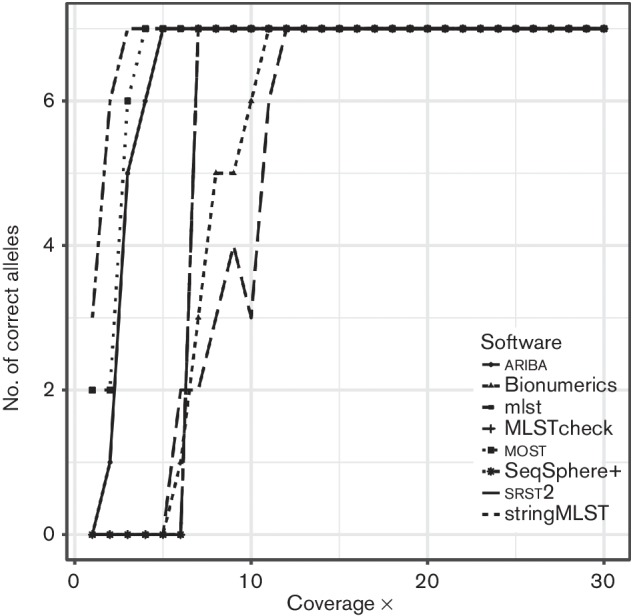
Fig. 1.
Fig. 1.
Number of correct calls of each application as coverage increases. Each ST consists of seven alleles, and all seven must be correctly and confidently called to calculate a ST.
Fig. 2.
Fig. 2.
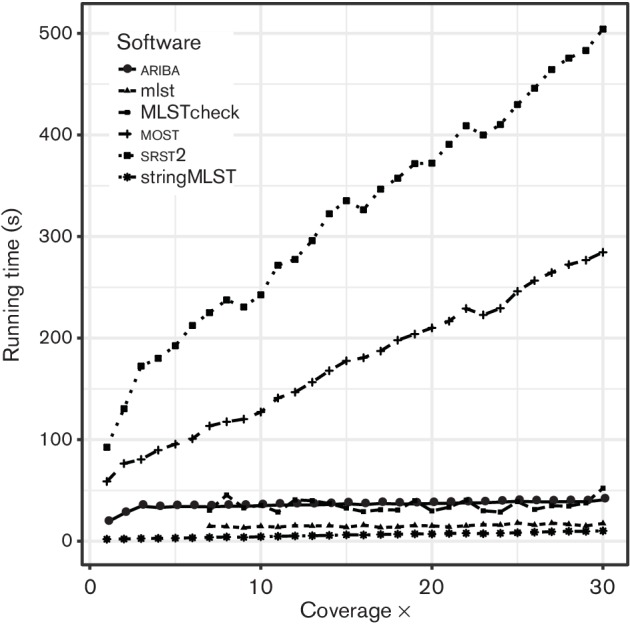
Running time (s) of each application as the coverage increases to assess the impact of the depth of coverage. No assembled contiguous sequences could be generated where the coverage was less than 7×, as such no data was recorded for the reliant methods (mlst and MLSTcheck). No performance results are available for BioNumerics or SeqSphere+.
Fig. 3.
Fig. 3.
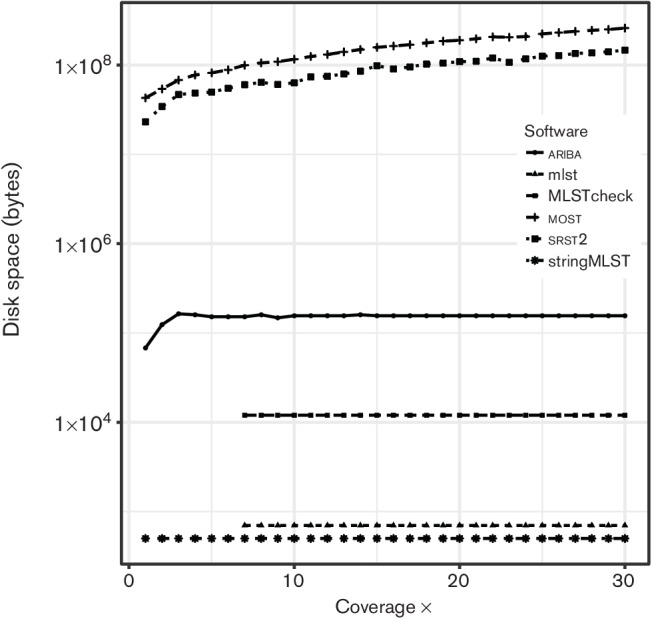
Disk space requirements in bytes for each software application as the depth of coverage increases. Due to the large difference between applications, a log scale is used.
Fig. 4.
Fig. 4.
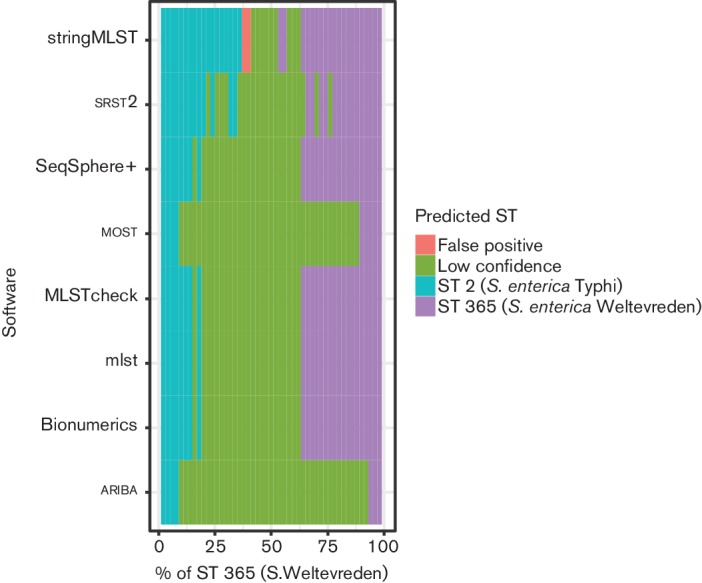
STs called by each software application when given data containing two different Salmonella samples in varying ratios of abundance. Where there is no ST called, or where the ST has any ambiguity at all, it is marked as low confidence. A false positive is where an ST is called with high confidence and is not one of the two samples in the raw data.

References

    1. Silk BJ, Mahon BE, Griffin PM, Gould LH, Tauxe R, V, et al. Vital signs: listeria illnesses, deaths, and outbreaks - United States, 2009–2011. Morb Mortal Wkly Rep. 2013;62:448–452. - PMC - PubMed
    1. Siegman-Igra Y, Levin R, Weinberger M, Golan Y, Schwartz D, et al. Listeria monocytogenes infection in Israel and review of cases worldwide. Emerg Infect Dis. 2002;8:305–310. doi: 10.3201/eid0803.010195. - DOI - PMC - PubMed
    1. Scharff RL, Besser J, Sharp DJ, Jones TF, Peter GS, et al. An economic evaluation of PulseNet: a network for foodborne disease surveillance. Am J Prev Med. 2016;50:S66–73. doi: 10.1016/j.amepre.2015.09.018. - DOI - PubMed
    1. Ragon M, Wirth T, Hollandt F, Lavenir R, Lecuit M, et al. A new perspective on Listeria monocytogenes evolution. PLoS Pathog. 2008;4:e1000146. doi: 10.1371/journal.ppat.1000146. - DOI - PMC - PubMed
    1. Achtman M, Wain J, Weill FX, Nair S, Zhou Z, et al. Multilocus sequence typing as a replacement for serotyping in Salmonella enterica. PLoS Pathog. 2012;8:e1002776. doi: 10.1371/journal.ppat.1002776. - DOI - PMC - PubMed

Publication types

LinkOut - more resources