


Unbiased Taxonomic Annotation of Metagenomic Samples
- PMID: 29028181
- PMCID: PMC5865273
- DOI: 10.1089/cmb.2017.0144
Unbiased Taxonomic Annotation of Metagenomic Samples
Abstract
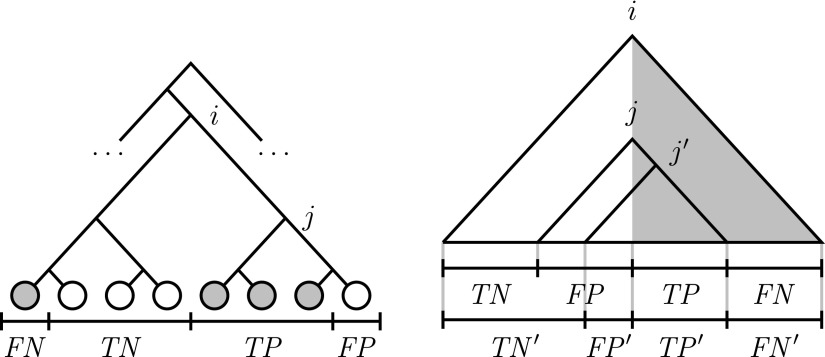
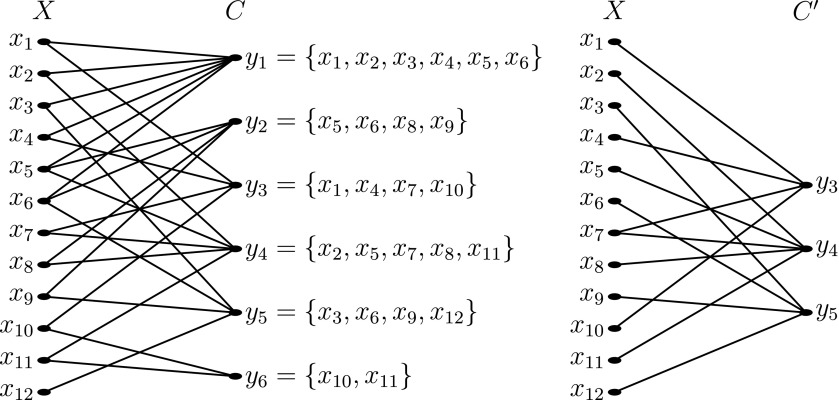
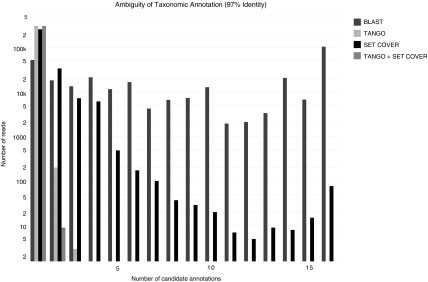
The classification of reads from a metagenomic sample using a reference taxonomy is usually based on first mapping the reads to the reference sequences and then classifying each read at a node under the lowest common ancestor of the candidate sequences in the reference taxonomy with the least classification error. However, this taxonomic annotation can be biased by an imbalanced taxonomy and also by the presence of multiple nodes in the taxonomy with the least classification error for a given read. In this article, we show that the Rand index is a better indicator of classification error than the often used area under the receiver operating characteristic (ROC) curve and F-measure for both balanced and imbalanced reference taxonomies, and we also address the second source of bias by reducing the taxonomic annotation problem for a whole metagenomic sample to a set cover problem, for which a logarithmic approximation can be obtained in linear time and an exact solution can be obtained by integer linear programming. Experimental results with a proof-of-concept implementation of the set cover approach to taxonomic annotation in a next release of the TANGO software show that the set cover approach further reduces ambiguity in the taxonomic annotation obtained with TANGO without distorting the relative abundance profile of the metagenomic sample.
Keywords: classification; correlation; metagenomics; set cover; taxonomic annotation..
Conflict of interest statement
No competing financial interests exist.
Figures
References
-
- Alonso D., Barré A., Beretta S., et al. 2013. Further steps in TANGO: Improved taxonomic assignment in metagenomics. Bioinformatics 30, 17–23 - PubMed
-
- Altschul S.F., Gish W., Miller W., et al. 1990. Basic local alignment search tool. J. Mol. Biol. 215, 403–410 - PubMed
-
- Bar-Yehuda R., and Even S. 1981. A linear-time approximation algorithm for the weighted vertex cover problem. J. Algorithms 2, 198–203
Publication types
MeSH terms
LinkOut - more resources
Full Text Sources
Other Literature Sources
