


Gynecologic cancer in HIV-infected women: treatment and outcomes in a multi-institutional cohort
- PMID: 29028665
- PMCID: PMC5921933
- DOI: 10.1097/QAD.0000000000001664
Gynecologic cancer in HIV-infected women: treatment and outcomes in a multi-institutional cohort
Abstract
Objective: To evaluate gynecologic cancer treatments in HIV-infected women for adherence to National Comprehensive Cancer Network (NCCN) guidelines and to describe survival by adherence to guidelines.
Design: Beyond cervical cancer, there are little data on treatment and outcomes for these women. This is a retrospective cohort study of HIV-infected women with gynecologic cancers.
Methods: HIV-infected women with gynecologic cancers from 2000 to 2015 were identified at two urban, comprehensive cancer centers. Chart reviews extracted demographic, HIV, and cancer-related variables. Cancer treatment was evaluated for adherence to NCCN guidelines. Overall survival was compared between those who received NCCN adherent and nonadherent cancer care.
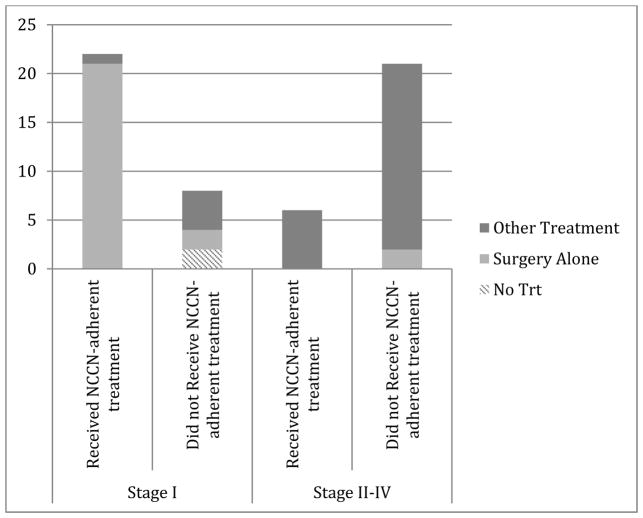
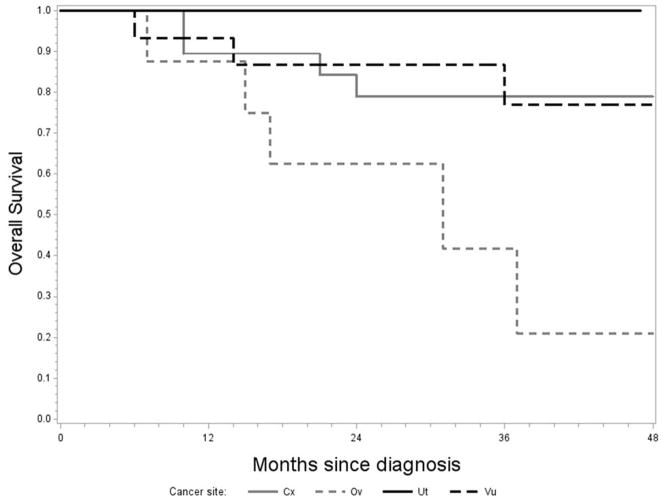
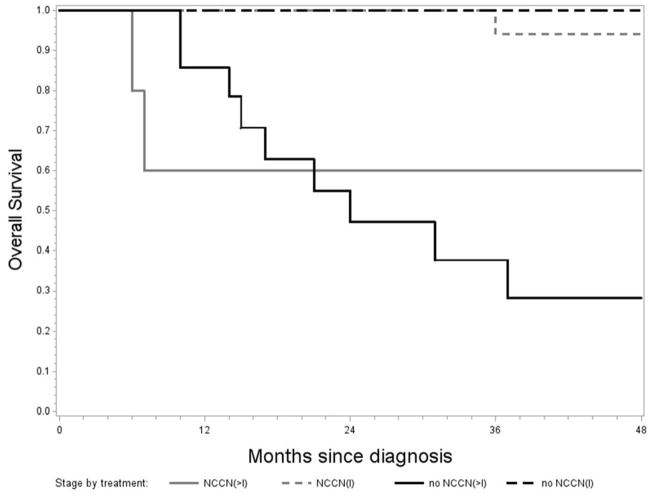
Results: Fifty-seven women were identified; 15 vulvar (26%), 26 cervical (46%), nine ovarian (16%), and seven endometrial (12%) cancers. Median time from HIV to cancer diagnosis was 8.5 years, and 88% of women were black. Thirty patients (53%) had stage I, and 27 (47%) had stage II-IV disease. Overall, 28 women (49%) received NCCN-adherent care; 22 of 30 stage I (73%) and six of 27 stage II-IV patients (22%). Among 29 women not receiving NCCN-adherent care, 69% were due to patient-related factors or toxicity. Among women with II-IV cancers, 48-month survival was higher in women who received NCCN-adherent care than those who did not (60 versus 28%).
Conclusion: Most HIV-infected women with advanced gynecologic cancers did not receive NCCN-adherent care and had worse survival compared to those who did. Focus on treatment-related toxicities and patient-related barriers to cancer care are necessary in this population.
Conflict of interest statement
Conflicts of Interest and Source of Funding: Kimberly Levinson received a grant from the Johns Hopkins University Center for AIDS Research. Dr. Riedel has non-financial support from Merck, outside of the submitted work. Dr. Ojalvo receives personal fees from PapGene, Inc and from EMDSerono, both outside of the submitted work. For all other authors, no conflicts of interest were declared.
Figures
References
-
- Panel on Antiretroviral Guidelines for Adults and Adolescents. Guidelines for the use of antiretroviral agents in HIV-1-infected adults and adolescents. Department of Health and Human Services; [Accessed August 3, 2017]. Available at: https://aidsinfo.nih.gov/contentfiles/lvguidelines/adultandadolescentgl.pdf. Section E-1.
-
- Patel P, Hanson DL, Sullivan PS, Novak RM, Moorman AC, Tong TC, et al. Incidence of types of cancer among HIV-infected persons compared with the general population in the United Sates, 1992–2003. Ann Intern Med. 2008;148(10):728–36. - PubMed
Publication types
MeSH terms
Grants and funding
LinkOut - more resources
Full Text Sources
Other Literature Sources
Medical
