Review
. 2018 Feb 10:80:49-70.
doi: 10.1146/annurev-physiol-022516-034008. Epub 2017 Oct 13.

Lymphatic Dysfunction, Leukotrienes, and Lymphedema

Affiliations
Review

Lymphatic Dysfunction, Leukotrienes, and Lymphedema

Xinguo Jiang et al. Annu Rev Physiol. .

Abstract

The lymphatic system is essential for the maintenance of tissue fluid homeostasis, gastrointestinal lipid absorption, and immune trafficking. Whereas lymphatic regeneration occurs physiologically in wound healing and tissue repair, pathological lymphangiogenesis has been implicated in a number of chronic diseases such as lymphedema, atherosclerosis, and cancer. Insight into the regulatory mechanisms of lymphangiogenesis and the manner in which uncontrolled inflammation promotes lymphatic dysfunction is urgently needed to guide the development of novel therapeutics: These would be designed to reverse lymphatic dysfunction, either primary or acquired. Recent investigation has demonstrated the mechanistic role of leukotriene B4 (LTB4) in the molecular pathogenesis of lymphedema. LTB4, a product of the innate immune response, is a constituent of the eicosanoid inflammatory mediator family of molecules that promote both physiological and pathological inflammation. Here we provide an overview of lymphatic development, the pathophysiology of lymphedema, and the role of leukotrienes in lymphedema pathogenesis.

Keywords: 5-lipoxygenase; leukotriene B4; lymphedema.


Figures
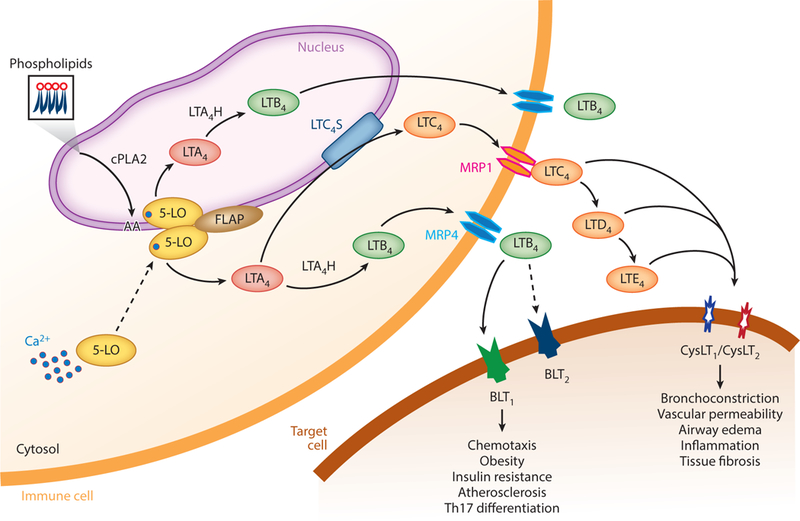
Figure 1
Figure 1
Overview of the synthesis and actions of leukotrienes. Ca2+-activated 5-LO translocates to either the inner or outer nuclear membrane and converts arachidonic acid to LTA4 under the influence of FLAP. LTA4 is further metabolized to LTB4 or LTC4. These are transported out of the cell by MRP4 or MRP1. LTC4 can be sequentially metabolized into LTD4 and LTE4. The molecules bind to BLT or CysLT receptors and elicit biological or pathological functions. Abbreviations: 5-LO, 5-lipoxygenase; BLT, LTB4 receptor; cPLA2, cytosolic phospholipase A2; CysLT, cysteinyl LT receptor; FLAP, 5-LO-activating protein; LT, leukotriene; LTA4H, LTA4 hydrolase; LTB4, leukotriene B4; LTC4S, LTC4 synthase; MRP, multidrug resistance-associated protein; Th17, T helper 17.
Figure 2
Figure 2
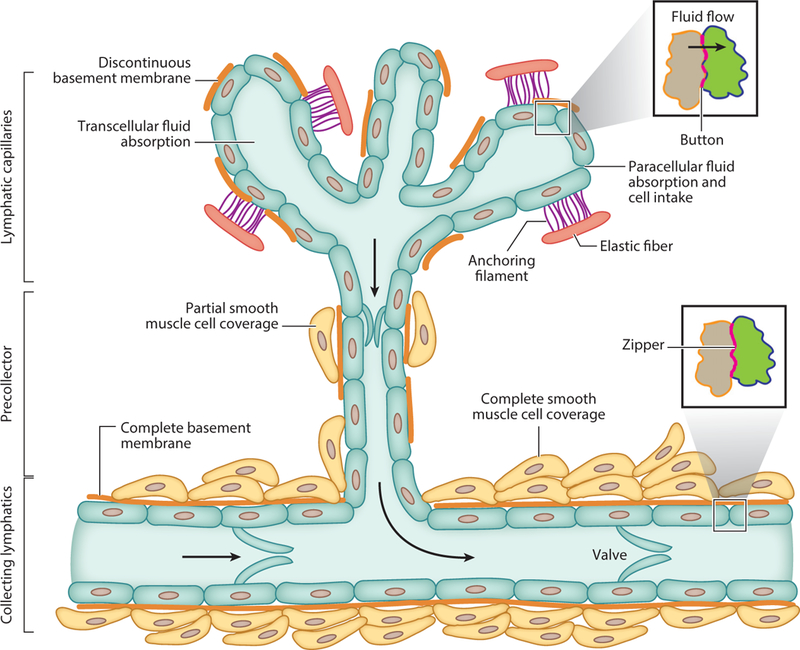
Schematic diagram of the lymphatic vascular tree. Lymphatic capillaries are blind ended. Capillary lymphatic endothelial cells (LECs) are only partially covered by basement membrane (BM). Button structures locate at the capillary LECs, and LECs anchor to the elastic components of the extracellular matrix by anchoring filaments. This facilitates interstitial fluid and cellular entry into the lymphatic capillaries. Interstitial fluid and cells can enter the lymphatic capillary through both paracellular and transcellular routes. Lymphatic capillaries converge into precollectors, which also have incomplete BM and partial smooth muscle cell (SMC) coverage. Precollectors further converge into collecting lymphatics, which have complete BM and SMC layers. Lymphatic valves allow only unidirectional lymph flow. Zippers locate among the collector LECs.
Figure 3
Figure 3
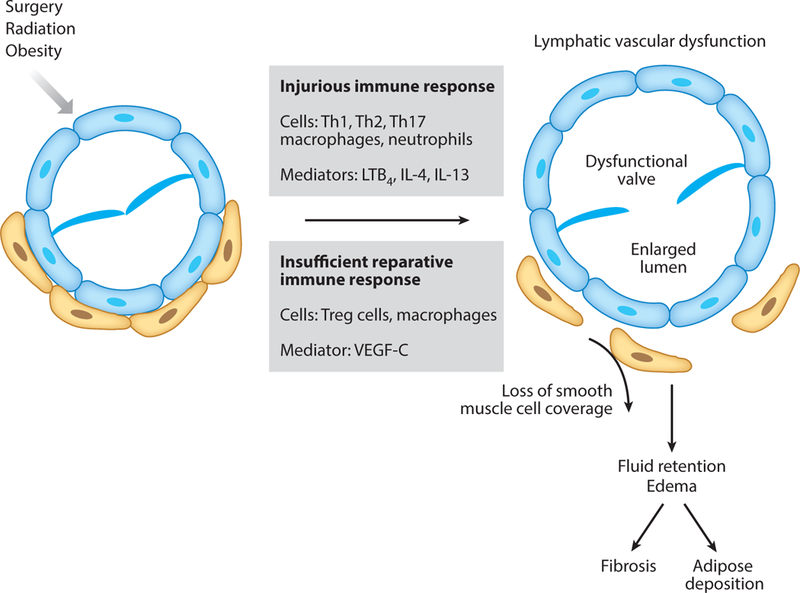
Pathophysiology of acquired lymphedema. Lymphatic injury, caused by surgery, radiation, or obesity, induces an immune response that includes Th1-, Th2-, and Th17-mediated T cell immunity, along with macrophage- and neutrophil-mediated innate immunity. Insufficient regulatory T cell (Treg) activity and insufficient production of lymphatic reparative factors, such as VEGF-C, lead to lymphatic vascular dysfunction, which includes lymphatic vessel lumen enlargement, valve dysfunction, and loss of smooth muscle cell coverage. Prolonged lymphatic vascular dysfunction induces interstitial fluid retention and tissue edema, followed by tissue fibrosis and adipose deposition. Abbreviations: IL, interleukin; LTB4, leukotriene B4;Th1/2/17,T helper 1/2/17; VEGF-C, vascular endothelial growth factor-C.

References

    1. Peters-Golden M, Henderson WR Jr. 2007. Leukotrienes. N. Engl.J. Med. 357:1841–54 - PubMed
    1. Radmark OP. 2000. The molecular biology and regulation of 5-lipoxygenase. Am. J. Respir. Crit. Care Med. 161:S11–15 - PubMed
    1. Peters-Golden M, Brock TG. 2001. Intracellular compartmentalization of leukotriene synthesis: unexpected nuclear secrets. FEBS Lett. 487:323–26 - PubMed
    1. Luo M, Jones SM, Peters-Golden M, Brock TG. 2003. Nuclear localization of 5-lipoxygenase as a determinant ofleukotriene B4 synthetic capacity. PNAS 100:12165–70 - PMC - PubMed
    1. Rouzer CA, Samuelsson B. 1985. On the nature of the 5-lipoxygenase reaction in human leukocytes: enzyme purification and requirement for multiple stimulatory factors. PNAS 82:6040–44 - PMC - PubMed

Publication types