


Answering Schrödinger's question: A free-energy formulation
- PMID: 29029962
- PMCID: PMC5857288
- DOI: 10.1016/j.plrev.2017.09.001
Answering Schrödinger's question: A free-energy formulation
Abstract
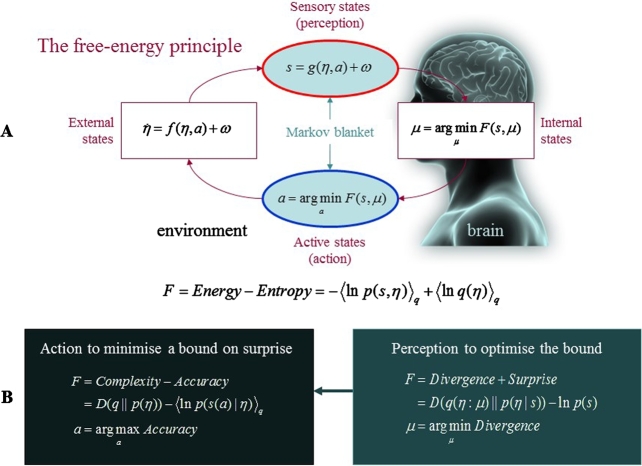
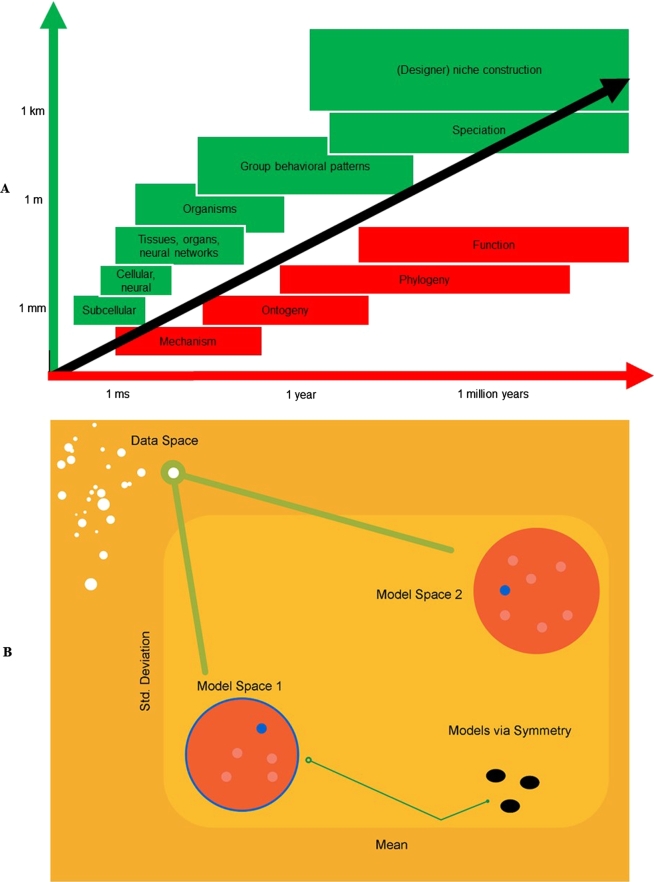
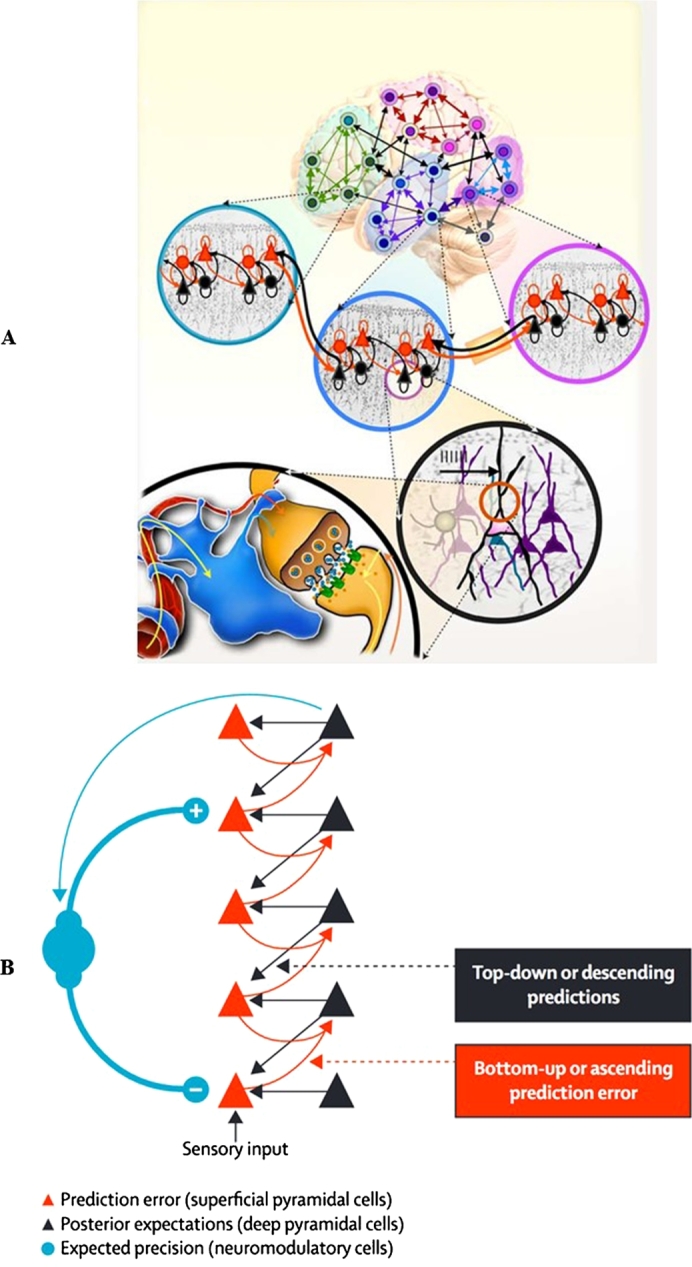
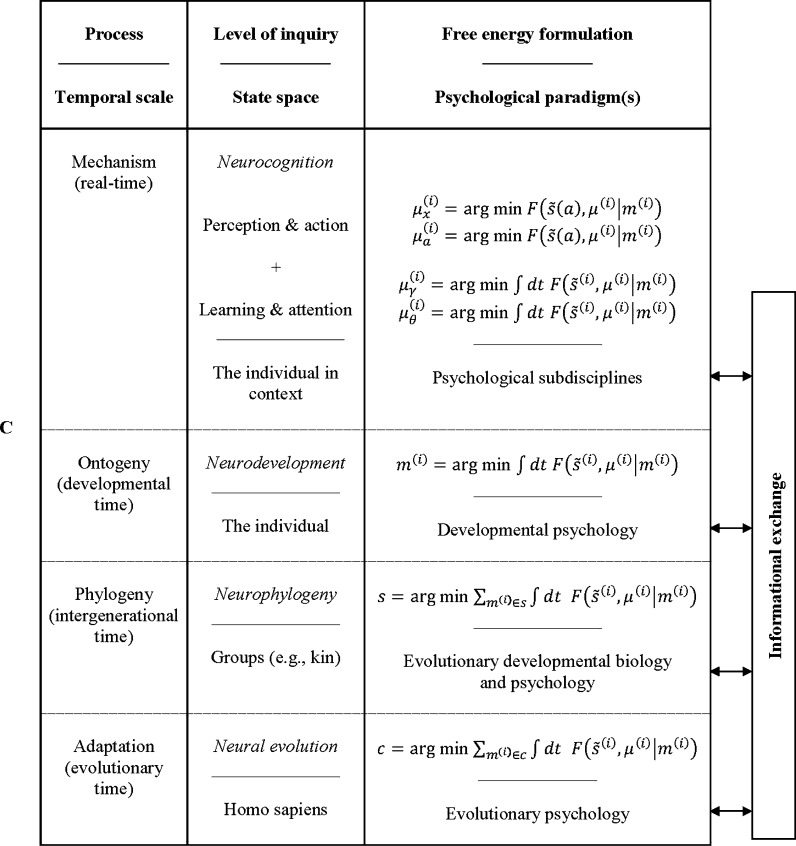
The free-energy principle (FEP) is a formal model of neuronal processes that is widely recognised in neuroscience as a unifying theory of the brain and biobehaviour. More recently, however, it has been extended beyond the brain to explain the dynamics of living systems, and their unique capacity to avoid decay. The aim of this review is to synthesise these advances with a meta-theoretical ontology of biological systems called variational neuroethology, which integrates the FEP with Tinbergen's four research questions to explain biological systems across spatial and temporal scales. We exemplify this framework by applying it to Homo sapiens, before translating variational neuroethology into a systematic research heuristic that supplies the biological, cognitive, and social sciences with a computationally tractable guide to discovery.
Keywords: Complex adaptive systems; Evolutionary systems theory; Free energy principle; Hierarchically mechanistic mind; Physics of the mind; Variational neuroethology.
Copyright © 2017 Elsevier B.V. All rights reserved.
Figures

Comment in
-
Critique of pure free energy principle: Comment on "Answering Schrödinger's question: A free-energy formulation" by Maxwell James Désormeau Ramstead et al.Phys Life Rev. 2018 Mar;24:52-55. doi: 10.1016/j.plrev.2017.10.003. Epub 2017 Oct 16. Phys Life Rev. 2018. PMID: 29050920 No abstract available.
-
Dynamics and equilibria of living systems: Comment on "Answering Schrödinger's question: A free-energy formulation" by Maxwell James Dèsormeau Ramstead et al.Phys Life Rev. 2018 Mar;24:50-51. doi: 10.1016/j.plrev.2017.10.004. Epub 2017 Oct 19. Phys Life Rev. 2018. PMID: 29066075 No abstract available.
-
Lifting the Markov blankets of socio-cultural evolution: A comment on "Answering Schrödinger's question: A free-energy formulation" by Maxwell James Désormeau Ramstead et al.Phys Life Rev. 2018 Mar;24:45-46. doi: 10.1016/j.plrev.2017.11.005. Epub 2017 Nov 3. Phys Life Rev. 2018. PMID: 29122562 No abstract available.
-
Towards a unification of evolutionary dynamics: Comment on "Answering Schrödinger's question: A free-energy formulation" by Maxwell James Désormeau Ramstead et al.Phys Life Rev. 2018 Mar;24:42-44. doi: 10.1016/j.plrev.2017.11.008. Epub 2017 Nov 3. Phys Life Rev. 2018. PMID: 29122563 No abstract available.
-
Cultural Markov blankets? Mind the other minds gap!: Comment on "Answering Schrödinger's question: A free-energy formulation" by Maxwell James Désormeau Ramstead et al.Phys Life Rev. 2018 Mar;24:47-49. doi: 10.1016/j.plrev.2017.11.001. Epub 2017 Nov 3. Phys Life Rev. 2018. PMID: 29122565 No abstract available.
-
Living systems do not minimize free energy: Comment on "Answering Schrödinger's question: A free-energy formulation" by Maxwell James Dèsormeau Ramstead et al.Phys Life Rev. 2018 Mar;24:40-41. doi: 10.1016/j.plrev.2017.11.010. Epub 2017 Nov 10. Phys Life Rev. 2018. PMID: 29129485 No abstract available.
-
Beyond blanket terms: Challenges for the explanatory value of variational (neuro-)ethology: Comment on "Answering Schrödinger's question: A free-energy formulation" by Maxwell James Désormeau Ramstead et al.Phys Life Rev. 2018 Mar;24:37-39. doi: 10.1016/j.plrev.2017.11.015. Epub 2017 Nov 14. Phys Life Rev. 2018. PMID: 29158029 No abstract available.
-
Embodying Markov blankets: Comment on "Answering Schrödinger's question: A free-energy formulation" by Maxwell James Désormeau Ramstead et al.Phys Life Rev. 2018 Mar;24:32-36. doi: 10.1016/j.plrev.2017.11.020. Epub 2017 Nov 24. Phys Life Rev. 2018. PMID: 29191410 No abstract available.
-
A plea for "variational neuroethology": Comment on "Answering Schrödinger's question: A free-energy formulation" by M.J. Desormeau Ramstead et al.Phys Life Rev. 2018 Mar;24:56-58. doi: 10.1016/j.plrev.2017.11.019. Epub 2017 Nov 24. Phys Life Rev. 2018. PMID: 29191411 No abstract available.
-
Ontologies of life: From thermodynamics to teleonomics: Comment on "Answering Schrödinger's question: A free-energy formulation" by Maxwell James Désormeau Ramstead et al.Phys Life Rev. 2018 Mar;24:29-31. doi: 10.1016/j.plrev.2017.11.022. Epub 2017 Dec 2. Phys Life Rev. 2018. PMID: 29217151 No abstract available.
-
Hierarchical Markov blankets and adaptive active inference: Comment on "Answering Schrödinger's question: A free-energy formulation" by Maxwell James Désormeau Ramstead et al.Phys Life Rev. 2018 Mar;24:27-28. doi: 10.1016/j.plrev.2017.12.009. Epub 2018 Jan 2. Phys Life Rev. 2018. PMID: 29306637 No abstract available.
-
The free energy principle and autopoiesis: Comment on "Answering Schrödinger's question: A free-energy formulation" by Maxwell James Désormeau Ramstead, Paul Benjamin Badcock, Karl John Friston.Phys Life Rev. 2018 Mar;24:24-26. doi: 10.1016/j.plrev.2017.12.011. Epub 2018 Jan 4. Phys Life Rev. 2018. PMID: 29307787 No abstract available.
-
Upgrading Gestalt psychology with variational neuroethology: The case of perceptual pleasures: Comment on "Answering Schrödinger's question: A free-energy formulation" by M.J. Desormeau Ramstead et al.Phys Life Rev. 2018 Mar;24:21-23. doi: 10.1016/j.plrev.2018.01.002. Epub 2018 Jan 5. Phys Life Rev. 2018. PMID: 29325935 No abstract available.
-
The foundation: Mechanism, prediction, and falsification in Bayesian enactivism: Comment on "Answering Schrödinger's question: A free-energy formulation" by Maxwell James Désormeau Ramstead et al.Phys Life Rev. 2018 Mar;24:17-20. doi: 10.1016/j.plrev.2018.01.007. Epub 2018 Feb 2. Phys Life Rev. 2018. PMID: 29426594 No abstract available.
References
-
- Schrödinger E. Cambridge University Press; Cambridge: 1944. What is life?
-
- Wright S. In: Proceedings of the sixth international congress of genetics. Jones D.F., editor. Brooklyn Botanical Garden; Ithaca, New York: 1932. The roles of mutation, inbreeding, crossbreeding, and selection in evolution.
-
- Fisher R.A. Oxford Clarendon Press; 1930. The genetical theory of natural selection.
-
- Sarkar S. Kluwer Academic Publishers; Dordrecht/Boston/London: 1992. The founders of evolutionary genetics: a centenary reappraisal.
-
- Ao P. Laws in Darwinian evolutionary theory. Phys Life Rev. 2005;2:117–156.
Further reading
-
- Friston K., FitzGerald T., Rigoli F., Schwartenbeck P., Pezzulo G. Active inference: a process theory. Neural Comput. 2017;29:1–49. - PubMed
-
- Arnold L. Springer-Verlag; Berlin: 2003. Random dynamical systems. (Springer Monogr Math).
-
- Beer R.D. A dynamical systems perspective on agent-environment interaction. Artif Intell. 1995;72:173–215.
-
- Crauel H., Flandoli F. Attractors for random dynamical systems. Probab Theory Relat Fields. 1994;100:365–393.
-
- Freeman W.J. Characterization of state transitions in spatially distributed, chaotic, nonlinear, dynamical systems in cerebral cortex. Integr Physiol Behav Sci. 1994;29:294–306. - PubMed
Publication types
MeSH terms
Grants and funding
LinkOut - more resources
Full Text Sources
Other Literature Sources
