


Definition and characterization of an extended multiple-demand network
- PMID: 29030105
- PMCID: PMC5732056
- DOI: 10.1016/j.neuroimage.2017.10.020
Definition and characterization of an extended multiple-demand network
Abstract
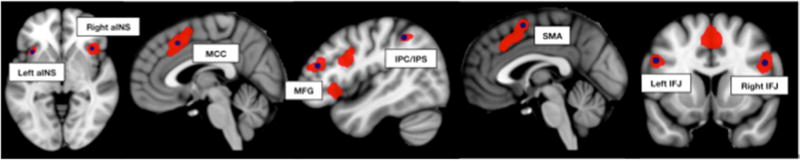
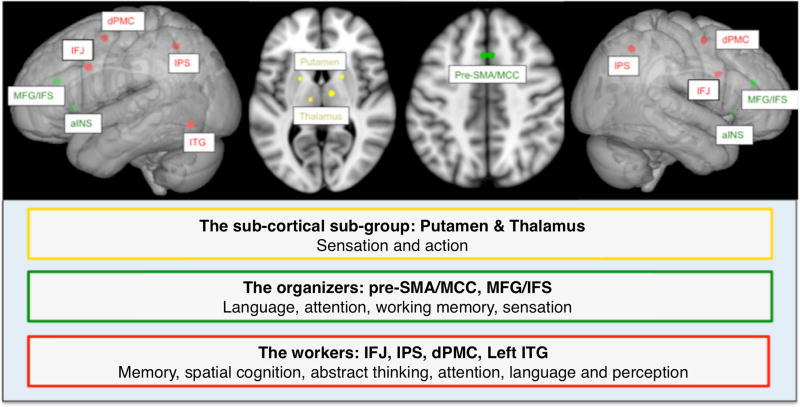
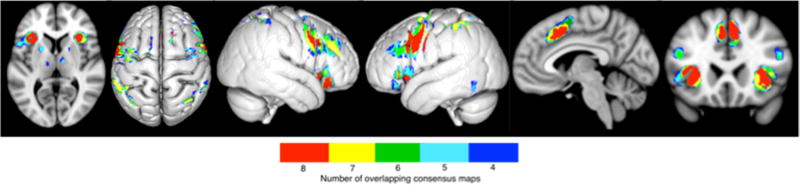
Neuroimaging evidence suggests that executive functions (EF) depend on brain regions that are not closely tied to specific cognitive demands but rather to a wide range of behaviors. A multiple-demand (MD) system has been proposed, consisting of regions showing conjoint activation across multiple demands. Additionally, a number of studies defining networks specific to certain cognitive tasks suggest that the MD system may be composed of a number of sub-networks each subserving specific roles within the system. We here provide a robust definition of an extended MDN (eMDN) based on task-dependent and task-independent functional connectivity analyses seeded from regions previously shown to be convergently recruited across neuroimaging studies probing working memory, attention and inhibition, i.e., the proposed key components of EF. Additionally, we investigated potential sub-networks within the eMDN based on their connectional and functional similarities. We propose an eMDN network consisting of a core whose integrity should be crucial to performance of most operations that are considered higher cognitive or EF. This then recruits additional areas depending on specific demands.
Keywords: Executive functioning; Functional connectivity; Hierarchical clustering; Higher cognitive functions; Meta-analytical connectivity modeling.
Copyright © 2017 Elsevier Inc. All rights reserved.
Conflict of interest statement
The authors declare that the research was conducted in the absence of any commercial or financial relationships that could be construed as a potential conflict of interest.
Figures



References
-
- Alexander GE, Crutcher MD. Functional architecture of basal ganglia circuits: neural substrates of parallel processing. Trends Neurosci. 1990;13:266–271. - PubMed
-
- Alexander GE, DeLong MR, Strick PL. Parallel organization of functionally segregated circuits linking basal ganglia and cortex. Annu. Rev. Neurosci. 1986;9:357–381. - PubMed
-
- Alvarez JA, Emory E. Executive function and the frontal lobes: a meta-analytic review. Neuropsychol. Rev. 2006;16:17–42. - PubMed
Publication types
MeSH terms
Grants and funding
LinkOut - more resources
Full Text Sources
Other Literature Sources
