. 2017 Oct 13;7(1):13144.
doi: 10.1038/s41598-017-13447-4.

Fish perform like mammals and birds in inhibitory motor control tasks

Affiliations

Fish perform like mammals and birds in inhibitory motor control tasks

Tyrone Lucon-Xiccato et al. Sci Rep. .

Abstract

Inhibitory control is an executive function that positively predicts performance in several cognitive tasks and has been considered typical of vertebrates with large and complex nervous systems such as primates. However, evidence is growing that some fish species have evolved complex cognitive abilities in spite of their relatively small brain size. We tested whether fish might also show enhanced inhibitory control by subjecting guppies, Poecilia reticulata, to the motor task used to test warm-blooded vertebrates. Guppies were trained to enter a horizontal opaque cylinder to reach a food reward; then, the cylinder was replaced by a transparent one, and subjects needed to inhibit the response to pass thought the transparency to reach the food. Guppies performed correctly in 58% trials, a performance fully comparable to that observed in most birds and mammals. In experiment 2, we tested guppies in a task with a different type of reward, a group of conspecifics. Guppies rapidly learned to detour a transparent barrier to reach the social reward with a performance close to that of experiment 1. Our study suggests that efficient inhibitory control is shown also by fish, and that its variation between-species is only partially explained by variation in brain size.


Conflict of interest statement

The authors declare that they have no competing interests.

Figures

Figure 1
Figure 1
Performance of guppies in the cylinder task (experiment 1). (a) Percentage of correct trials in which guppies did not contact the cylinder (mean ± SEM), and (b) time to solve the task (mean ± SEM) over the 10 days of the test phase.
Figure 2
Figure 2
Comparison between the performance of guppies in the cylinder task (black bar) and that of 32 mammalian and avian species tested in the same task by MacLean et al.. Bars represent mean percentage of correct trials. To allow the comparison with the other species, we used the performance of guppies in the initial 10 trials.
Figure 3
Figure 3
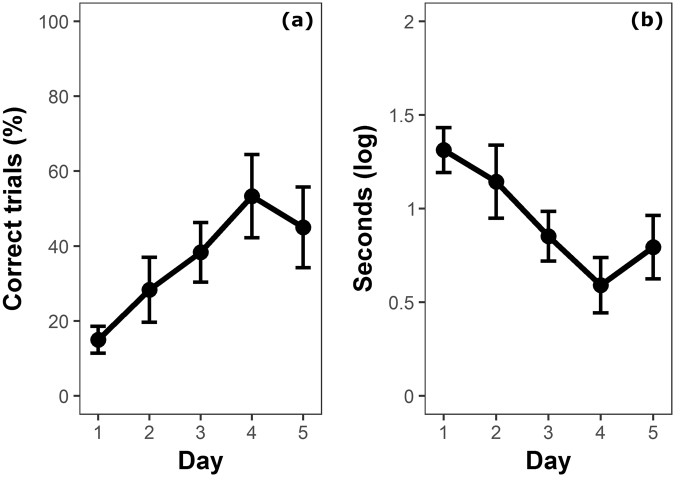
Performance of guppies in the barrier task (experiment 2). (a) Percentage of correct trials in which guppies did not enter the barrier (mean ± SEM) and (b) time to solve the task (mean ± SEM) over the 5 days of the experiment.
Figure 4
Figure 4
View from above of the apparatuses used in (a) experiment 1, and in (b) experiment 2.

References

    1. Gilbert SJ, Burgess PW. Executive function. Curr. Biol. 2008;18:R110–R114. doi: 10.1016/j.cub.2007.12.014. - DOI - PubMed
    1. Chudasama Y. Animal models of prefrontal-executive function. Behav. Neurosci. 2011;125:327. doi: 10.1037/a0023766. - DOI - PubMed
    1. Diamond A. Executive functions. Annu. Rev. Psychol. 2013;64:135–168. doi: 10.1146/annurev-psych-113011-143750. - DOI - PMC - PubMed
    1. Band GPH, Van Boxtel GJM. Inhibitory motor control in stop paradigms: review and reinterpretation of neural mechanisms. Acta Psychol. 1999;101:179–211. doi: 10.1016/S0001-6918(99)00005-0. - DOI - PubMed
    1. Shamosh NA, et al. Individual differences in delay discounting: relation to intelligence, working memory, and anterior prefrontal cortex. Psychol. Sci. 2008;19:904–911. doi: 10.1111/j.1467-9280.2008.02175.x. - DOI - PubMed

Publication types

LinkOut - more resources