


Whole-genome comparison of urinary pathogenic Escherichia coli and faecal isolates of UTI patients and healthy controls
- PMID: 29031453
- PMCID: PMC5792705
- DOI: 10.1016/j.ijmm.2017.09.007
Whole-genome comparison of urinary pathogenic Escherichia coli and faecal isolates of UTI patients and healthy controls
Abstract
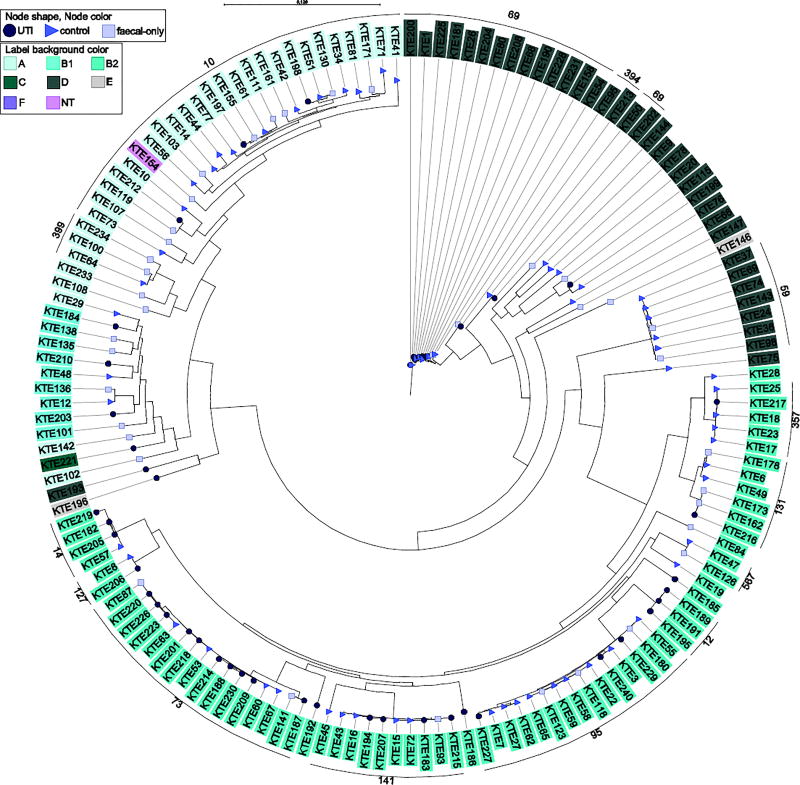
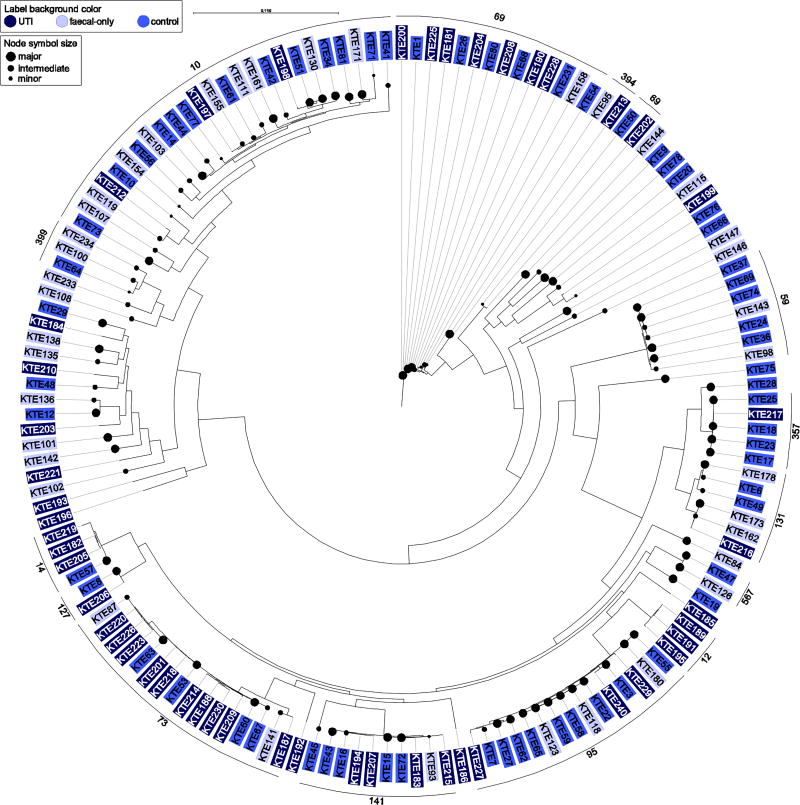
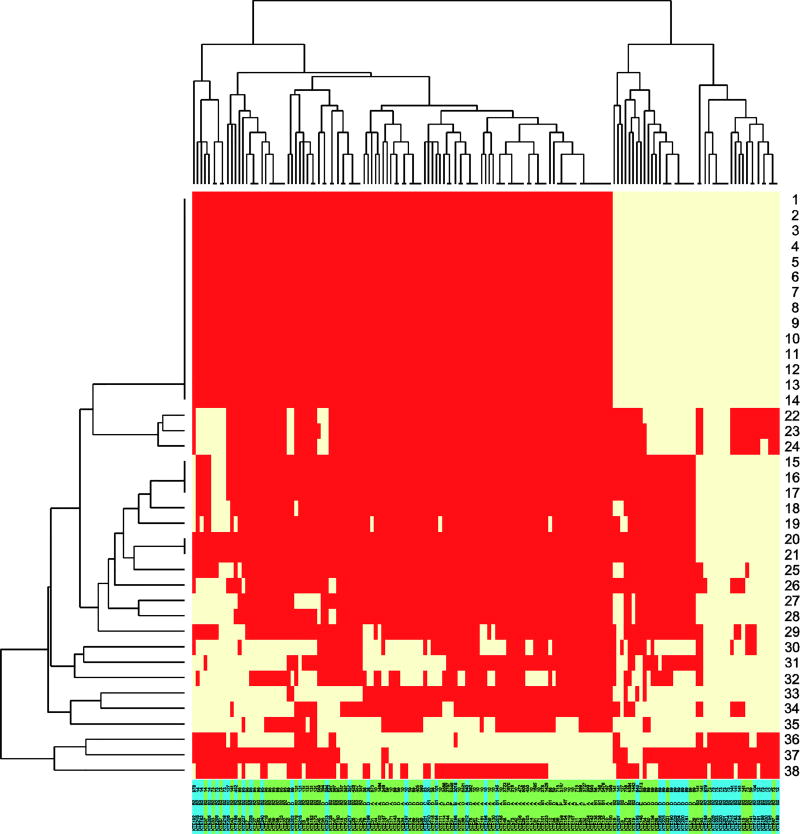
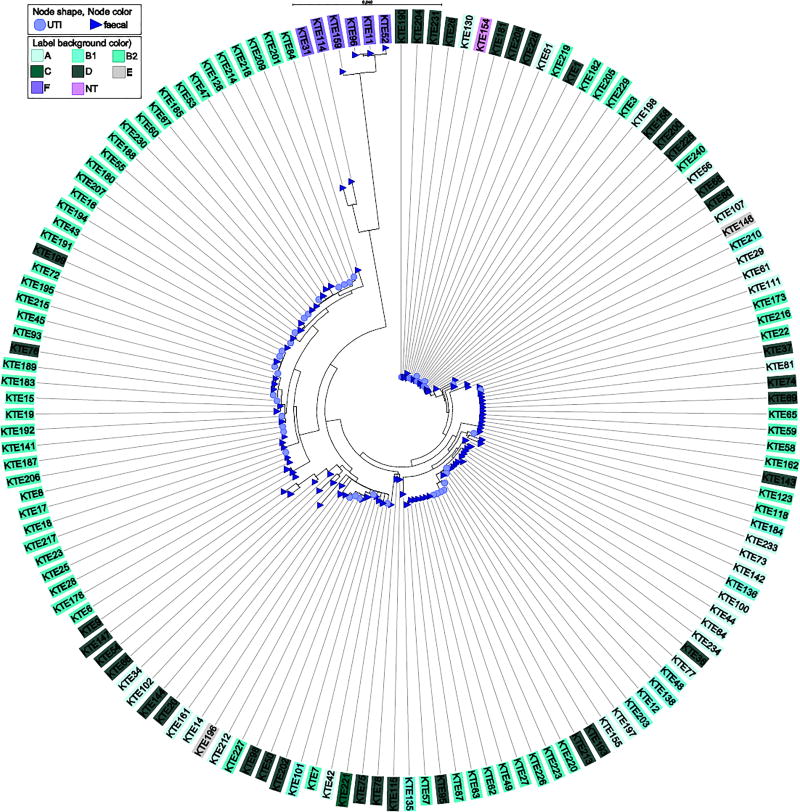
The faecal flora is a common reservoir for urinary tract infection (UTI), and Escherichia coli (E. coli) is frequently found in this reservoir without causing extraintestinal infection. We investigated these E. coli reservoirs by whole-genome sequencing a large collection of E. coli from healthy controls (faecal), who had never previously had UTI, and from UTI patients (faecal and urinary) sampled from the same geographical area. We compared MLST types, phylogenetic relationship, accessory genome content and FimH type between patient and control faecal isolates as well as between UTI and faecal-only isolates, respectively. Comparison of the accessory genome of UTI isolates to faecal isolates revealed 35 gene families which were significantly more prevalent in the UTI isolates compared to the faecal isolates, although none of these were unique to one of the two groups. Of these 35, 22 belonged to a genomic island and three putatively belonged to a type VI secretion system (T6SS). MLST types and SNP phylogeny indicated no clustering of the UTI or faecal E. coli from patients distinct from the control faecal isolates, although there was an overrepresentation of UTI isolates belonging to clonal lineages CC73 and CC12. One combination of mutations in FimH, N70S/S78N, was significantly associated to UTI, while phylogenetic analysis of FimH and fimH identified no signs of distinct adaptation of UTI isolates compared to faecal-only isolates not causing UTI. In summary, the results showed that (i) healthy women who had never previously had UTI carried faecal E. coli which were overall closely related to UTI and faecal isolates from UTI patients; (ii) UTI isolates do not cluster separately from faecal-only isolates based on SNP analysis; and (iii) 22 gene families of a genomic island, putative T6SS proteins as well as specific metabolism and virulence associated proteins were significantly more common in UTI isolates compared to faecal-only isolates and (iv) evolution of fimH for these isolates was not linked to the clinical source of the isolates, apart from the mutation combination N70S/S78N, which was correlated to UTI isolates of phylogroup B2. Combined, these findings illustrate that faecal and UTI isolates, as well as faecal-only and faecal-UTI isolates, are closely related and can only be distinguished, if at all, by their accessory genome.
Keywords: Adaption; Environment; Evolution; Faecal flora; Fimbria; Genomes; Gut; Microbiota; Mutations; NGS; Next generation sequencing; Phylogeny; Polymorphism; SNPs; Urinary tract infection; Virulence; WGS.
Copyright © 2017 Elsevier GmbH. All rights reserved.
Figures

References
-
- Aprikian P, Tchesnokova V, Kidd B, Yakovenko O, Yarov-Yarovoy V, Trinchina E, Vogel V, Thomas W, Sokurenko E. Interdomain interaction in the FimH adhesin of Escherichia coli regulates the affinity to mannose. J. Biol. Chem. 2007;282:23437–46. - PubMed
-
- Bielaszewska M, Dobrindt U, Gärtner J, Gallitz I, Hacker J, Karch H, Müller D, Schubert S, Alexander Schmidt M, Sorsa LJ, Zdziarski J. Aspects of genome plasticity in pathogenic Escherichia coli. Int. J. Med. Microbiol. 2007;297:625–39. - PubMed
Publication types
MeSH terms
Substances
Grants and funding
LinkOut - more resources
Full Text Sources
Other Literature Sources
Medical
