. 2017 Oct;15(5):324-330.
doi: 10.1016/j.gpb.2017.04.005. Epub 2017 Oct 12.

Ribosome Profiling Reveals Genome-wide Cellular Translational Regulation upon Heat Stress in Escherichia coli

Affiliations

Ribosome Profiling Reveals Genome-wide Cellular Translational Regulation upon Heat Stress in Escherichia coli

Yanqing Zhang et al. Genomics Proteomics Bioinformatics. 2017 Oct.

Abstract

Heat shock response is a classical stress-induced regulatory system in bacteria, characterized by extensive transcriptional reprogramming. To compare the impact of heat stress on the transcriptome and translatome in Escherichia coli, we conducted ribosome profiling in parallel with RNA-Seq to investigate the alterations in transcription and translation efficiency when E. coli cells were exposed to a mild heat stress (from 30 °C to 45 °C). While general changes in ribosome footprints correlate with the changes of mRNA transcripts upon heat stress, a number of genes show differential changes at the transcription and translation levels. Translation efficiency of a few genes that are related to environment stimulus response is up-regulated, and in contrast, some genes functioning in mRNA translation and amino acid biosynthesis are down-regulated at the translation level in response to heat stress. Moreover, our ribosome occupancy data suggest that in general ribosomes accumulate remarkably in the starting regions of ORFs upon heat stress. This study provides additional insights into bacterial gene expression in response to heat stress, and suggests the presence of stress-induced but yet-to-be characterized cellular regulatory mechanisms of gene expression at translation level.

Keywords: Heat shock response; RNA-Seq; Ribosome profiling; Transcription regulation; Translation regulation.


Figures

Figure 1
Figure 1
Simultaneous monitoring of the changes in transcriptome and translatome in E. coli upon heat stress A. Comparison of the total mRNA transcripts between 45 °C and 30 °C conditions. Red dots represent the genes with log2FC (45 °C/30 °C) >2; green dots represent the genes with log2FC < −2. B. Plot of the FC (log2FC) of RPFs (45 °C/30 °C) against FC of respective mRNAs (45 °C/30 °C). The four dash lines indicate log2FC values −1 or +1. FC, fold change; RPF, ribosome-protected fragment.
Figure 2
Figure 2
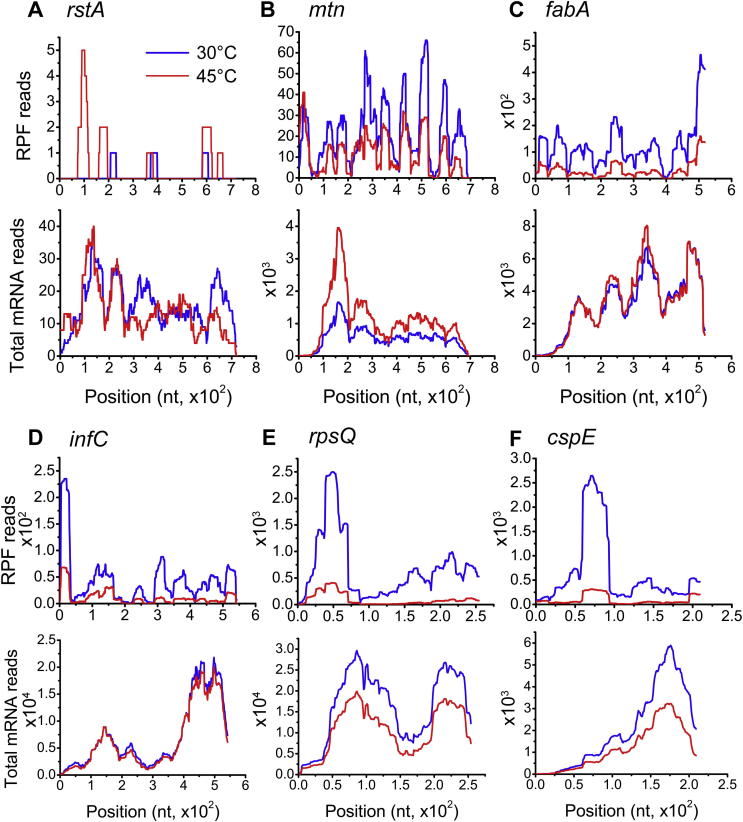
Representative genes with large changes in translation efficiency upon heat stress A. Read densities of rstA in RPF (upper panel) and total mRNA (bottom panel) as an example for a two-component system (with TE up-regulated upon heat stress). B. Read densities of mtn, an example for cysteine and methionine metabolism pathway (with TE up-regulated upon heat stress). C. Read densities of fabA, a representative of genes involved in fatty acid biosynthesis pathway. D. Read densities of infC, an example of translation factors. E. Read densities of rpsQ, a representative of ribosome protein genes. F. Read densities of cspE, an example of genes with down-regulation at both transcription and translation levels. On the X-axis, positions relative to the translational start site are indicated. TE, translation efficiency.
Figure 3
Figure 3
The density of ribosome footprints around start codon increases upon heat stress A. Alignments of RPF reads in the 5′UTR of all mapped genes in a 20-nucleotide distance to start codon. B. Alignments of the RPF reads in 3′UTR of all mapped genes in a 20-nucleotide distance to stop codon. C.–E. Three representative genes higB (C), cfa (D), and intB (E) with their ribosome footprint densities sharply increased around the start codon. The start and stop codons locations are marked by vertical dash lines in cyan and magenta respectively. On the X-axis, positions relative to the translational start site are indicated in panels CE.
Supplementary Figure S1
Flow chart of experimental designA flow chart of experimental design from cell culture to deep sequencing (heat shock treatment, total mRNA-Seq and ribosome profiling) is illustrated.
Supplementary Figure S2
Distribution of genes in terms of read countsThe distribution of genes in terms of read counts in the four samples was shown for RPF-30 °C (A), RPF-45 °C (B), mRNA-30 °C (C), and mRNA-45 °C (D), respectively.
Supplementary Figure S3
Representative genes of E. coli with down-regulated translation efficiency upon heat stressRead densities of metE (A) and asd (B) at RPF (upper panel) and total mRNA (lower panel) levels, as examples for genes involved in cysteine and methionine metabolism pathway. (C) Read densities of fabZ, an example for fatty acid biosynthesis pathway. (D) Read densities of infA, an example for genes involved in translation. (E) Read densities of rpsK, an example of genes encoding ribosomal proteins. (F) Read densities of cspC, an example for cold shock-like proteins. The start codon and stop codon locations are marked by dash lines in cyan and magenta, respectively. On the X-axis, positions relative to the translational start site are indicated.

References

    1. Schumann W. Regulation of bacterial heat shock stimulons. Cell Stress Chaperones. 2016;21:959–968. - PMC - PubMed
    1. Arsene F., Tomoyasu T., Bukau B. The heat shock response of Escherichia coli. Int J Food Microbiol. 2000;55:3–9. - PubMed
    1. Lindquist S. The heat-shock response. Annu Rev Biochem. 1986;55:1151–1191. - PubMed
    1. Guisbert E., Yura T., Rhodius V.A., Gross C.A. Convergence of molecular, modeling, and systems approaches for an understanding of the Escherichia coli heat shock response. Microbiol Mol Biol Rev. 2008;72:545–554. - PMC - PubMed
    1. Wang Z.X., Zhou X.Z., Meng H.M., Liu Y.J., Zhou Q., Huang B. Comparative transcriptomic analysis of the heat stress response in the filamentous fungus Metarhizium anisopliae using RNA-Seq. Appl Microbiol Biotechnol. 2014;98:5589–5597. - PubMed

MeSH terms