. 2017 Dec;217(6):684.e1-684.e17.
doi: 10.1016/j.ajog.2017.10.003. Epub 2017 Oct 12.

Altered angiogenesis as a common mechanism underlying preterm birth, small for gestational age, and stillbirth in women living with HIV

Affiliations

Altered angiogenesis as a common mechanism underlying preterm birth, small for gestational age, and stillbirth in women living with HIV

Andrea L Conroy et al. Am J Obstet Gynecol. 2017 Dec.

Abstract

Background: Angiogenic processes in the placenta are critical regulators of fetal growth and impact birth outcomes, but there are limited data documenting these processes in HIV-infected women or women from low-resource settings.

Objective: We sought to determine whether angiogenic factors are associated with adverse birth outcomes in HIV-infected pregnant women started on antiretroviral therapy.

Study design: This is a secondary analysis of samples collected as part of a clinical trial randomizing pregnant women and adolescents infected with HIV to lopinavir/ritonavir-based (n = 166) or efavirenz-based (n = 160) antiretroviral therapy in Tororo, Uganda. Pregnant women living with HIV were enrolled between 12-28 weeks of gestation. Plasma samples were evaluated for angiogenic biomarkers (angiopoietin-1, angiopoietin-2, vascular endothelial growth factor, soluble fms-like tyrosine kinase-1, placental growth factor, and soluble endoglin) by enzyme-linked immunosorbent assay between: 16-<20, 20-<24, 24-<28, 28-<32, 32-<36, 36-<37 weeks of gestation. The primary outcome was preterm birth.

Results: In all, 1115 plasma samples from 326 pregnant women and adolescents were evaluated. There were no differences in angiogenic factors according to antiretroviral therapy group (P > .05 for all). The incidence of adverse birth outcomes was 16.9% for spontaneous preterm births, 25.6% for small-for-gestational-age births, and 2.8% for stillbirth. We used linear mixed effect modelling to evaluate longitudinal changes in angiogenic factor concentrations between birth outcome groups adjusting for gestational age at venipuncture, maternal age, body mass index, gravidity, and the interaction between treatment arm and gestational age. Two angiogenic factors-soluble endoglin and placental growth factor-were associated with adverse birth outcomes. Significantly higher concentrations of soluble endoglin throughout gestation were found in study participants destined to deliver preterm [likelihood ratio test, χ2(1) = 12.28, P < .0005] and in those destined to have stillbirths [χ2(1) = 5.67, P < .02]. By contrast, significantly lower concentrations of placental growth factor throughout gestation were found in those destined to have small-for-gestational-age births [χ2(1) = 7.89, P < .005] and in those destined to have stillbirths [χ2(1) = 21.59, P < .0001].

Conclusion: An antiangiogenic state in the second or third trimester is associated with adverse birth outcomes, including stillbirth in women and adolescents living with HIV and receiving antiretroviral therapy.

Keywords: HIV-1; angiogenesis; placental growth factor; pregnancy; preterm birth; small for gestational age; soluble endoglin; soluble fms-like tyrosine kinase-1; stillbirth.


Figures

Figure 1
Figure 1
Flow chart of maternal plasma samples processed by gestational age ART, antiretroviral therapy; EFV, efavirenz; LPV/r, lopinavir/ritonavir. Conroy et al. Angiogenic factors across pregnancy in women living with HIV. Am J Obstet Gynecol 2017.
Figure 2
Figure 2
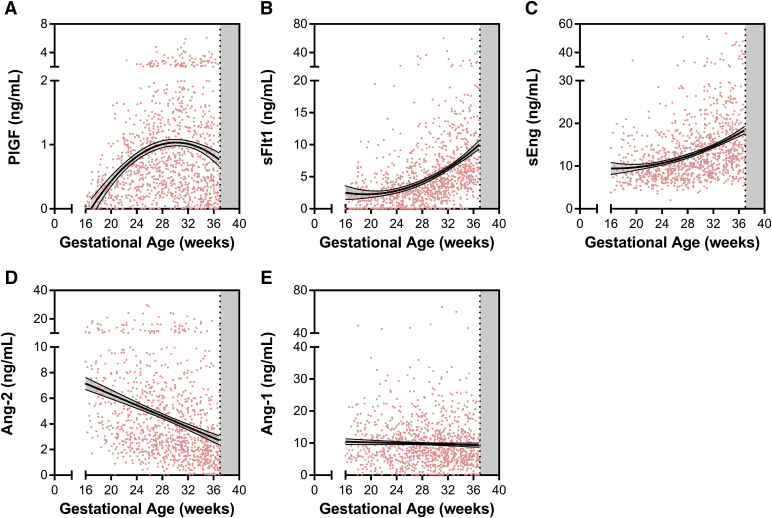
Angiogenic factors in HIV infected study participants receiving antiretroviral therapy Scatter plot of plasma levels of angiogenic factors plotted according to gestational age of sample collection: A, placental growth factor (PlGF); B, soluble fms-like tyrosine kinase (sFlt)-1; C, soluble endoglin (sEng); D, angiopoietin (Ang)-2; and E, Ang-1. Line indicates best fit line with 95% confidence intervals. Conroy et al. Angiogenic factors across pregnancy in women living with HIV. Am J Obstet Gynecol 2017.
Figure 3
Figure 3
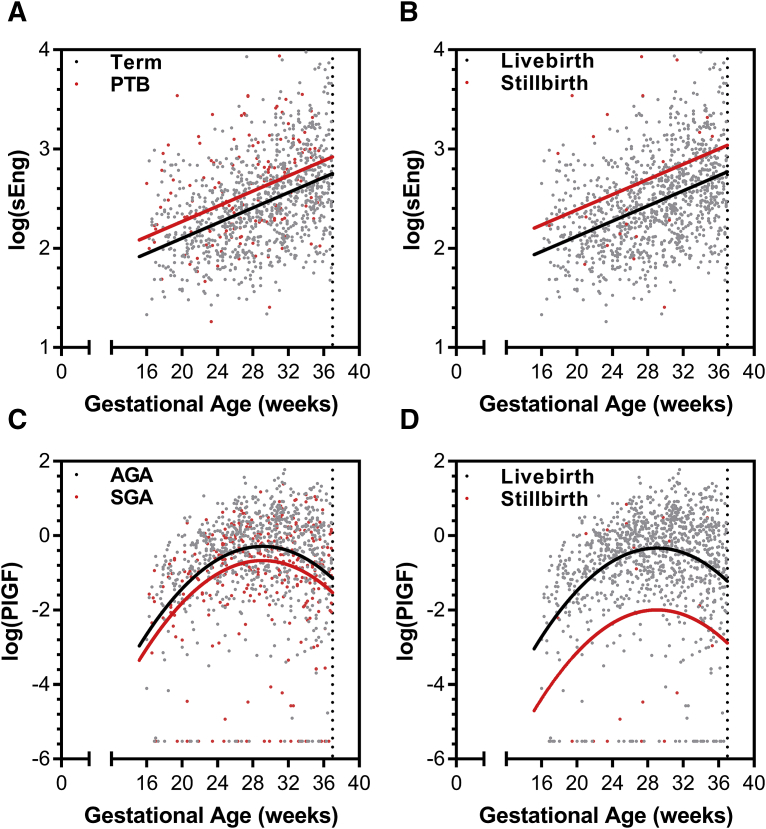
Antiangiogenic shift is associated with adverse birth outcomes in women living with HIV receiving antiretroviral therapy Individual data points colored by birth outcome. Overlaid regression lines are from linear mixed effects models, fitted for subject with average values (conditional on fixed effects only). AGA, appropriate for gestational age; PlGF, placental growth factor; PTB, preterm birth; sEng, soluble endoglin; SGA, small for gestational age. Conroy et al. Angiogenic factors across pregnancy in women living with HIV. Am J Obstet Gynecol 2017.
Supplemental Figure 1
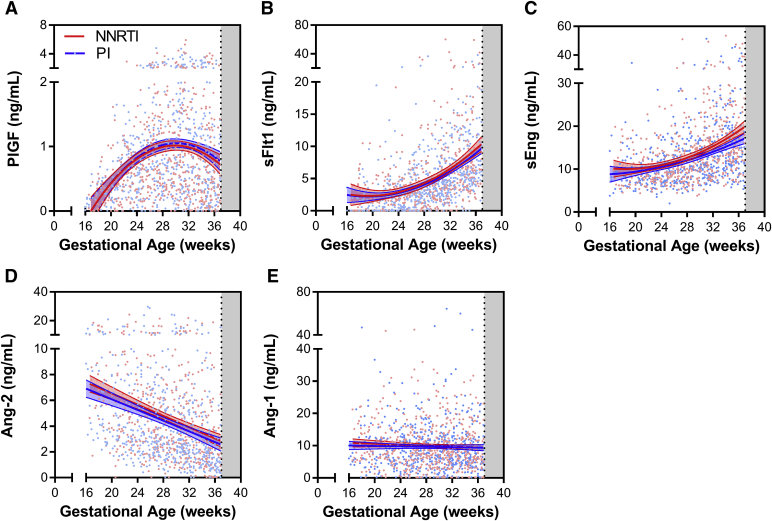
Longitudinal changes in angiogenic factors by treatment arm Scatter plot of plasma levels of angiogenic factors plotted by treatment arm with nonnucleoside reverse transcriptase inhibitor (NNRTI)-based antiretroviral therapy (ART) in red and protease inhibitor (PI)-based ART in blue. Biomarkers plotted according to gestational age of sample collection: A, placental growth factor (PlGF); B, soluble fms-like tyrosine kinase (sFlt)-1; C, soluble endoglin (sEng); D, angiopoietin (Ang)-2; and E, Ang-1. Line indicates best fit line with 95% confidence intervals. Conroy et al. Angiogenic factors across pregnancy in women living with HIV. Am J Obstet Gynecol 2017.
Supplemental Figure 2
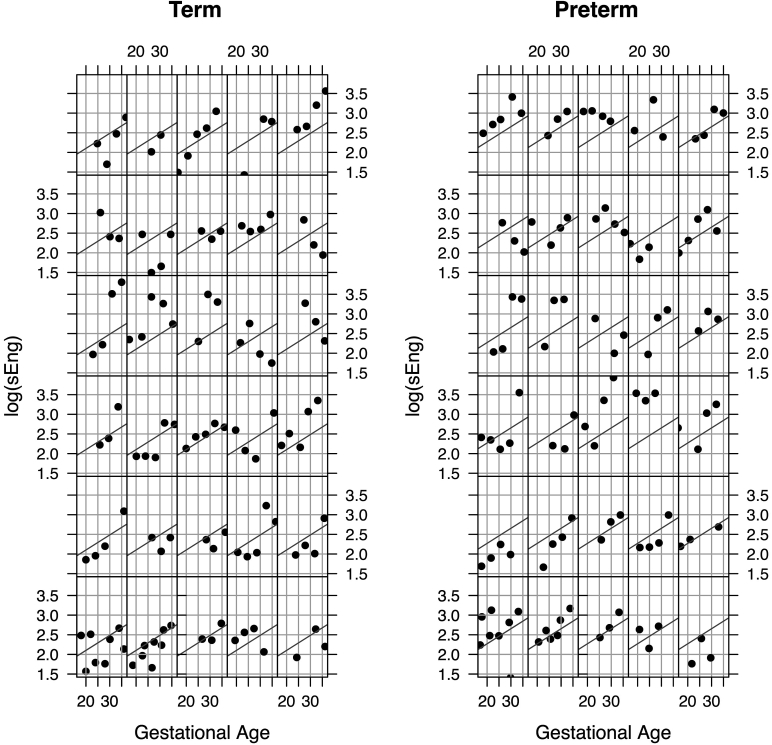
Representative plots of soluble endoglin (sEng) levels over gestation in participants destined to have preterm or term delivery Trellis plots of 60 randomly selected subjects (n = 30 term, n = 30 preterm). Solid line depicts fitted regression line from linear mixed effect model (conditional on fixed effects only). Conroy et al. Angiogenic factors across pregnancy in women living with HIV. Am J Obstet Gynecol 2017.
Supplemental Figure 3
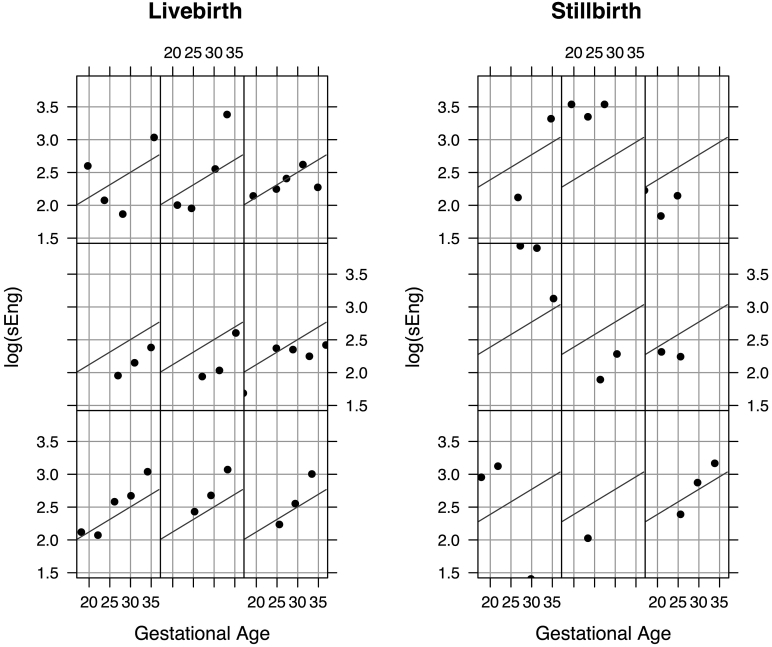
Representative plots of soluble endoglin (sEng) levels over gestation in participants destined to have livebirth or stillbirth infant Trellis plots of 18 randomly selected subjects (n = 9 livebirth, n = 9 stillbirth). Solid line depicts fitted regression line from linear mixed effect model (conditional on fixed effects only). Conroy et al. Angiogenic factors across pregnancy in women living with HIV. Am J Obstet Gynecol 2017.
Supplemental Figure 4
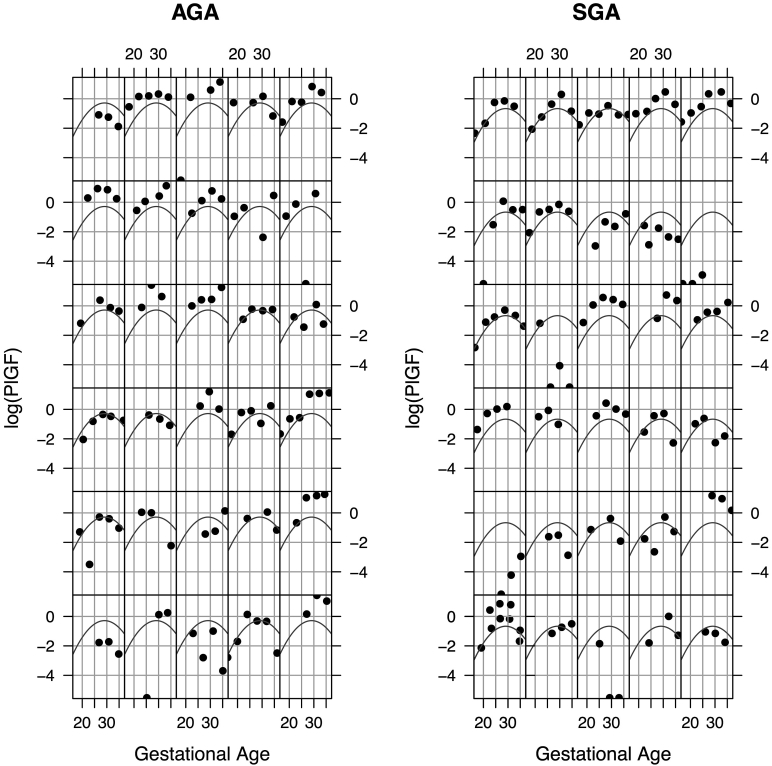
Representative plots of placental growth factor (PlGF) levels over gestation in participants destined to have small-for-gestational-age (SGA) or appropriate-for-gestational-age (AGA) infant Trellis plots of 60 randomly selected subjects (n = 30 AGA, n = 30 SGA). Solid line depicts fitted regression line from linear mixed effect model (conditional on fixed effects only). Conroy et al. Angiogenic factors across pregnancy in women living with HIV. Am J Obstet Gynecol 2017.
Supplemental Figure 5
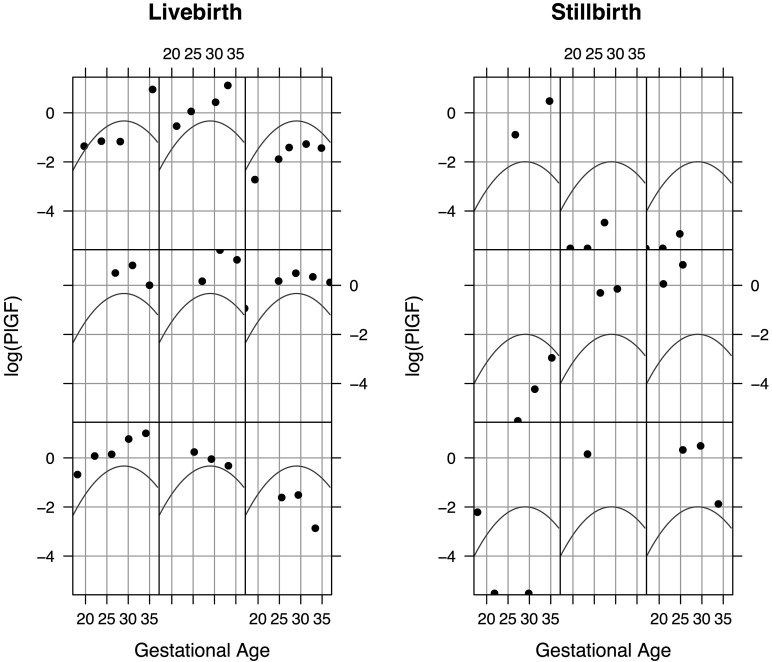
Representative plots of placental growth factor (PlGF) levels over gestation in women destined to have livebirth or stillbirth infant Trellis plots of 18 randomly selected subjects (n = 9 livebirth, n = 9 stillbirth). Solid line depicts fitted regression line from linear mixed effect model (conditional on fixed effects only). Conroy et al. Angiogenic factors across pregnancy in women living with HIV. Am J Obstet Gynecol 2017.

References

    1. World Health Organization . WHO-HIV Department; Geneva, Switzerland: 2015. Global summary of the AIDS epidemic.
    1. Papp E., Mohammadi H., Loutfy M.R. HIV protease inhibitor use during pregnancy is associated with decreased progesterone levels, suggesting a potential mechanism contributing to fetal growth restriction. J Infect Dis. 2015;211:10–18. - PMC - PubMed
    1. Chen J.Y., Ribaudo H.J., Souda S. Highly active antiretroviral therapy and adverse birth outcomes among HIV-infected women in Botswana. J Infect Dis. 2012;206:1695–1705. - PMC - PubMed
    1. Machado E.S., Hofer C.B., Costa T.T. Pregnancy outcome in women infected with HIV-1 receiving combination antiretroviral therapy before versus after conception. Sex Transm Infect. 2009;85:82–87. - PMC - PubMed
    1. Ekouevi D.K., Coffie P.A., Becquet R. Antiretroviral therapy in pregnant women with advanced HIV disease and pregnancy outcomes in Abidjan, Cote d'Ivoire. AIDS. 2008;22:1815–1820. - PubMed

Publication types

MeSH terms

Substances