Review
. 2018 Feb:50:1-8.
doi: 10.1016/j.coi.2017.09.005. Epub 2017 Oct 12.

Innate sensing of cancer's non-immunologic hallmarks

Affiliations
Review

Innate sensing of cancer's non-immunologic hallmarks

Ruth Seelige et al. Curr Opin Immunol. 2018 Feb.

Abstract

A cancer mass consists of a complex composition of cancer cells, stromal cells, endothelial cells and also immune cells, which can represent more than half of the cellularity of a solid cancer. These immune cells become activated when they sense cancer antigens and stress ligands. Innate immune cells also detect various aspects of cellular stress that characterize a growing tumor mass. These key hallmarks of cellular stress are also detected by the cancer cell itself. In this review, we highlight studies that show that the cancer cell itself could be considered an 'innate cell' that senses and reacts to non-immunologic hallmarks of cancer, including displaced nucleic acids, proteotoxic stress, oxidative stress, and metabolic alterations.


Conflict of interest statement

Conflict of Interest Statement

The authors declare no conflicts of interest regarding this manuscript.

Figures
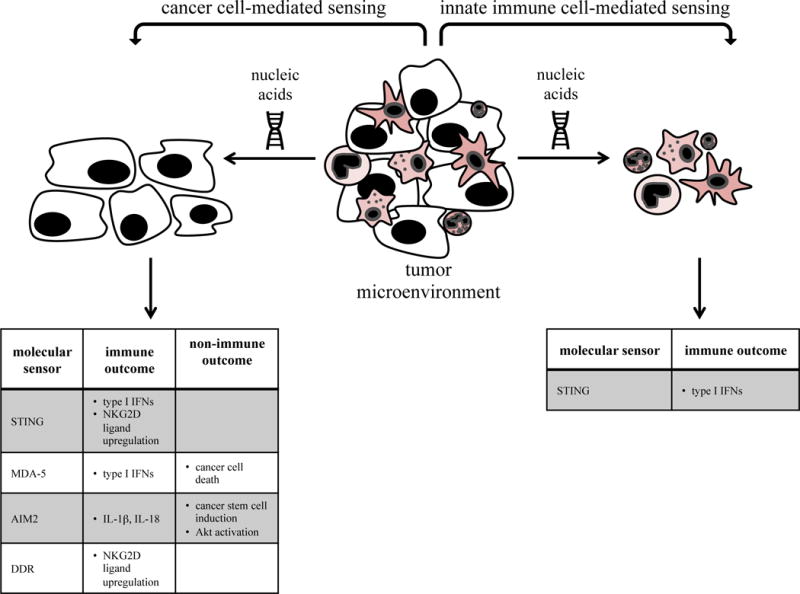
Fig. 1
Fig. 1. Sensing of nucleic acids by cancer cells and innate immune cells
Distinct molecular sensors mediate nucleic acid sensing by either cancer cells (left) or innate immune cells (right).
Fig. 2
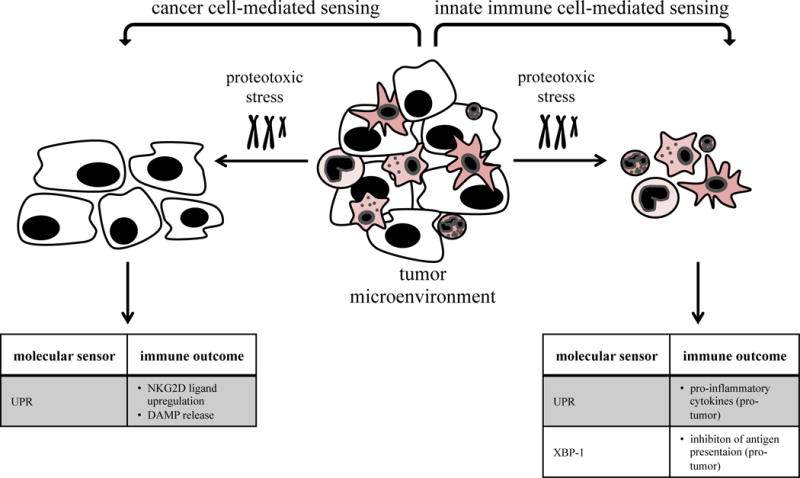
Fig. 2. Sensing of proteotoxic stress by cancer cells and innate immune cells
Cancer cells and innate immune cells can experience and sense proteotoxic stress induced by hyperploidy, proteotoxic stress-inducing agents or cell-to-cell transmission. Proteotoxic stress is sensed by the UPR, resulting in distinct outcomes on innate immunity.
Fig. 3
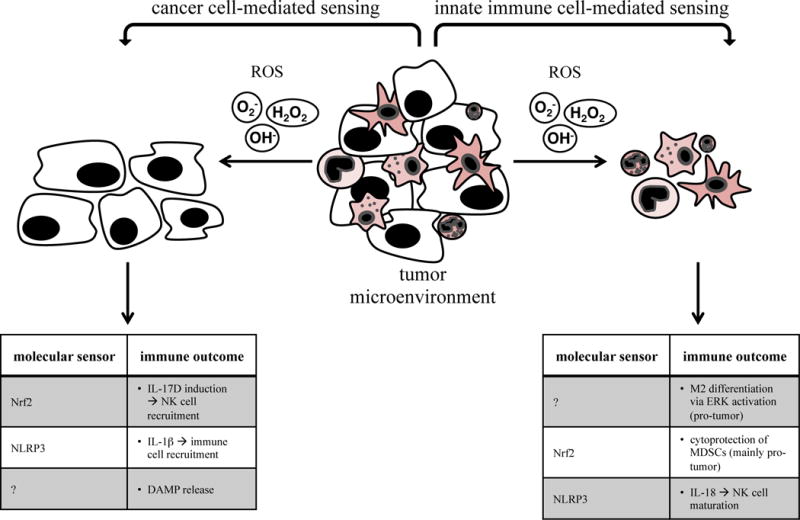
Fig. 3. Sensing of oxidative stress by cancer cells and innate immune cells
Reactive oxygen species in the tumor environment are produced and sensed by both cancer cells and innate immune cells. They are mostly detrimental, but can also induce anti-cancer immunity.
Fig. 4
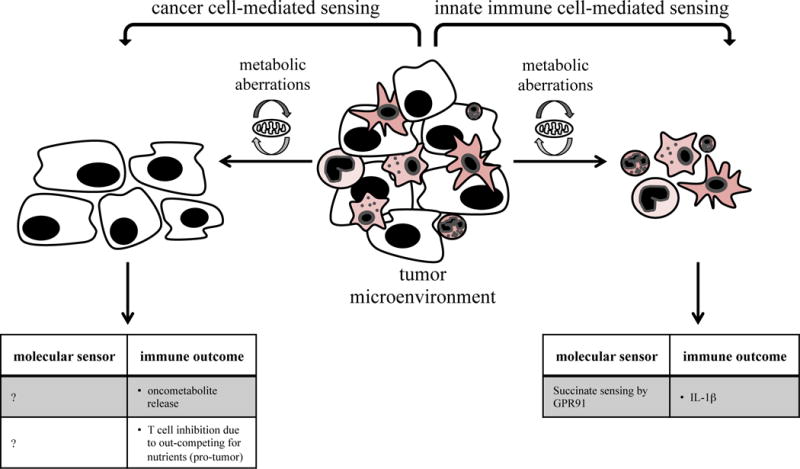
Fig. 4. Sensing of metabolic aberrations by cancer cells and innate immune cells
A progressively growing tumor features several metabolic aberrations such as hypoxia, abundant ROS and oncometabolites or nutrient deprivation. Those can be sensed by both cancer cells and innate immune cells with different outcomes on immunity.

References

    1. Hanahan D, Weinberg RA. The hallmarks of cancer. Cell. 2000;100(1):57–70. - PubMed
    1. Luo J, Solimini NL, Elledge SJ. Principles of cancer therapy: oncogene and non-oncogene addiction. Cell. 2009;136(5):823–37. - PMC - PubMed
    1. Seelige R, Searles S, Bui JD. Mechanisms regulating immune surveillance of cellular stress in cancer. Cell Mol Life Sci. 2017 - PMC - PubMed
    1. Hanahan D, Weinberg RA. Hallmarks of cancer: the next generation. Cell. 2011;144(5):646–74. - PubMed
    1. Brzostek-Racine S, Gordon C, Van Scoy S, Reich NC. The DNA damage response induces IFN. J Immunol. 2011;187(10):5336–45. - PMC - PubMed

Publication types