Review
. 2017 Dec;4(2):209-218.
doi: 10.1007/s40744-017-0085-z. Epub 2017 Oct 14.

Treatment Outcomes with Biosimilars: Be Aware of the Nocebo Effect

Affiliations
Review

Treatment Outcomes with Biosimilars: Be Aware of the Nocebo Effect

Mourad F Rezk et al. Rheumatol Ther. 2017 Dec.

Abstract

Over the years, biologic agents have proven their importance in the management of chronic autoimmune diseases, such as rheumatoid arthritis, psoriasis, and inflammatory bowel disease. Biosimilars, which are biologic medicines, are highly similar to approved biologic medicines, and are comprehensively developed and rigorously tested to ensure efficacy and safety are similar to the reference product. A broader armamentarium of biosimilars is expected to improve patients' access to safe and effective biologic medicines, thus offering benefits to healthcare systems around the globe. Here we consider the factors that may compromise the benefits of biosimilars being realized, including patient and physician perception of biosimilars, and an often overlooked factor, the nocebo effect, which is re-emerging with the widespread adoption of biosimilar medicines. We have also described a variety of strategies and recommendations that could help limit the nocebo effect.

Funding: Biogen.

Keywords: Adherence; Biologic; Biosimilar; Nocebo.


Figures
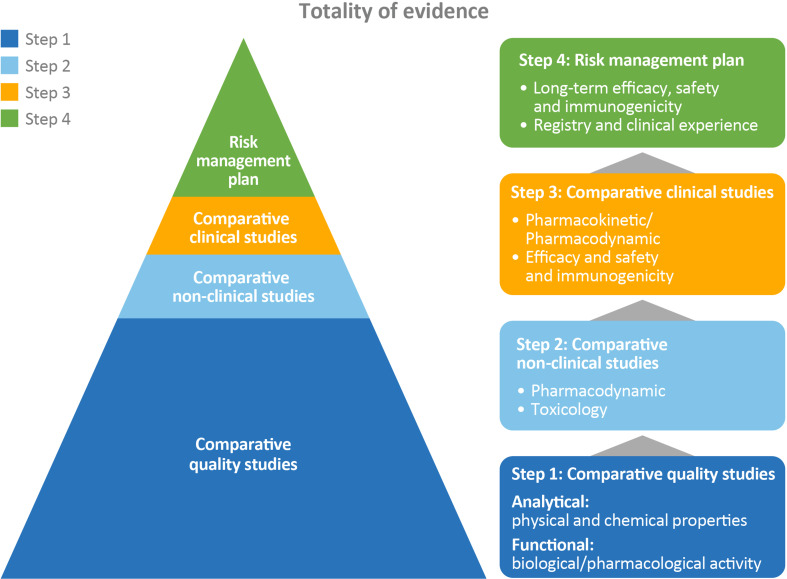
Fig. 1
Fig. 1
Data requirements for approval of a biosimilar [14]. Regulatory agencies in the EU and USA have defined a pathway for the development of a biosimilar that is designed to leverage the existing information and clinical experience from the reference product, resulting in reduced clinical trials for the biosimilar candidate and a greater preponderance of analytical characterization as well as non-clinical and clinical pharmacology data. In order for the biosimilar candidate to leverage the clinical history of the reference product, the biosimilar must demonstrate analytically similarity to the reference product. The higher the similarity at the analytical level, the lower the uncertainty will be that the biosimilar will behave differently at the clinical level. This is a stepwise approach to establishing biosimilarity where each step must be satisfied as no steps can refute significant differences in the preceding steps. Adapted from Biosimilars in the EU. Available at: http://www.ema.europa.eu/docs/en_GB/document_library/Leaflet/2017/05/WC500226648.pdf (Accessed August 2017)
Fig. 2
Fig. 2
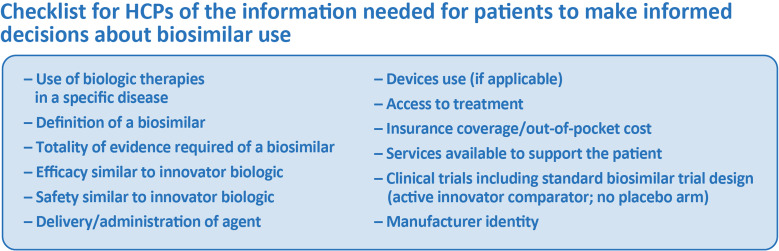
A checklist for HCPs with the information needed for patients to make informed decisions about biosimilar use. Patient Preference and Adherence by Dove Press Limited. Reproduced with permission of Dove Press Limited in the format Republish in a journal/magazine via Copyright Clearance Center. [7]
Fig. 3
Fig. 3
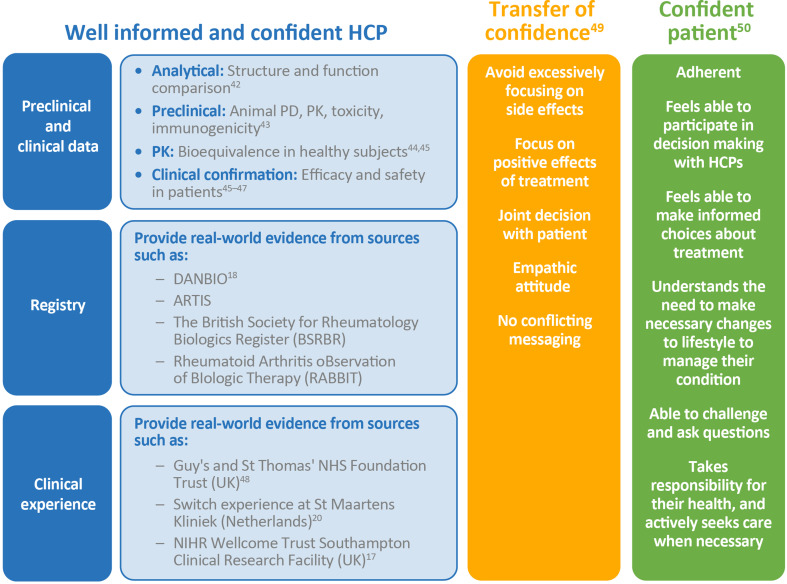
Confidence of HCPs regarding biosimilar agents results in empowered patient treatment decisions in rheumatoid arthritis. HCPs’ awareness of the depth and breadth of biosimilar data and their ability to explain this information effectively to a patient will result in patient confidence in their treatment choice, ultimately leading to an increase in medication adherence and a reduction in the probability of a nocebo effect. The different sources of information available to HCPs to help them gain confidence include RCTs (which demonstrate comparable efficacy and safety between biosimilars and their reference biologics) and an increasing collection of RWE from registries and individual clinical centers that provide further information on use of biosimilars and long-term safety and effectiveness. Furthermore, to assure patient safety, approved biosimilars are under strict pharmacovigilance (the monitoring and tracking of drug safety over time). HCP healthcare professional, PD pharmacodynamics, PK pharmacokinetics, RCT randomized clinical trials, RWE real-world evidence

References

    1. Rischin A, Östör AJ. Update on biosimilars in rheumatology. Inflammopharmacology. 2017;25:177–184. doi: 10.1007/s10787-017-0333-4. - DOI - PubMed
    1. Dorner T, Strand V, Cornes P, et al. The changing landscape of biosimilars in rheumatology. Ann Rheum Dis. 2016;75:974–982. doi: 10.1136/annrheumdis-2016-209166. - DOI - PMC - PubMed
    1. European Public Assessment Reports. http://www.ema.europa.eu/ema/index.jsp?curl=pages/medicines/landing/epar.... Accessed Aug 2017.
    1. IMS report. 2016. http://www.medicinesforeurope.com/wp-content/uploads/2016/08/IMS-Impact-.... Accessed Aug 2017.
    1. Cohen H, Beydoun D, Chien D, et al. Awareness, knowledge, and perceptions of biosimilars among specialty physicians. Adv Ther. 2017;33:2160–2172. doi: 10.1007/s12325-016-0431-5. - DOI - PMC - PubMed

LinkOut - more resources