. 2018:1690:183-200.
doi: 10.1007/978-1-4939-7383-5_15.

Genetic Transformation and Complementation

Affiliations

Genetic Transformation and Complementation

D Scott Samuels et al. Methods Mol Biol. 2018.

Abstract

The disciplines of Borrelia (Borreliella) burgdorferi microbiology and Lyme disease pathogenesis have come to depend on the genetic manipulation of the spirochete. Generating mutants in these recalcitrant bacteria, while not straightforward, is routinely accomplished in numerous laboratories, although there are several crucial caveats to consider. This chapter describes the design of basic molecular genetic experiments as well as the detailed methodologies to prepare and transform competent cells, select for and isolate transformants, and complement or genetically restore mutants.

Keywords: Antibiotic resistance; Borrelia burgdorferi; Complementation; Electroporation; Lyme disease; Molecular genetics; Mutagenesis; Shuttle vector; Spirochete; Transformation.


Figures
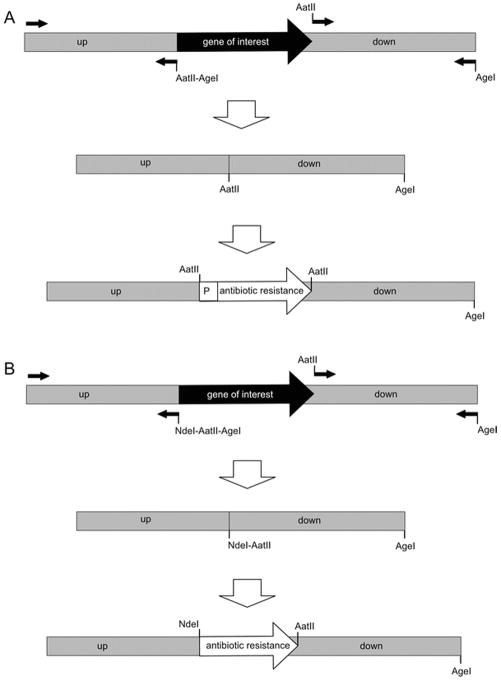
Fig. 1
Fig. 1
Molecular cloning strategies for generating transformation substrates used to disrupt genes by allelic exchange. (a) Mutagenesis by replacing all or most of a gene of interest with an antibiotic resistance cassette transcriptionally driven by a constitutive B. burgdorferi promoter (P). (b) Mutagenesis by replacing all or most of a gene of interest with a promoterless antibiotic resistance gene fused to the promoter for the gene of interest at a synthetic NdeI site. Small arrows represent primers with the relevant restriction enzyme sites (AatII, AgeI, and NdeI); the large black arrow represents the gene of interest to be mutated; the large white arrows represent the genes conferring antibiotic resistance; and the large gray boxes represent the flanking upstream (up) and downstream (down) sequences for recombination.
Fig. 2
Fig. 2
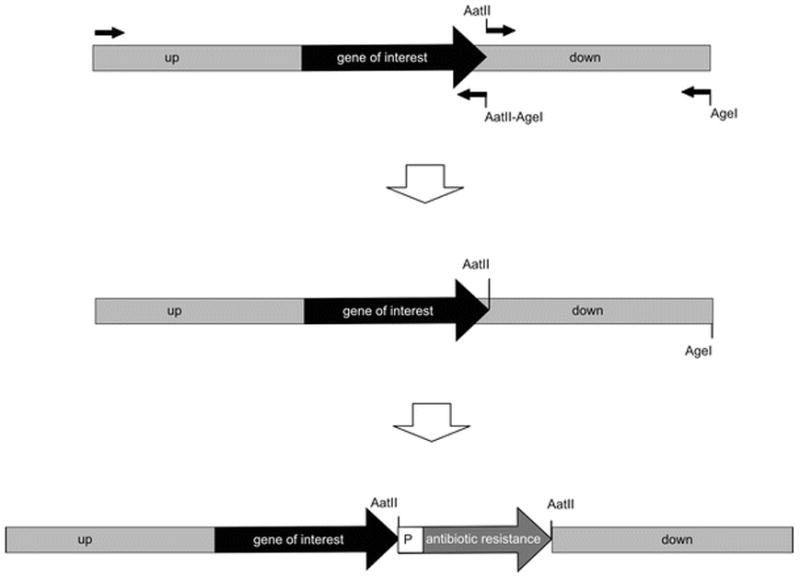
Molecular cloning strategy for generating transformation substrates used to cis-complement mutated genes by genetic reconstitution. Small arrows represent primers with the relevant restriction enzyme sites (AatII and AgeI); the large black arrow represents the gene of interest to be complemented; the large dark gray arrow represents the gene conferring antibiotic resistance, which must be different than the antibiotic resistance gene used to mutate the gene of interest, although the promoter (P) driving expression can be the same; and the large light gray boxes represent the flanking upstream (up) and downstream (down) sequences for recombination.

References

    1. Samuels DS, Mach KE, Garon CF. Genetic transformation of the Lyme disease agent Borrelia burgdorferi with coumarin-resistant gyrB. J Bacteriol. 1994;176:6045–6049. - PMC - PubMed
    1. Samuels DS. Electrotransformation of the spirochete Borrelia burgdorferi. In: Nickoloff JA, editor. Electroporation protocols for microorganisms, Methods in molecular biology. Vol. 47. Humana Press; Totowa, NJ: 1995. pp. 253–259. - PMC - PubMed
    1. Brisson D, Drecktrah D, Eggers CH, Samuels DS. Genetics of Borrelia burgdorferi. Annu Rev Genet. 2012;46:515–536. - PMC - PubMed
    1. Groshong AM, Blevins JS. Insights into the biology of Borrelia burgdorferi gained through the application of molecular genetics. Adv Appl Microbiol. 2014;86:41–143. - PubMed
    1. Lin T, Troy EB, Hu LT, Gao L, Norris SJ. Transposon mutagenesis as an approach to improved understanding of Borrelia pathogenesis and biology. Front Cell Infect Microbiol. 2014;4:63. - PMC - PubMed

Publication types

LinkOut - more resources