


Consumption of commercially produced snack foods and sugar-sweetened beverages during the complementary feeding period in four African and Asian urban contexts
- PMID: 29032629
- PMCID: PMC6865897
- DOI: 10.1111/mcn.12412
Consumption of commercially produced snack foods and sugar-sweetened beverages during the complementary feeding period in four African and Asian urban contexts
Abstract
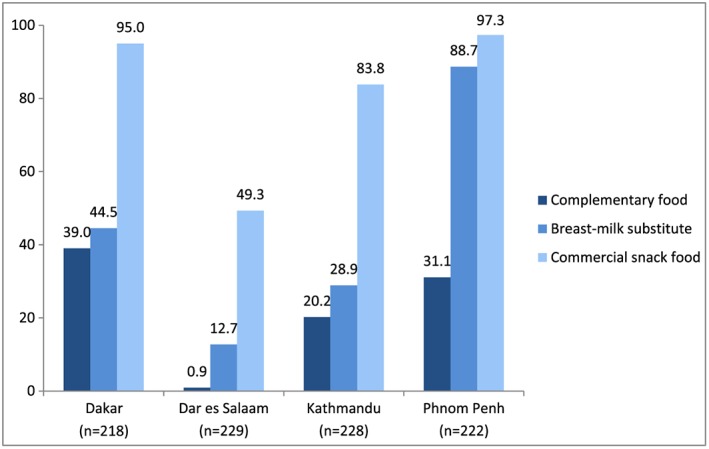
The availability and consumption of commercially produced foods and beverages have increased across low-income and middle-income countries. This cross-sectional survey assessed consumption of commercially produced foods and beverages among children 6-23 months of age, and mothers' exposure to promotions for these products. Health facility-based interviews were conducted among 218 randomly sampled mothers utilizing child health services in Dakar, Senegal; 229 in Dar es Salaam, Tanzania; 228 in Kathmandu Valley, Nepal; and 222 in Phnom Penh, Cambodia. In the day prior to the interview, 58.7% of 6-23-month-olds in Dakar, 23.1% in Dar es Salaam, 74.1% in Kathmandu Valley, and 55.0% in Phnom Penh had consumed a commercially produced snack food. In the previous week, the majority of children in Dakar (79.8%), Kathmandu Valley (91.2%), and Phnom Penh (80.6%) had consumed such products. Consumption of commercially produced sugar-sweetened beverages was noted among 32.0% of Phnom Penh, 29.8% of Dakar, 23.1% of Dar es Salaam, and 16.2% of Kathmandu Valley children. Maternal education was negatively associated with commercial snack food consumption in Dakar and Kathmandu Valley. Children of Phnom Penh mothers in the lowest wealth tercile were 1.5 times more likely to consume commercial snack food products, compared to wealthier mothers. These snack consumption patterns during the critical complementary feeding period demand attention; such products are often high in added sugars and salt, making them inappropriate for infants and young children.
Keywords: child feeding; complementary feeding; double burden of malnutrition; infant and child nutrition; infant feeding; nutrition transition.
© 2017 John Wiley & Sons Ltd.
Conflict of interest statement
The authors declare that they have no conflicts of interest.
Figures
References
-
- Agence Nationale de la Statistique et de la Démographie (ANSD) [Senegal], and ICF International . (2013). Continuous Demographic and Health Survey in Senegal (Continuous DHS) 2012–2013. Calverton, Maryland, USA: ANSD and ICF International.
-
- Agence Nationale de la Statistique et de la Démographie (ANSD) [Sénégal], et ICF International (2015). Sénégal: Enquête Démographique et de Santé Continue (EDSContinue 2014). Rockville, Maryland, USA: ANSD et ICF International.
-
- Angeles‐Agdeppa, I. , Lana, R. D. , & Barba, C. V. (2003). A case study on dual forms of malnutrition among selected households in District 1, Tondo, Manila. Asia Pacific Journal of Clinical Nutrition, 12(4), 438–446. - PubMed
-
- Anzman‐Frasca, S. , Stifter, C. A. , & Birch, L. L. (2012). Temperament and childhood obesity risk: A review of the literature. Journal of Developmental and Behavioral Pediatrics, 33(9), 732–745. - PubMed
Publication types
MeSH terms
Substances
LinkOut - more resources
Full Text Sources
Other Literature Sources
Medical
