Review
. 2017 Sep 27:11:2871-2890.
doi: 10.2147/DDDT.S142337. eCollection 2017.

The new era of nanotechnology, an alternative to change cancer treatment

Affiliations
Review

The new era of nanotechnology, an alternative to change cancer treatment

Ancuta Jurj et al. Drug Des Devel Ther. .

Abstract

In the last few years, nanostructures have gained considerable interest for the safe delivery of therapeutic agents. Several therapeutic approaches have been reported, such as molecular diagnosis, disease detection, nanoscale immunotherapy and anticancer drug delivery that could be integrated into clinical use. The current paper aims to highlight the background that supports the use of nanoparticles conjugated with different types of therapeutic agents, applicable in targeted therapy and cancer research, with a special emphasis on hematological malignancies. A particular key point is the functional characterization of nonviral delivery systems, such as gold nanoparticles, liposomes and dendrimers. The paper also presents relevant published data related to microRNA and RNA interference delivery using nanoparticles in cancer therapy.

Keywords: RNA interference; dendrimers; gold nanoparticles; liposomes; microRNA; nanotechnology.


Conflict of interest statement

Disclosure The authors report no conflicts of interest in this work.

Figures
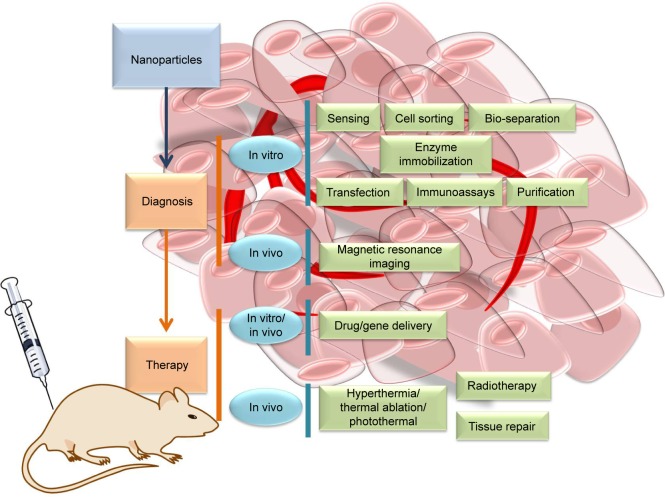
Figure 1
Figure 1
Different applications of nanoparticles involved in therapy and diagnosis.
Figure 2
Figure 2
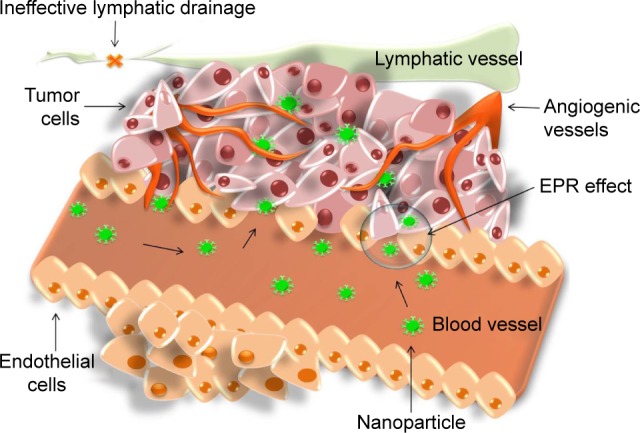
Passive targeting relies on cell-specific functions or local environments specific to target the tissue to facilitate uptake and accumulation in tumor tissues and inflammatory sites. Abbreviation: EPR, enhanced permeability and retention.
Figure 3
Figure 3
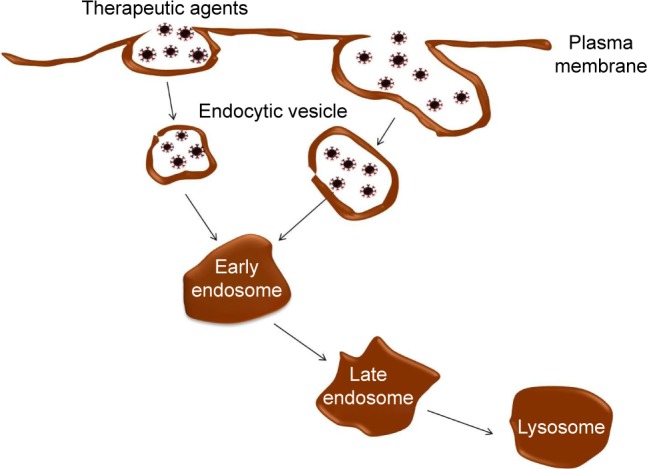
Nanoparticles internalization. Nanoparticles enter the cell via endocytosis, which is the main pathway for crossing the cellular membrane. Also, nanoparticles are internalized into the cells, and the cargo is released inside. Nanoparticles administered are cleared in the liver and spleen, which remain in these organs for a long time and are then uptaken by macrophages. Then, the nanoparticles exit the cell via exocytosis.
Figure 4
Figure 4
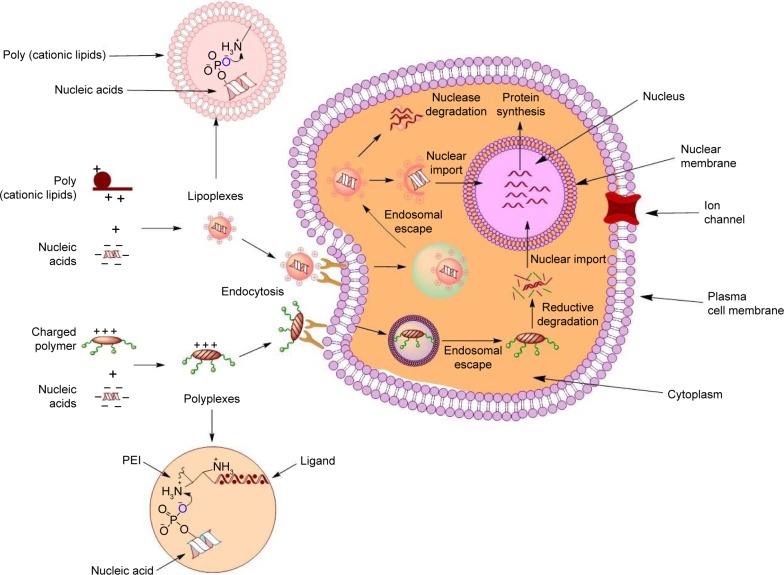
Nonviral gene delivery using lipoplexes and polyplexes. Nucleic acid is complexed with these two types of nonviral delivery systems, and it is internalized through receptor-mediated endocytosis. A large amount of complexes are degraded after their internalization in the endosomal compartments. Only a small fraction enters the nucleus and elicits desired gene expression. Abbreviation: PEI, polyethylenimine.
Figure 5
Figure 5
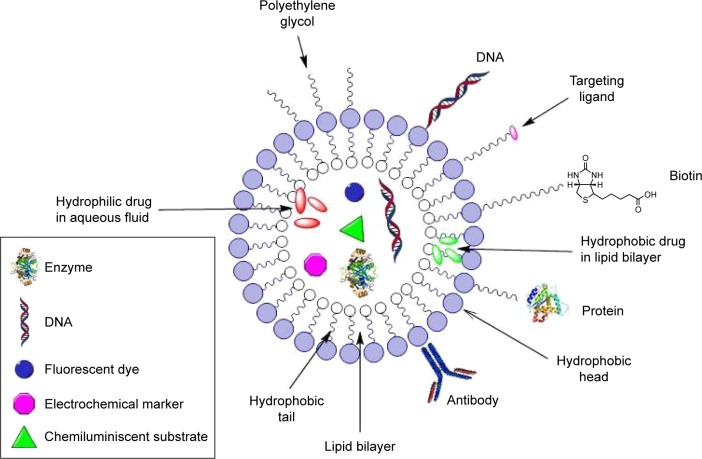
Structure of liposomes. Liposomes are colloidal drug carriers consisting of a phospholipid bilayer surface enclosing an aqueous core. Hydrophilic components can be entrapped inside the aqueous core, while the lipophilic components can be incorporated between the lipid bilayers. On the liposomes surface, different particles that target the interest cells can be attached. To avoid the immune system response, the liposomes surface is loaded with a polymer called polyethylene glycol. Thus, the cargo is protected and is discharged into the target cells.
Figure 6
Figure 6
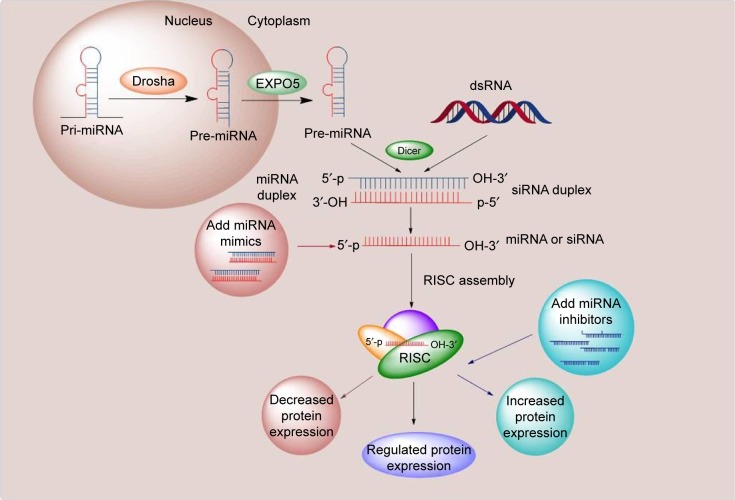
miRNA and siRNA mechanism. miRNA is first transcribed in the nucleus as primary miRNA and then is activated by the RNase III Drosha to create precursor miRNA. The siRNA mechanism starts from dsRNA being transferred into cytoplasm. miRNA mimic involves the reintroduction of a tumor suppressor miRNA to restore a loss of function. Anti-miRNA traps the endogenous miRNA in a configuration that is unable to be processed by RISC. Abbreviations: miRNA, microRNA; siRNA, small interfering RNA; dsRNA, double-stranded RNA; RISC, RNA-induced silencing complex; pri-miRNA, primary microRNA; pre-miRNA, precursor microRNA; expo5, exportin-5.

References

    1. Rosenzweig SA. Acquired resistance to drugs targeting receptor tyrosine kinases. Biochem Pharmacol. 2012;83(8):1041–1048. - PMC - PubMed
    1. Gultekin M, Dursun P, Vranes B, et al. Gynecologic oncology training systems in Europe: a report from the European network of young gynaecological oncologists. Int J Gynecol Cancer. 2011;21(8):1500–1506. - PubMed
    1. Braicu C, Chiorean R, Irimie A, et al. Novel insight into triple-negative breast cancers, the emerging role of angiogenesis, and antiangiogenic therapy. Expert Rev Mol Med. 2016;18:e18. - PubMed
    1. Vlad C, Kubelac P, Vlad D, Irimie A, Achimas Cadariu P. Evaluation of clinical, morphopathological and therapeutic prognostic factors in rectal cancer. Experience of a tertiary oncology center. J BUON. 2015;20(1):92–99. - PubMed
    1. Herbrink M, Nuijen B, Schellens JH, Beijnen JH. Variability in bioavailability of small molecular tyrosine kinase inhibitors. Cancer Treat Rev. 2015;41(5):412–422. - PubMed

LinkOut - more resources