. 2017 Sep 28:8:1190.
doi: 10.3389/fimmu.2017.01190. eCollection 2017.

Unexpectedly High Prevalence of Common Variable Immunodeficiency in Finland

Affiliations

Unexpectedly High Prevalence of Common Variable Immunodeficiency in Finland

Jannica S Selenius et al. Front Immunol. .

Abstract

Background: Common variable immunodeficiency (CVID) is the most common primary immunodeficiency. Prevalence varies greatly between countries and studies. Most diagnostic criteria include hypogammaglobulinemia and impaired vaccine response.

Aim: To evaluate the minimum prevalence as well as the clinical and immunological phenotypes of CVID in Southern Finland.

Methods: We performed a cross-sectional study to assess all adult CVID patients followed up in three hospital districts in Southern and South-Eastern Finland between April 2007 and August 2015. CVID diagnosis was based, with a minor modification, on the ESID/PAGID criteria for primary CVID. Antipolysaccharide responses to Pneumovax® were defined as impaired only if 50% or more of the serotypes did not reach a level of 0.35 µg/mL after vaccination. We further characterized the patients' B cell phenotypes and complications associated with CVID.

Results: In total, 9 patients were excluded due to potential secondary causes before diagnosis. ESID/PAGID criteria were met by 132 patients (males 52%), of whom, 106 had "probable" and 26 "possible CVID." Based on the population statistics in the three hospital districts, the minimum adult prevalence per 100,000 inhabitants in Finland for all CVID ("probable CVID," respectively) patients was 6.9 (5.5). In the highest prevalence district (Helsinki and Uusimaa), the prevalence was 7.7 (6.1). CVID patients suffer from frequent complications. Ten patients died during follow-up. Of probable CVID patients, 73% had more than one clinical phenotype. Intriguingly, gradual B cell loss from peripheral blood during follow-up was seen in as many as 16% of "probable CVID" patients. Patients with possible CVID displayed somewhat milder clinical and laboratory phenotypes than probable CVID patients. We also confirm that large granular lymphocyte lymphoproliferation is a CVID-associated complication.

Conclusion: The prevalence of CVID in Finland appears the highest recorded, likely reflecting the genetic isolation and potential founder effects in the Finnish population. Studies to discover potential gene variants responsible for the high prevalence in Finland thus seem warranted. Increased awareness of CVID among physicians would likely lead to earlier diagnosis and improved quality of care.

Keywords: common variable immunodeficiency; hypogammaglobulinemia; prevalence; primary antibody deficiency; primary immunodeficiency; secondary antibody deficiency.


Figures

Figure 1
Figure 1
Age at diagnosis (A) and age at the time of the study (B). 106 patients with “probable CVID.”
Figure 2
Figure 2
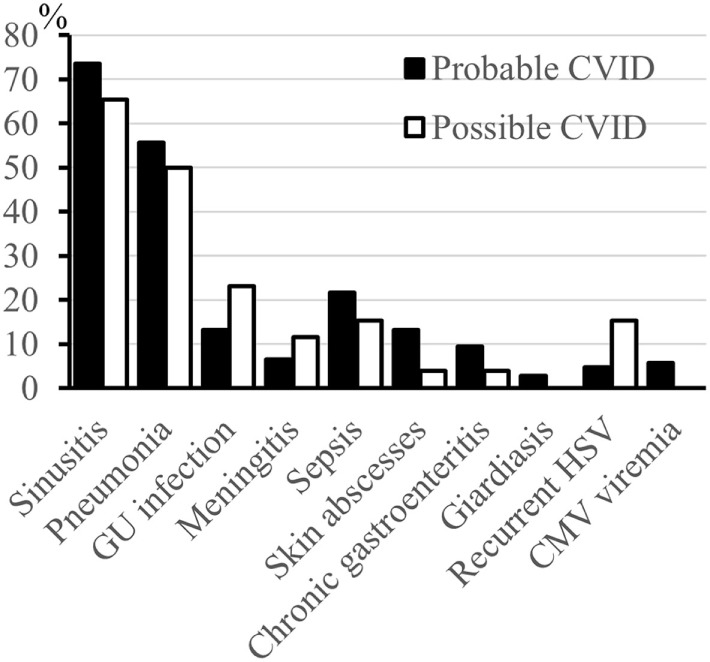
Infections (%) in probable and possible CVID patients. No statistical differences were noted between “probable” and “possible CVID” patients. GU, genitourinary. Sepsis includes patients with a severe bacteremic infection leading to hospitalization.
Figure 3
Figure 3
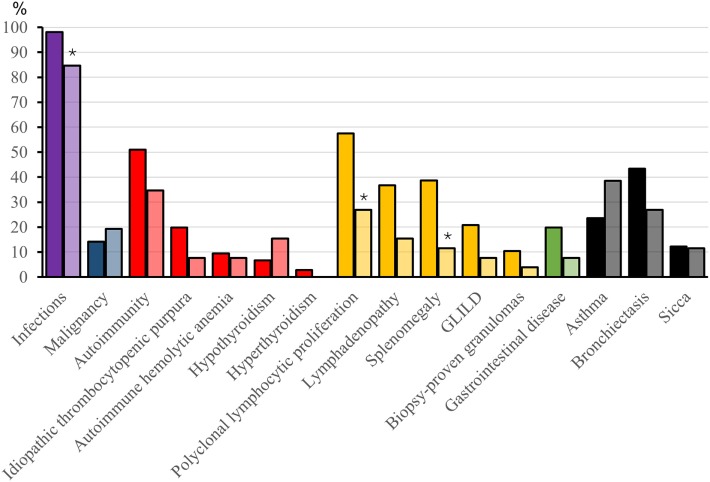
Complications (%) in probable and possible CVID patients. Asterisks mark statistical significance between “probable” and “possible CVID” patients, *p < 0.05 (Fisher’s 2-sided Exact test or Pearson Chi-square, as appropriate). For each complication, data are presented with pairwise bars for “probable” and “possible CVID” where “probable CVID” is first and with darker color. Sicca diagnosis was based on doctor-assessed symptoms and findings.
Figure 4
Figure 4
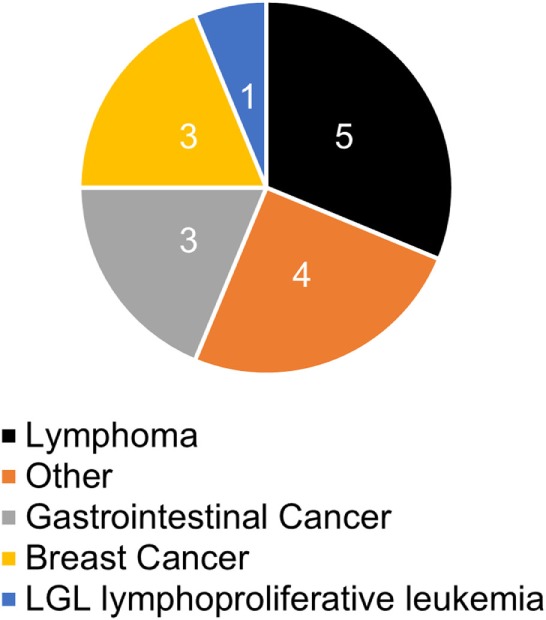
Malignancies (%) in probable CVID patients. Other four cancers include one cervical cancer and one renal carcinoma, one melanoma, and one myeloid sarcoma. LGL, large granular lymphocytic.
Figure 5
Figure 5
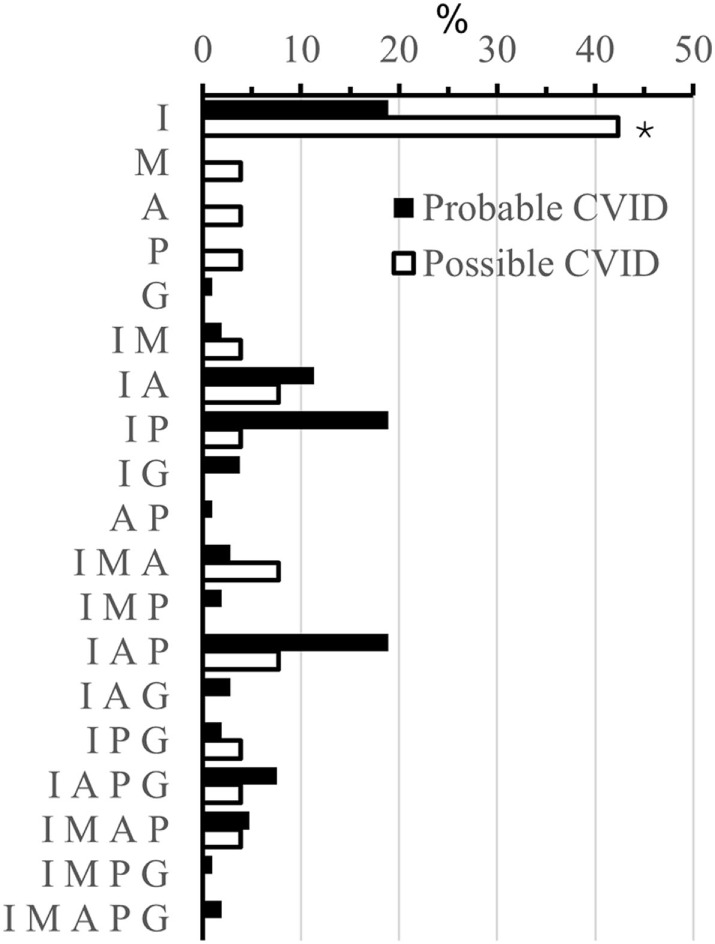
Different phenotypes (%) in probable and possible CVID. Phenotypes are abbreviated as follows; also their combinations are used: I, infections; M, malignancies; A, autoimmunity; P, polyclonal lymphocytic proliferation; G, gastrointestinal disease. Asterisks mark statistical significance between “probable” and “possible CVID” patients, *p < 0.05 (Fisher’s 2-sided Exact test).
Figure 6
Figure 6
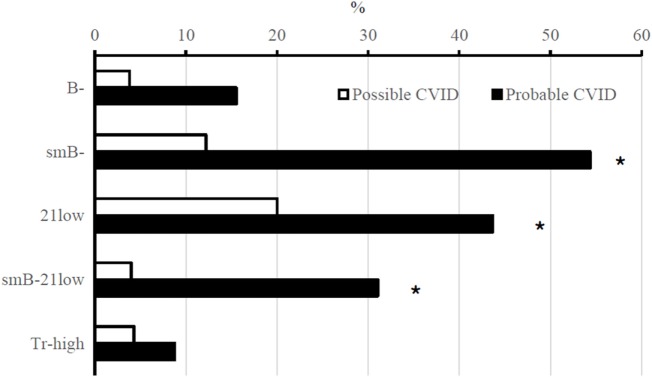
B-cell phenotyping results (%) in probable and possible CVID patients. Abbreviations: B, CD19+ B cells ≤1% of lymphocytes; smB, switched memory B cells ≤2% of B cells; 21low, CD21low cells ≥10% of B cells; Tr-high, transitional B cells ≥9% of B cells (in total, 129 CVID patients had B-cell phenotyping data available. Transitional B cells had been studied in 114 subjects). Asterisks mark statistical significance between “probable” and “possible CVID” patients, *p < 0.01 (χ2-test).

References

    1. CEREDIH: The French PID Study Group. The French national registry of primary immunodeficiency diseases. Clin Immunol (2010) 135:264–72.10.1016/j.clim.2010.02.021 - DOI - PubMed
    1. Matamoros Florí N, Mila Llambi J, Español Boren T, Raga Borja S, Fontan Casariego G. Primary immunodeficiency syndrome in Spain: first report of the National Registry in Children and Adults. J Clin Immunol (1997) 17:333–9.10.1023/A:1027382916924 - DOI - PubMed
    1. Stray-Pedersen A, Abrahamsen TG, Froland SS. Primary immunodeficiency diseases in Norway. J Clin Immunol (2000) 20:477–85.10.1023/A:1026416017763 - DOI - PubMed
    1. Kilic SS, Ozel M, Hafizoglu D, Karaca NE, Aksu G, Kutukculer N. The prevalences and patient characteristics of primary immunodeficiency diseases in Turkey – two centers study (2013). J Clin Immunol (2013) 33:74–83.10.1007/s10875-012-9763-3 - DOI - PubMed
    1. Edgar JDM, Buckland M, Guzman D, Conlon NP, Knerr V, Bangs C, et al. The United Kingdom primary immune deficiency (UKPID) registry: report of the first 4 years’ activity 2008-2012. Clin Exp Immunol (2014) 175:68–78.10.1111/cei.12172 - DOI - PMC - PubMed

LinkOut - more resources