


Prevalence of mental health conditions and relationship with general health in a whole-country population of people with intellectual disabilities compared with the general population
- PMID: 29034100
- PMCID: PMC5620469
- DOI: 10.1192/bjpo.bp.117.005462
Prevalence of mental health conditions and relationship with general health in a whole-country population of people with intellectual disabilities compared with the general population
Abstract
Background: There are no previous whole-country studies on mental health and relationships with general health in intellectual disability populations; study results vary.
Aims: To determine the prevalence of mental health conditions and relationships with general health in a total population with and without intellectual disabilities.
Method: Ninety-four per cent completed Scotland's Census 2011. Data on intellectual disabilities, mental health and general health were extracted, and the association between them was investigated.
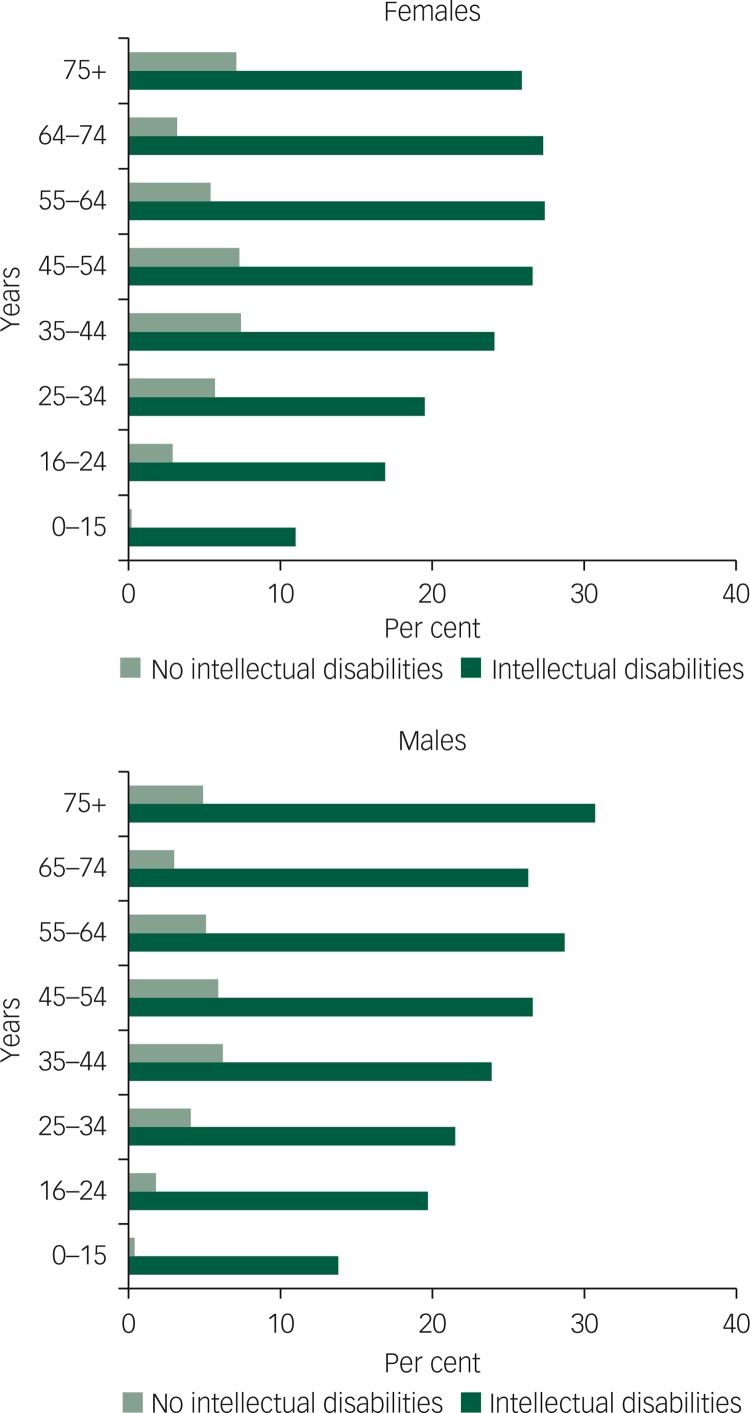
Results: A total of 26 349/5 295 403 (0.5%) had intellectual disabilities. In total, 12.8% children, 23.4% adults and 27.2% older adults had mental health conditions compared with 0.3, 5.3 and 4.5% of the general population. Intellectual disabilities predicted mental health conditions; odds ratio (OR)=7.1 (95% CI 6.8-7.3). General health was substantially poorer and associated with mental health conditions; fair health OR=1.8 (95% CI 1.7-1.9), bad/very bad health OR=4.2 (95% CI 3.9-4.6).
Conclusions: These large-scale, whole-country study findings are important, given the previously stated lack of confidence in comparative prevalence results, and the need to plan services accordingly.
Declaration of interest: None.
Copyright and usage: © The Royal College of Psychiatrists 2017. This is an open access article distributed under the terms of the Creative Commons Non-Commercial, No Derivatives (CC BY-NC-ND) license.
Figures
References
-
- Cooper S-A, Smiley E, Morrison J, Allan L, Williamson A. Prevalence of and associations with mental ill-health in adults with intellectual disabilities. Br J Psychiatry 2007; 190: 27–35. - PubMed
-
- Emerson E, Hatton C. The mental health of children and adolescents with intellectual disabilities in Britain. Br J Psychiatry 2007; 191: 493–9. - PubMed
-
- National Institute for Health and Care Excellence. Mental Health Problems in People with Learning Disabilities: Prevention, Assessment and Management. NICE Clinical Guideline 54. NICE, 2016. - PubMed
-
- Einfeid SL, Ellis LA, Emerson E. Comorbidity if intellectual disability and mental disorder in children and adolescents: a systematic review. J Intellect Dev Disabil 2011; 36: 137–43. - PubMed
-
- Buckles J, Luckasson R, Keefe E. A systematic review of the prevalence of psychiatric disorders in adults with intellectual disabilities, 2003–2010. J Ment Health Res Intellect Disabil 2013; 6: 181–207.
LinkOut - more resources
Full Text Sources
Other Literature Sources
Research Materials
