


Decision aids to increase living donor kidney transplantation
- PMID: 29034143
- PMCID: PMC5638125
- DOI: 10.1007/s40472-017-0133-1
Decision aids to increase living donor kidney transplantation
Abstract
Purpose of review: For the more than 636,000 adults with end-stage renal disease (ESRD) in the U.S., kidney transplantation is the preferred treatment compared to dialysis. Living donor kidney transplantation (LDKT) comprised 31% of kidney transplantations in 2015, an 8% decrease since 2004. We aimed to summarize the current literature on decision aids that could be used to improve LDKT rates.
Recent findings: Decision aids are evidence-based tools designed to help patients and their families make difficult treatment decisions. LDKT decision aids can help ESRD patients, patients' family and friends, and healthcare providers engage in treatment decisions and thereby overcome multifactorial LDKT barriers.
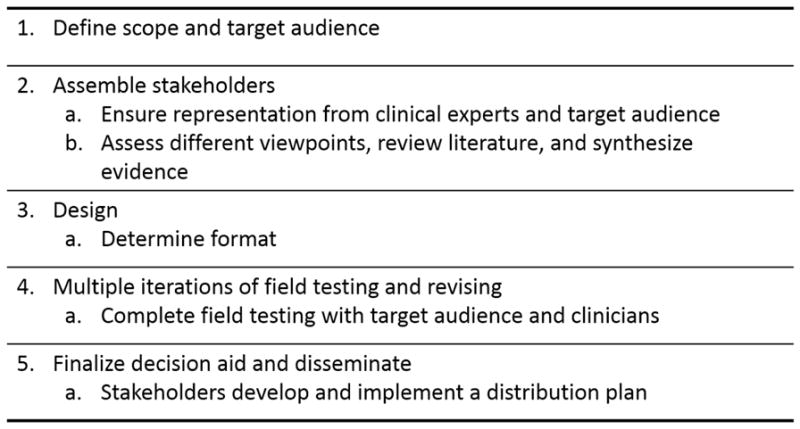
Summary: We identified 12 LDKT decision aids designed to provide information about LDKT, and/or to help ESRD patients identify potential living donors, and/or to help healthcare providers make decisions about treatment for ESRD or living donation. Of these, 4 were shown to be effective in increasing LDKT, donor inquiries, LDKT knowledge, and willingness to discuss LDKT. Although each LDKT decision aid has limitations, adherence to decision aid development guidelines may improve decision aid utilization and access to LDKT.
Keywords: dialysis; end stage renal disease; kidney transplantation; living donor; living donor kidney transplantation.
Figures
References
-
- Laupacis A, et al. A study of the quality of life and cost-utility of renal transplantation. Kidney international. 1996;50(1):235–242. - PubMed
-
- System, U.S.R.D. USRDS 2015 Annual Data Report: Atlas of Chronic Kidney Disease and End-Stage Renal Disease in the United States. National Institute of Health; National Institute of Diabetes and Digestive and Kidney Diseases; 2015.
-
- System, U.S.R.D. U S Renal Data System. USRDS 2013 Annual Data Report: Atlas of Chronic Kidney Disease and End-Stage Renal Disease in the United States. National Institutes of Health, National Institute of Diabetes and Digestive and Kidney Diseases; Bethesda, MD: 2013.
Grants and funding
LinkOut - more resources
Full Text Sources
Other Literature Sources
Research Materials