. 2017 Dec 15;45(22):12715-12722.
doi: 10.1093/nar/gkx879.

Global inhibition of transcription causes an increase in histone H2A.Z incorporation within gene bodies

Affiliations

Global inhibition of transcription causes an increase in histone H2A.Z incorporation within gene bodies

Anahita Lashgari et al. Nucleic Acids Res. .

Abstract

H2A.Z histone variant is an important regulator of gene transcription, which is enriched at regulatory regions but is also found within gene bodies. Recent evidence suggests that active recruitment of H2A.Z within gene bodies is required to induce gene repression. In contrast to this view, we show that global inhibition of transcription results in H2A.Z accumulation at gene transcription start sites, as well as within gene bodies. Our results indicate that accumulation of H2A.Z within repressed genes can also be a consequence of the repression of gene transcription rather than an active mechanism required to establish the repression.


Figures

Figure 1.
Figure 1.
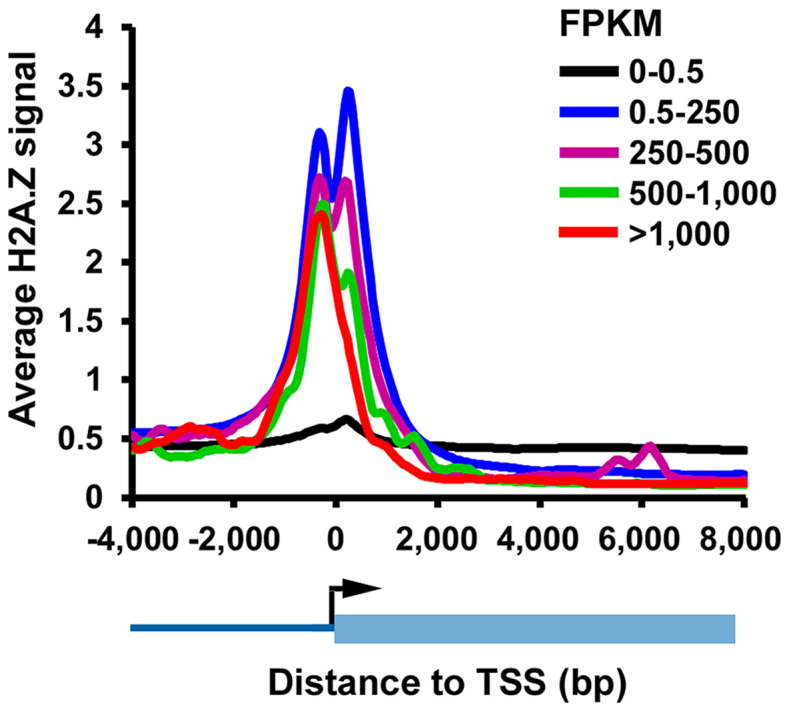
The presence of H2A.Z within genes anti-correlates with transcription. Genes were grouped based on their FPKM values and the average ChIP-seq signal of H2A.Z is shown at TSS for each group.
Figure 2.
Figure 2.
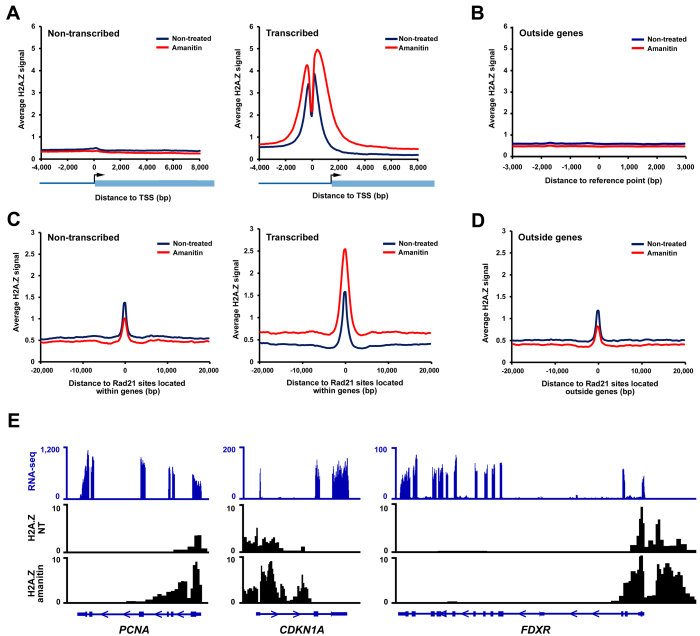
Inhibition of transcription specifically increases the incorporation of H2A.Z within genes. Average H2A.Z ChIP-seq signal at different location following treatment of cells with 8 μM α-amanitin for 24 h: (A) at TSS of non-transcribed (FPKM = 0; n = 14 676) or transcribed (FPKM > 0.5; n = 5046) non-overlapping genes; (C) at regions located outside genes (n = 4238). The average distance of these sites to the closest gene is >30 kb; (C) at Rad21 sites located within non-transcribed (FPKM = 0; n = 3193) or transcribed (FPKM > 0.5; n = 9,550) non-overlapping genes; (D) at Rad21 sites located outside genes (n = 8825). (E) Example of genes where H2A.Z accumulates within gene bodies following transcription inhibition. RNA-seq (blue) and H2A.Z ChIP-seq (black) tracks are shown.
Figure 3.
Figure 3.
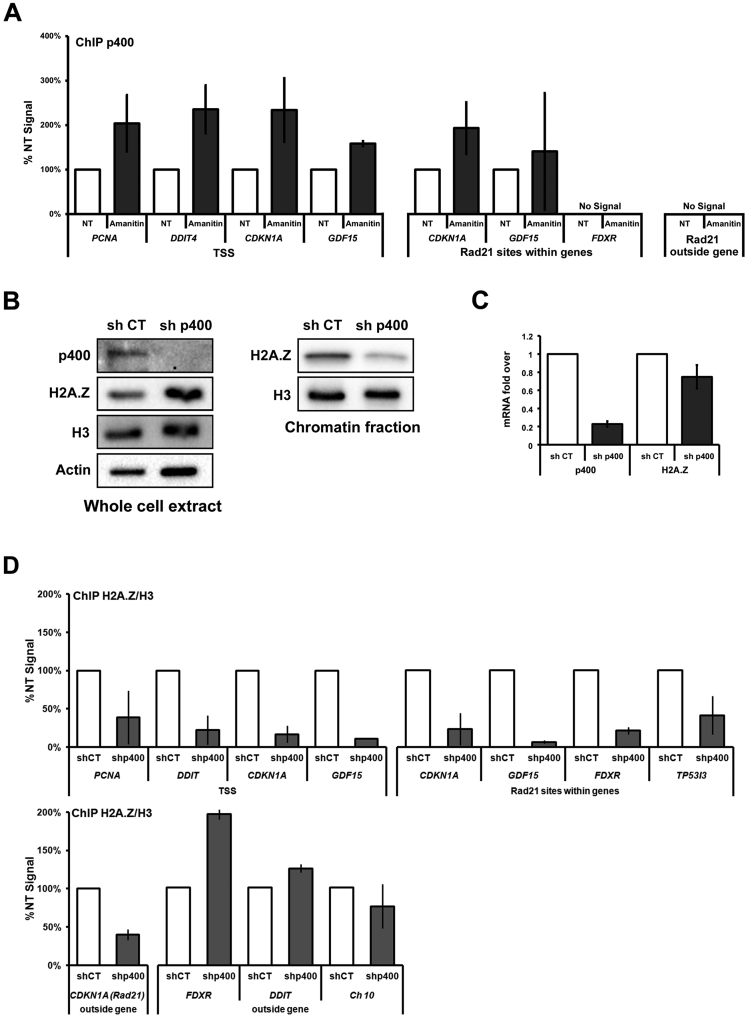
The p400 chromatin-remodeling ATPase is specifically recruited at gene TSSs following transcription inhibition. (A) ChIP experiment showing p400 binding following treatment of cells with 8 μM α-amanitin for 24 h. (B) Immunoblot analysis of p400, H2A.Z, H3 and actin in p400 depleted HCT116 cells. (C) RT-qPCR of p400 and H2A.Z in p400 depleted HCT116 cells. (D) ChIP analysis of H2A.Z enrichment following p400 depletion using shRNA. knockdown at different p53 target genes. The primers used in these experiments correspond to the mentioned sites for each genes. Chr10 correspond to an intergenic region at chromosome 10. Data presented as % non-treated (NT) signal (% input of H2A.Z/H3 considered as 100 and % input of H2A.Z/H3 of amanitin treatment normalized to respective NT).
Figure 4.
Figure 4.
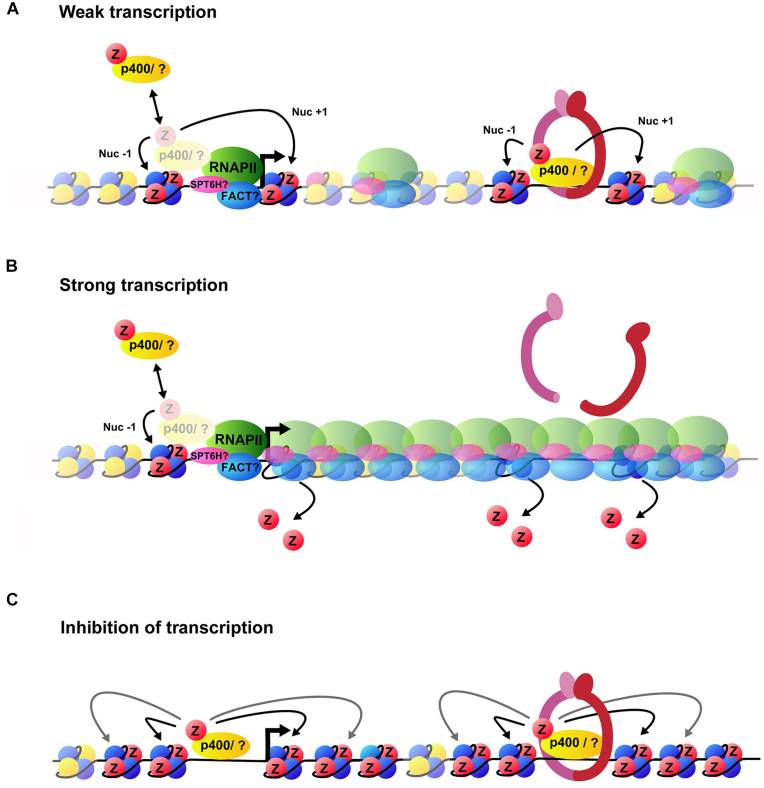
A schematic model illustrating H2A.Z accumulation at gene following inhibition of transcription. (A) In the presence of weak transcription H2A.Z is incorporated at nucleosome –1 and +1 of TSSs and intragenic cohesin sites by p400 or another remodelling complex (indicated by a question mark). (B) When transcription level is high, the sustained passage of elongating RNA pol II accompanied by its histone chaperone (e.g. FACT and Spt6H) results in the eviction of H2A.Z from gene bodies. (C) When transcription is inhibited by α-amanitin, RNA pol II is evicted from DNA and H2A.Z accumulates specifically within gene bodies through the action of chromatin remodelers such as p400.

References

    1. Voss T.C., Hager G.L.. Dynamic regulation of transcriptional states by chromatin and transcription factors. Nat. Rev. Genet. 2014; 15:69–81. - PMC - PubMed
    1. Clapier C.R., Cairns B.R.. The biology of chromatin remodeling complexes. Annu. Rev. Biochem. 2009; 78:273–304. - PubMed
    1. Kouzarides T. SnapShot: Histone-modifying enzymes. Cell. 2007; 131:822. - PubMed
    1. Gevry N., Chan H.M., Laflamme L., Livingston D.M., Gaudreau L.. p21 transcription is regulated by differential localization of histone H2A.Z. Genes Dev. 2007; 21:1869–1881. - PMC - PubMed
    1. Zhang H., Roberts D.N., Cairns B.R.. Genome-wide dynamics of Htz1, a histone H2A variant that poises repressed/basal promoters for activation through histone loss. Cell. 2005; 123:219–231. - PMC - PubMed

MeSH terms