


The elderly left behind-changes in survival trends of primary central nervous system lymphoma over the past 4 decades
- PMID: 29036697
- PMCID: PMC5892148
- DOI: 10.1093/neuonc/nox187
The elderly left behind-changes in survival trends of primary central nervous system lymphoma over the past 4 decades
Abstract
Background: There has been significant improvement in treatment outcomes of primary central nervous system lymphoma (PCNSL) at specialized centers over the past several decades; however, it is unclear if these changes have translated to benefits in the general population.
Methods: In this study, we utilized 2 national databases to examine survival trends over time for PCNSL: the Central Brain Tumor Registry of the United States (CBTRUS, 2000-2013) and 18 registries from the Surveillance, Epidemiology, and End Results program (SEER, 1973-2013).
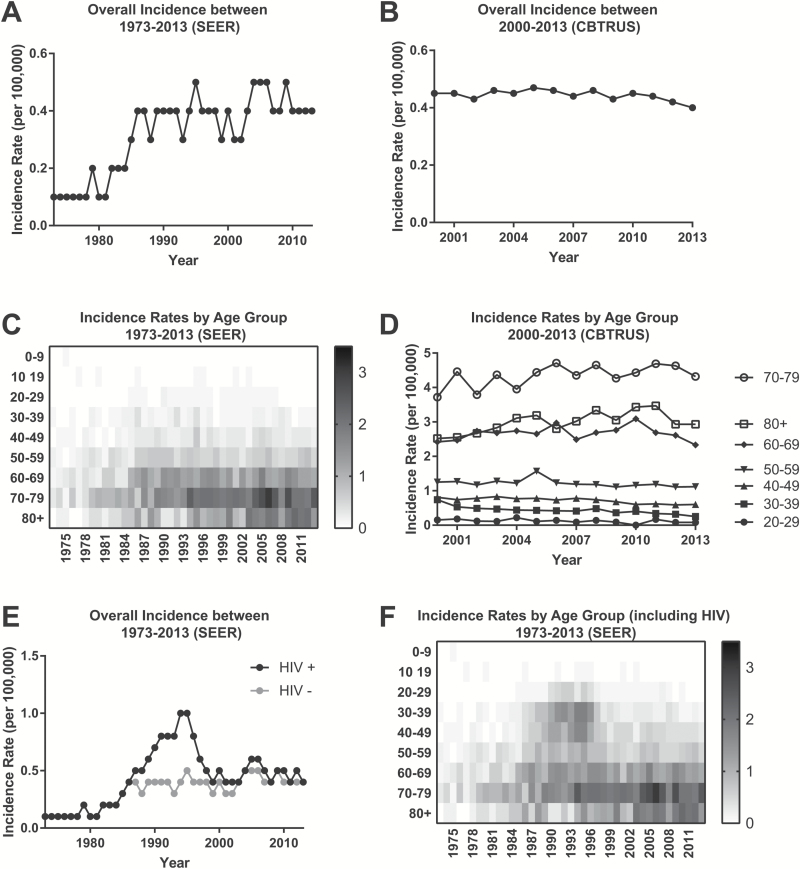
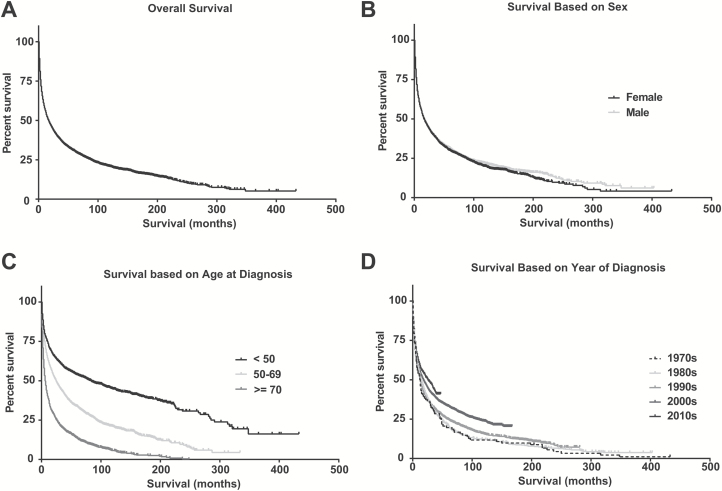
Results: The annual incidence of PCNSL in 2013 was 0.4 per 100000 population (CBTRUS/SEER). Incidence increased from 0.1 per 100000 in the 1970s to 0.4 per 100000 in the 1980s, correlating with an increase in the diagnosis of patients ≥70 years (1973: 0.2 vs 2013: 2.1 [SEER]). Incidence rates differed greatly between young and elderly patients (age 20-29 y: 0.08 vs 70-79 y: 4.32 [CBTRUS]). Even though the median overall survival of all patients doubled from 12.5 months in the 1970s to 26 months in the 2010s, this survival benefit was limited to patients <70 years. Survival in the elderly population has not changed in the last 40 years (6 mo in the 1970s vs 7 mo in the 2010s, P = 0.1).
Conclusion: The poor outcome seen in the particularly vulnerable elderly patient population highlights the need for clinical trials targeting the elderly in hopes of improving treatment strategies and survival.
Figures
References
-
- Eby NL, Grufferman S, Flannelly CM, Schold SC Jr, Vogel FS, Burger PC. Increasing incidence of primary brain lymphoma in the US. Cancer. 1988;62(11):2461–2465. - PubMed
-
- Olson JE, Janney CA, Rao RD et al. The continuing increase in the incidence of primary central nervous system non-Hodgkin lymphoma: a Surveillance, Epidemiology, and End Results analysis. Cancer. 2002;95(7):1504–1510. - PubMed
-
- O’Neill BP, Decker PA, Tieu C, Cerhan JR. The changing incidence of primary central nervous system lymphoma is driven primarily by the changing incidence in young and middle-aged men and differs from time trends in systemic diffuse large B-cell non-Hodgkin’s lymphoma. Am J Hematol. 2013;88(12):997–1000. - PMC - PubMed
Publication types
MeSH terms
Grants and funding
LinkOut - more resources
Full Text Sources
Other Literature Sources
Medical
Miscellaneous
