


Situation and determinants of the infant and young child feeding (IYCF) indicators in Madagascar: analysis of the 2009 Demographic and Health Survey
- PMID: 29037229
- PMCID: PMC5644246
- DOI: 10.1186/s12889-017-4835-1
Situation and determinants of the infant and young child feeding (IYCF) indicators in Madagascar: analysis of the 2009 Demographic and Health Survey
Abstract
Background: Studies evaluating child feeding in Madagascar are scarce despite its importance in child growth during the first two years of life. This study assessed the associations between the WHO infant and young child feeding (IYCF) indicators and stunting and identified determinants of inappropriate child feeding practices.
Methods: The most recent Demographic and Health Survey was used including a total of 1956 infants aged 0-23 months. Logistic regressions were performed for the association between IYCF indicators and stunting and for the determination of risk factors for inappropriate feeding practices.
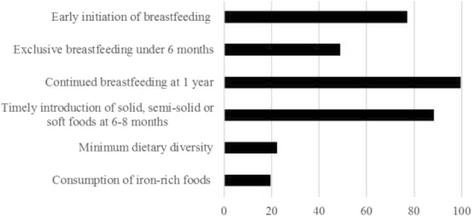
Results: The rates of initiation of breastfeeding within one hour after birth (77.2%), continued breastfeeding at one year (99.6%) and timely introduction of solid, semi-solid or soft foods at 6-8 months (88.3%) were high. Exclusive breastfeeding under 6 months (48.8%), attaining minimum dietary diversity (22.2%) and consumption of iron-rich foods (19.6%) were relatively low. Higher length-for-age was associated with achieving minimum dietary diversity (p<0.01). The other indicators assessed (early initiation of breastfeeding, exclusive breastfeeding under 6 months, timely introduction of complementary foods and consumption of iron-rich foods) were not associated with stunting. Infants born to mothers who had first given birth at an age younger than 19 were more likely not to be breastfed within one hour after birth, not to be exclusively breastfed and not to have the recommended dietary diversity. Infants whose mothers had low media exposure were at increased risk of being inappropriately fed. Low household wealth also was associated with higher odds of not meeting the minimum dietary diversity.
Conclusions: Despite almost total continued breastfeeding at one year and early initiation of breastfeeding by more than three-quarter of mothers, minimum dietary diversity scores were still low, confirming the need for more effective programs for improving child feeding practices in Madagascar. Improving dietary diversity in children aged 6-23 months may help reduce stunting. The identified risk factors for inappropriate feeding practices could be used in directing future nutrition sensitive interventions.
Keywords: Child feeding; IYCF indicators; Madagascar; Stunting.
Conflict of interest statement
Ethics approval and consent to participate
Not applicable.
Consent for publication
Not applicable.
Competing interests
The authors declare that they have no competing interests.
Publisher’s Note
Springer Nature remains neutral with regard to jurisdictional claims in published maps and institutional affiliations.
Figures
References
-
- WHO . Part. Definitions. Geneva: World Health Organization; 2008. Indicators for assessing infants and young children feeding practices.
-
- Jones AD, Ickes SB, Smith LE, Mbuya MN, Chasekwa B, Heidkamp RA, Menon P, Zongrone AA, Stoltzfus RJ. World Health Organization infant and young child feeding indicators and their associations with child anthropometry: a synthesis of recent findings. Matern Child Nutr. 2014;10(1):1–17. doi: 10.1111/mcn.12070. - DOI - PMC - PubMed
-
- Disha AD, Rawat R, Subandoro A, Menon P. Infant and young child feeding practices in Ethiopia and Zambia and their association with child nutrition: analysis of demographic and health survey data. Afr J Food Agric Nutr Dev. 2012;12(2):5895–5914.
MeSH terms
LinkOut - more resources
Full Text Sources
Other Literature Sources
Medical
