


Optimal parameters for determining the LH surge in natural cycle frozen-thawed embryo transfers
- PMID: 29037231
- PMCID: PMC5644145
- DOI: 10.1186/s13048-017-0367-7
Optimal parameters for determining the LH surge in natural cycle frozen-thawed embryo transfers
Abstract
Background: There is no consensus on the exact parameters that define the LH surge for natural cycle frozen-thawed embryo transfers (NC-FET). Accurately determining the LH surge would affect the timing, and subsequently the success rates, of embryo transfer. Therefore, the aim of this study was to delineate the optimal levels and relationship for luteinizing hormone (LH) and estradiol in an effort to optimally identify the LH surge in NC-FET.
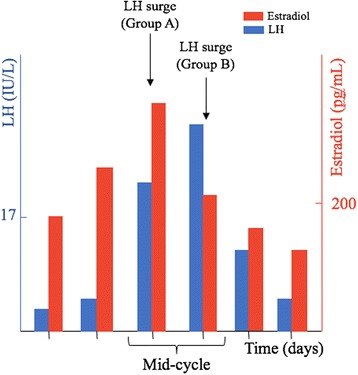
Methods: It is a retrospective study that was performed in an academic medical center. Patients who underwent blastocyst NC-FET who either had preimplantation genetic screening (PGS) or were <35 years old but did not undergo PGS (non-PGS) were included in separate analyses. They were divided into two groups: Group A included patients whose LH surge was defined as the first attainment of LH ≥ 17 IU/L during the follicular phase with a ≥30% drop in estradiol levels the following day; group B encompassed patients whose LH level continued to rise and the surge was defined as the highest serum LH level occurring a day after LH ≥ 17 IU/L despite a ≥ 30% drop in estradiol levels. The main outcomes measures were implantation and live birth rates.
Results: Four hundred-seven non-PGS and 284 PGS NC-FET were included. Among non-PGS cycles, group A was associated with significantly higher implantation rates (48.7% vs. 38.1%) and live birth rates (52.9% vs. 40.1%) compared to group B. In contrast, group A and B had comparable live birth rates among PGS cycles.
Conclusions: Among non-PGS cycles, measuring LH and estradiol levels the day after an LH ≥ 17 IU/L and defining the surge as the first day of LH ≥ 17 IU/L in the context of a ≥ 30% drop in estradiol the following day was associated with better NC-FET outcomes than defining the surge as the day representing the highest serum LH level despite a ≥30% drop in estradiol levels.
Keywords: Estradiol; LH surge; Luteinizing hormone; Natural cycle frozen-thawed embryo transfer; Timing of embryo transfer.
Conflict of interest statement
Authors’ information
MI, VG, DR, and ZR: The Ronald O. Perelman and Claudia Cohen Center for Reproductive Medicine, Weill Cornell Medicine, New York, NY 10021. AR: Department of Obstetrics and Gynecology, Weill Cornell Medicine, New York, NY 10021.
Ethics approval and consent to participate
The institutional review board at Weill Cornell Medical College approved this study (protocol number 1604017160).
Consent for publication
Not applicable.
Competing interests
The authors declare that they have no competing interests.
Publisher’s Note
Springer Nature remains neutral with regard to jurisdictional claims in published maps and institutional affiliations.
Figures
References
-
- Min JK, Hughes E, Young D, Gysler M, Hemmings R, Cheung AP, et al. Elective single embryo transfer following in vitro fertilization. Journal of obstetrics and gynaecology Canada : JOGC = Journal d'obstetrique et gynecologie du Canada : JOGC. 2010;32(4):363–377. - PubMed
-
- Griesinger G, Schultz L, Bauer T, Broessner A, Frambach T, Kissler S. Ovarian hyperstimulation syndrome prevention by gonadotropin-releasing hormone agonist triggering of final oocyte maturation in a gonadotropin-releasing hormone antagonist protocol in combination with a "freeze-all" strategy: a prospective multicentric study. Fertility and sterility. 2011;95(6):2029–2033, 33 e1. - PubMed
MeSH terms
Substances
LinkOut - more resources
Full Text Sources
Other Literature Sources
Medical
